
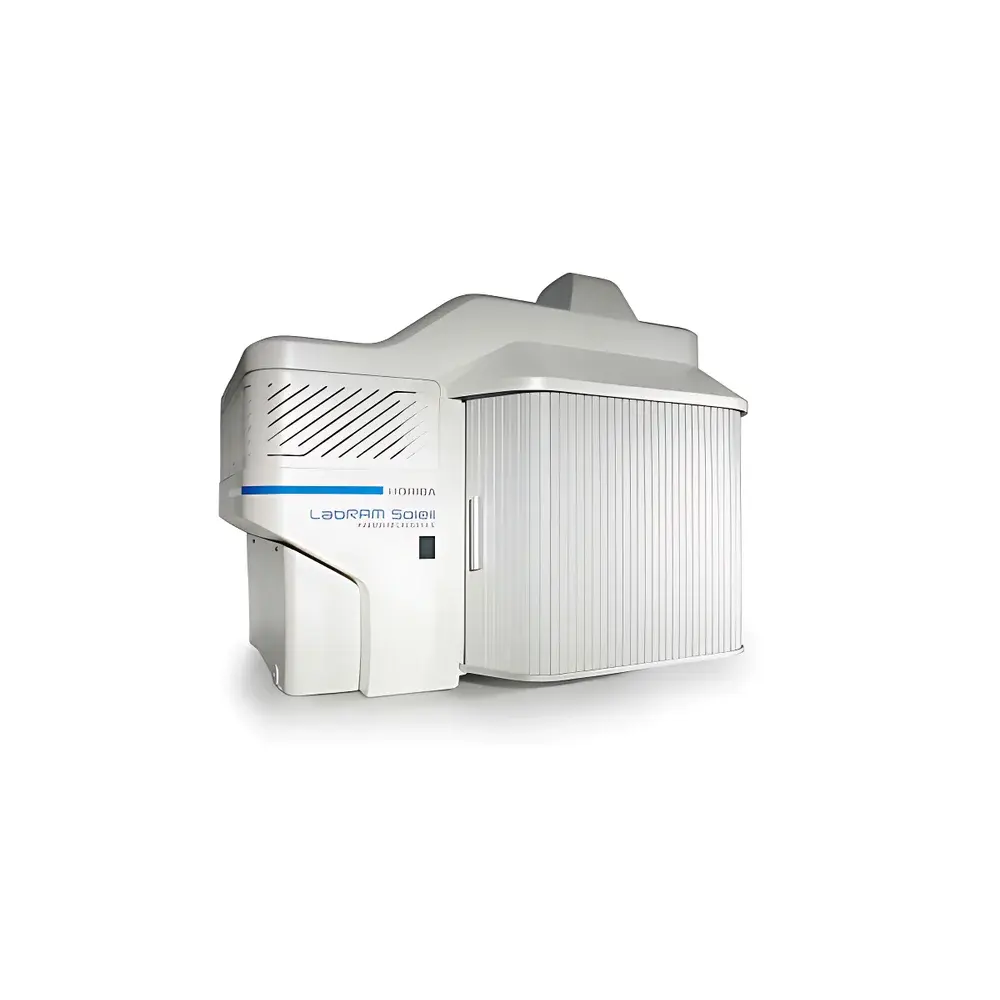
HORIBA LabRAM Soleil™ High-Resolution, Ultra-Sensitive Intelligent Raman Imaging Microscope
| Brand | HORIBA |
|---|---|
| Origin | France |
| Manufacturer Type | Original Equipment Manufacturer (OEM) |
| Product Category | Imported Instrument |
| Model | LabRAM Soleil™ |
| Instrument Type | Confocal Micro-Raman Spectrometer |
| Spectral Range | 200–2100 nm |
| Spectral Resolution | 0.5 cm⁻¹ |
| Spatial Resolution | <250 nm |
| Minimum Wavenumber | <5 cm⁻¹ |
| Spectral Reproducibility | Better than ±0.01 cm⁻¹ |
Overview
The HORIBA LabRAM Soleil™ is a state-of-the-art confocal micro-Raman imaging microscope engineered for high-resolution, ultra-sensitive vibrational spectroscopic analysis at the sub-micron scale. Based on confocal optical architecture with all-reflective, broadband dielectric mirror optics, it delivers exceptional light throughput and spectral fidelity across UV–NIR excitation ranges (325 nm to 785 nm). Its core measurement principle relies on inelastic scattering of monochromatic laser light—Raman scattering—enabling non-destructive, label-free chemical identification, molecular conformational analysis, stress/strain mapping, and phase distribution quantification in heterogeneous solid, thin-film, and biological samples. Designed for 24/7 unattended operation in regulated and research environments alike, the LabRAM Soleil™ integrates advanced automation, thermal and mechanical stability, and Class 1 laser safety compliance—making it suitable for routine QC labs, academic core facilities, and industrial R&D centers requiring trace-level detection, nanoscale spatial discrimination, and reproducible hyperspectral data acquisition.
Key Features
- Compact footprint (<1 m²) with integrated Class 1 laser-safe enclosure (444 × 509 × 337 mm sample chamber)
- Automated optical alignment via Fast Alignment™ technology (<15 s full path realignment using built-in PSD sensor)
- Four motorized gratings switchable in <60 s; TurboDrive™ closed-loop grating actuation at up to 400 nm/s
- SmartSampling™ adaptive acquisition algorithm prioritizes spectrally informative pixels—reducing imaging time from hours to minutes
- QScan™ vector-based laser sheet scanning enables true 3D confocal Raman tomography without physical Z-stage movement
- ViewSharp™ rapid 3D surface topography integration with simultaneous Raman mapping
- Multi-modal optical microscopy: brightfield, darkfield, epifluorescence, phase contrast, and DIC
- Low-wavenumber capability down to <5 cm⁻¹ (standard configuration: <30 cm⁻¹)
- Up to four internal lasers (325, 532, 638, 785 nm); six computer-controlled notch/edge filters
- Nano-Raman compatibility: seamless coupling with AFM and SEM for TERS, nano-PL, and cathodoluminescence
Sample Compatibility & Compliance
The LabRAM Soleil™ supports diverse sample types—including powders, polymers, semiconductors, pharmaceutical tablets, biological tissues, 2D materials, and geological specimens—without requirement for conductive coating or vacuum. Its large chamber accommodates standard petri dishes, wafer carriers (up to 200 mm), and custom fixtures. The system complies with IEC 60825-1:2014 for Class 1 laser safety under normal operating conditions. Optical and spectral performance meets ISO 17025 requirements for accredited testing laboratories. For regulated industries, hardware and software design support audit-ready workflows aligned with FDA 21 CFR Part 11, EU Annex 11, and GLP/GMP documentation standards—including electronic signatures, user access control, and full audit trail logging via ProtectionPlus™.
Software & Data Management
LabSpec 6 software provides an application-driven interface with customizable dashboards, wizard-guided workflows (EasyImage™), and embedded multivariate analysis tools. MVAPlus™ implements PCA, cluster analysis, and spectral unmixing algorithms optimized for datasets exceeding one million spectra. ParticuleFinder™ automates particle detection, morphological classification (size, aspect ratio, convexity), and chemical identification in heterogeneous mixtures—delivering statistically robust reports within seconds. All spectral acquisitions include metadata stamping (laser power, objective ID, grating position, ambient temperature/humidity), ensuring full traceability. Data export supports HDF5, ASCII, and vendor-neutral JCAMP-DX formats. Remote diagnostics and firmware updates are supported via secure HTTPS channel.
Applications
- Materials science: strain mapping in SiGe heterostructures, defect analysis in graphene and TMDCs, crystallinity assessment in perovskites
- Pharmaceuticals: API polymorph distribution, excipient compatibility, counterfeit drug screening, tablet coating uniformity
- Life sciences: label-free cellular component mapping (lipids, proteins, nucleic acids), tissue histopathology, bacterial identification
- Polymers & composites: filler dispersion homogeneity, interfacial adhesion quality, degradation profiling
- Geosciences: mineral phase identification in thin sections, fluid inclusion characterization, carbon speciation in meteorites
- Nanotechnology: plasmonic hot-spot verification, quantum dot emission profiling, nanowire phonon confinement analysis
FAQ
What laser wavelengths are supported natively?
The LabRAM Soleil™ offers four integrated diode and DPSS lasers: 325 nm (HeCd), 532 nm, 638 nm, and 785 nm—with automatic wavelength-aware calibration and filter selection.
Can the system perform simultaneous Raman and photoluminescence measurements?
Yes. The instrument supports concurrent acquisition in Raman, PL, ULF (ultra-low-frequency), and upconversion modes using configurable spectral windows and SWIFT™ XR multi-window functionality.
Is remote operation and maintenance possible?
Fully supported via encrypted VNC and dedicated service portal; includes real-time diagnostics, predictive calibration alerts, and over-the-air firmware updates.
How is spectral calibration maintained under variable lab conditions?
SmartCalibration™ performs automated recalibration in <10 s using internal Ne/Ar reference lines and environmental feedback (temperature, pressure, humidity).
Does the system meet regulatory requirements for pharmaceutical QA/QC?
Yes. With ProtectionPlus™ enabled, LabSpec 6 satisfies 21 CFR Part 11, Annex 11, and ALCOA+ data integrity principles—including role-based access, electronic signatures, and immutable audit trails.
Related Products






