
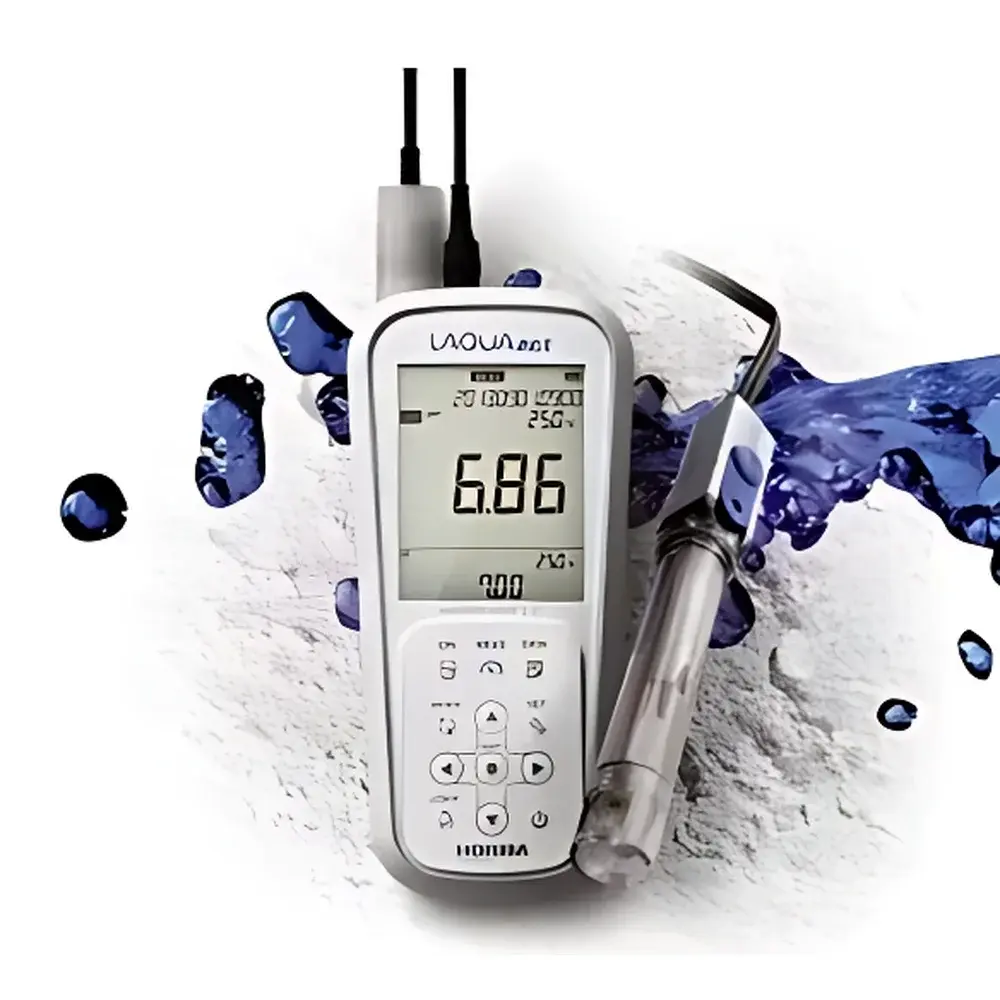
HORIBA LAQUAact D70 Series Portable Water Quality Analyzer
| Brand | HORIBA |
|---|---|
| Origin | Japan |
| Model(s) | D71, D72, D73, D74, D75 |
| Instrument Type | Portable / Handheld Water Quality Analyzer |
| Housing Material | Impact-Resistant Polycarbonate |
| IP Rating | IP67 |
| Display | Backlit LCD (D72–D75 only) |
| Data Storage | 1,000 measurements internal memory |
| Connectivity | USB PC interface (D72–D75) |
| Power | ~1000 hours continuous operation (typical) |
| Electrode Mount | Adjustable rotating electrode stand (desktop & handheld use) |
| Dual-Parameter Display | Simultaneous readout of two parameters (D73/D74/D75 only) |
| Cleaning Compatibility | Alcohol-, weak acid/base-, and oil-resistant surface |
Overview
The HORIBA LAQUAact D70 Series is a family of rugged, portable water quality analyzers engineered for high-reliability field and laboratory applications. Built on HORIBA’s legacy of electrochemical sensor precision, the D70 platform employs potentiometric, conductometric, and amperometric measurement principles—depending on the selected probe—to deliver trace-level accuracy in pH, ORP, conductivity, TDS, salinity, dissolved oxygen (DO), turbidity, and ion-selective measurements (e.g., NH₄⁺, NO₃⁻, F⁻). Each model integrates calibrated, replaceable electrodes with digital signal conditioning circuitry to minimize drift and ensure long-term stability under variable ambient conditions. Designed explicitly for environmental monitoring, wastewater treatment verification, aquaculture management, and source water assessment, the D70 Series meets the operational demands of regulatory field technicians, municipal utility staff, and academic researchers requiring rapid, repeatable, and audit-ready data acquisition outside controlled lab environments.
Key Features
- Ruggedized polycarbonate housing—impact resistance ≈2× higher than legacy ABS enclosures—ensures survivability in harsh outdoor or industrial settings.
- IP67-rated enclosure: fully dust-tight and submersible to 1 m for 30 minutes (non-operational immersion only), enabling safe use in rain, splashing, or accidental drops into shallow water.
- Large backlit LCD display (D72–D75 models)—1.4× larger than prior-generation units—with dual-parameter real-time readout (e.g., pH + mV, or DO mg/L + temperature) for contextual interpretation without menu navigation.
- Ergonomic single-hand operation: three dedicated tactile keys (Mode/Enter/Exit) reduce cognitive load during rapid sampling; intuitive icon-driven UI minimizes training requirements.
- Rotating electrode stand included: adjustable in X/Y/Z axes for stable desktop use while retaining full portability—no separate benchtop unit required.
- Extended battery life: optimized low-power electronics enable up to ~1000 hours of continuous operation on standard AA alkaline cells, eliminating frequent recharging in remote deployments.
- Chemically resistant surface: polycarbonate housing withstands direct wipe-down with 70% ethanol, dilute acids/bases (pH 2–12), and hydrocarbon oils—critical for decontamination between sampling sites.
Sample Compatibility & Compliance
The D70 Series supports aqueous samples across natural waters (rivers, lakes, groundwater), treated effluents, process streams, and aquaculture tanks. Electrode compatibility includes combination pH electrodes, ORP sensors, conductivity cells (K = 0.1, 1.0, 10 cm⁻¹), polarographic and optical DO probes, and ISEs certified per ISO 10523 (pH), ISO 7888 (conductivity), and ASTM D3223 (fluoride). All D72–D75 models comply with GLP and GMP documentation requirements: timestamped measurement records include operator ID, electrode serial number, calibration history, temperature compensation status, and measurement uncertainty flags. Optional thermal printer output generates 21 CFR Part 11–compliant audit trails when paired with validated firmware and access-controlled user accounts.
Software & Data Management
Internal memory stores up to 1,000 measurement records with full metadata (date/time, parameter, unit, temperature, electrode ID, calibration date). D72–D75 models support bidirectional USB communication via HORIBA’s free LAQUA Connect software (downloadable post-registration on HORIBA’s global support portal). Data exports as CSV or Excel-compatible files with embedded calibration logs and QA/QC flags. Software enables batch calibration validation, trend visualization, and automated report generation aligned with ISO/IEC 17025 documentation frameworks. D71 operates as a standalone meter with no connectivity—intended for basic field screening where data logging suffices.
Applications
- Regulatory compliance monitoring: EPA Method 150.1 (pH), 120.1 (conductivity), and 4500-O₂ D (DO) field verification.
- Wastewater treatment plant process control: influent/effluent characterization, nitrification/denitrification tracking, and disinfection residual validation.
- Aquatic ecosystem assessment: diurnal DO profiling, nutrient loading estimation (via conductivity/TDS correlation), and acid mine drainage screening.
- Drinking water safety: chlorine residual (via ORP), fluoride compliance (ISE), and distribution system integrity checks (conductivity anomalies).
- Educational field labs: student-led water quality surveys with built-in error diagnostics and calibration guidance.
FAQ
Which models support dual-parameter display?
D73, D74, and D75 support simultaneous real-time display of two independent parameters (e.g., pH and temperature, or conductivity and salinity). D71 and D72 are single-parameter meters.
Is the D70 Series compatible with USP purified water testing?
Yes—when equipped with a Class A-certified conductivity cell (K = 1.0 cm⁻¹) and operated within the specified temperature range (10–30 °C), D74/D75 meet USP system suitability requirements for non-sterile water testing.
Can calibration data be exported for audit purposes?
Yes—calibration events (date, buffer values, slope, offset, electrode ID) are stored with each measurement and exported alongside raw data via LAQUA Connect software, supporting FDA 21 CFR Part 11 and ISO/IEC 17025 traceability requirements.
What is the operating temperature range for field use?
The instrument functions reliably from 0 to 50 °C ambient; electrode specifications define the lower limit for individual parameter accuracy (e.g., DO probes rated to 0 °C, pH electrodes to 5 °C).
Does the IP67 rating permit underwater measurement?
No—IP67 certifies protection against temporary immersion (1 m × 30 min), but electrical operation underwater is prohibited due to sensor design constraints and safety standards.
Related Products







