
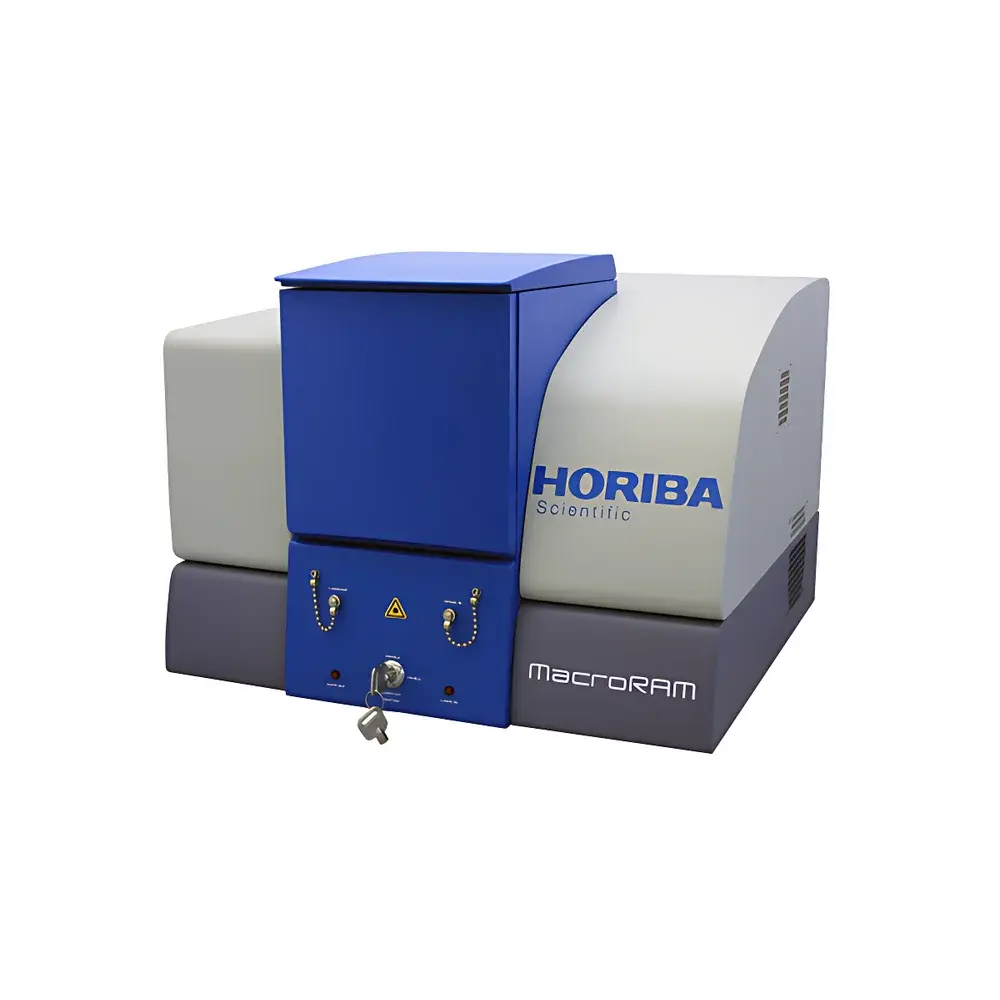
HORIBA MacroRAM Benchtop Integrated Raman Spectrometer
| Brand | HORIBA |
|---|---|
| Origin | USA |
| Manufacturer Type | Manufacturer |
| Origin Category | Imported |
| Model | MacroRAM |
| Instrument Type | Grating-Based Raman Spectrometer |
| Spectral Range | 100–3400 cm⁻¹ |
| Spectral Resolution | 8 cm⁻¹ at 914.9 nm |
| Minimum Wavenumber | 100 cm⁻¹ |
| Spectral Repeatability | ≤ ±0.03 cm⁻¹ |
| Excitation Wavelength | 785 nm |
| Max Laser Power | 450 mW (software-controllable, continuous variable) |
| Detector | Back-Thinned CCD, cooled to –50 °C, 80% QE at 800 nm |
| Dark Current | 0.05 e⁻/pixel/sec at –50 °C |
| Dynamic Range | 42,550:1 |
| Fiber Input | 100 µm core diameter, female FC/PC connector, NA = 0.15 |
| Dimensions (W × D × H) | 432 × 432 × 381 mm (17 × 17 × 15 in) |
Overview
The HORIBA MacroRAM Benchtop Integrated Raman Spectrometer is a purpose-engineered grating-based Raman system designed for robust, routine spectral acquisition in industrial quality control laboratories and undergraduate/graduate teaching environments. It operates on the principle of inelastic light scattering—where monochromatic 785 nm laser excitation induces vibrational mode transitions in molecular bonds, yielding characteristic Stokes-shifted Raman signals between 100 and 3400 cm⁻¹. Engineered for stability and reproducibility, the MacroRAM integrates a flat-field aberration-corrected Czerny–Turner spectrograph with a thermoelectrically cooled back-thinned CCD detector (–50 °C), delivering high quantum efficiency (80% at 800 nm) and low dark current (0.05 e⁻/pixel/sec). Its compact footprint (432 × 432 × 381 mm) and modular optical architecture support both in-chamber and remote fiber-coupled measurements—enabling analysis of large, irregular, or temperature-sensitive samples without physical relocation.
Key Features
- Integrated 785 nm diode laser with software-controlled power adjustment (0–450 mW), minimizing fluorescence interference while preserving signal-to-noise ratio across diverse sample matrices.
- Aberration-corrected flat-field spectrograph optimized for uniform spectral response and minimal wavelength-dependent intensity distortion across the full 100–3400 cm⁻¹ range.
- Deep-cooled back-thinned CCD detector providing high sensitivity, wide dynamic range (42,550:1), and exceptional spectral repeatability (≤ ±0.03 cm⁻¹) — critical for quantitative batch-to-batch comparisons.
- Modular fiber-optic interface (100 µm core, FC/PC, NA = 0.15) compatible with multiple probe configurations—including macro, immersion, and standoff probes—for flexible sampling geometries and non-contact analysis.
- Benchtop enclosure with rigid mechanical design, vibration-damped baseplate, and sealed optical path—ensuring long-term alignment stability under ambient laboratory conditions.
Sample Compatibility & Compliance
The MacroRAM supports direct analysis of solids, powders, liquids, gels, and thin films without mandatory sample preparation. Its large working distance and optional external probe accessories accommodate oversized or geometrically complex specimens—such as battery electrodes, polymer composites, pharmaceutical tablets, and geological cores—that cannot be inserted into conventional sample chambers. The system complies with ISO/IEC 17025 requirements for analytical instrument qualification and supports GLP/GMP-aligned workflows through configurable audit trails, user access levels, and electronic signature capabilities in its acquisition software. While not certified as medical device hardware, its performance parameters meet ASTM E1840 and ICH Q5E guidelines for spectral identity verification and stability-indicating assay development.
Software & Data Management
Acquisition and analysis are managed via HORIBA’s LabSpec 6 software—a validated platform supporting CFR 21 Part 11-compliant operation when deployed with appropriate IT infrastructure and administrative controls. Key functionalities include real-time spectral preview, automated baseline correction (Asymmetric Least Squares), peak fitting (Voigt/Pseudo-Voigt models), multivariate analysis (PCA, PLS), and spectral library matching against commercial (e.g., RRUFF, ICDD) and custom reference sets. Raw data are stored in vendor-neutral HDF5 format with embedded metadata (laser power, integration time, grating position, calibration coefficients), ensuring traceability and interoperability with third-party chemometric tools such as MATLAB, Python (SciPy, scikit-learn), and Unscrambler X.
Applications
- Pharmaceutical: Polymorph identification, API-excipient interaction screening, counterfeit drug detection, and lyophilized product characterization.
- Materials Science: Carbon allotrope (graphene, nanotubes) defect analysis, stress/strain mapping in semiconductors, and phase distribution in battery cathode materials (e.g., NMC, LFP).
- Forensics & Art Conservation: Non-destructive pigment identification, binder analysis in historical paintings, and explosive residue screening.
- Academic Teaching: Hands-on instruction in vibrational spectroscopy principles, spectral interpretation, and chemometrics—supported by preconfigured method templates and student lab modules.
- Industrial QC: Incoming raw material verification, blend uniformity assessment, and real-time reaction monitoring via fiber-coupled flow cells or reactor windows.
FAQ
Is the MacroRAM suitable for regulatory submissions in pharmaceutical manufacturing?
Yes—when operated under documented SOPs with validated software configuration (LabSpec 6 in 21 CFR Part 11 mode), it meets data integrity requirements for identity testing per USP and ICH Q5E.
Can it perform anti-Stokes Raman measurements?
Yes—an optional Anti-Stokes configuration extends coverage from –1700 to +1700 cm⁻¹ relative to the laser line, enabling low-frequency lattice mode analysis in crystals and superconductors.
What calibration standards are recommended for routine wavenumber validation?
NIST-traceable polystyrene film (Raman shift standard at 1001 cm⁻¹) and cyclohexane (802 cm⁻¹) are routinely used; HORIBA provides factory-calibrated quartz etalon for daily instrument performance verification.
Does the system support automated mapping or imaging?
No—MacroRAM is optimized for single-point or multi-position spot analysis; for Raman imaging, HORIBA recommends the XploRA or LabRAM HR series with motorized XYZ stages and confocal optics.
How is thermal drift managed during extended acquisitions?
The spectrograph housing incorporates passive thermal mass stabilization, and the CCD’s active cooling to –50 °C maintains detector responsivity stability over >2-hour integrations—verified per ISO 17025 intermediate precision protocols.



