
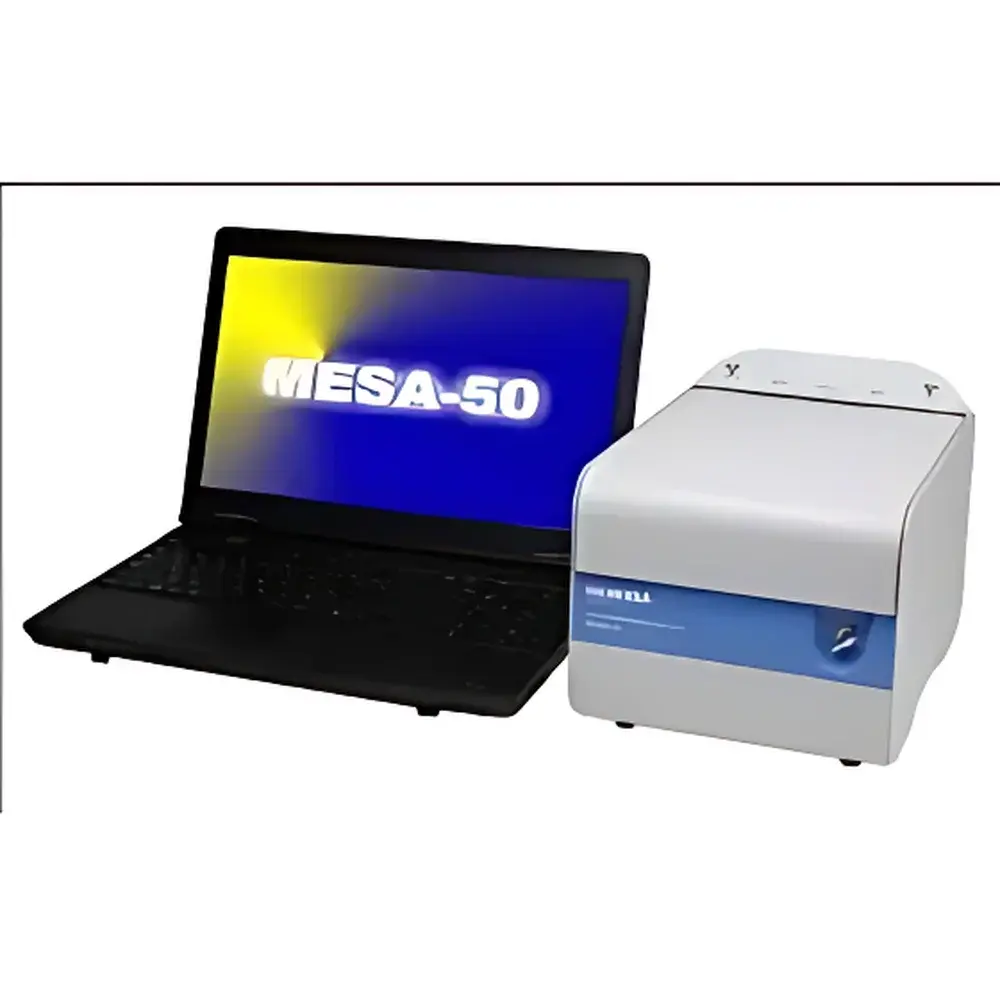
HORIBA MESA-50 Energy Dispersive X-Ray Fluorescence Spectrometer
| Brand | HORIBA |
|---|---|
| Origin | Japan |
| Manufacturer Type | Original Equipment Manufacturer (OEM) |
| Product Origin | Imported |
| Model | MESA-50 |
| Configuration | Benchtop/Free-standing |
| Industry Application | Electronics Manufacturing & Compliance Testing |
| Elemental Range | Al (Z=13) to U (Z=92) |
| Quantitative Detection Range | 1 ppm – 99.99 wt% |
| Energy Resolution | <140 eV (Mn Kα) |
| Relative Standard Deviation (RSD) | ≤0.05% for repeated measurements under standardized conditions |
| Detector | Silicon Drift Detector (SDD) |
| Signal Processing | HORIBA Digital Pulse Processor (DPP) |
| Collimator Options | Three fixed apertures (Ø0.1 mm, Ø0.3 mm, Ø1.0 mm) |
| Dimensions | 225 × 210 × 40 mm (L×W×H) |
| Weight | 12 kg |
| Battery Life | Up to 6 hours continuous operation (integrated rechargeable Li-ion) |
| Vacuum/Atmosphere | Ambient air analysis (no vacuum pump or cryogenic cooling required) |
Overview
The HORIBA MESA-50 is a benchtop energy dispersive X-ray fluorescence (EDXRF) spectrometer engineered for high-precision elemental quantification and regulatory screening in electronics manufacturing, supply chain compliance, and quality assurance laboratories. Operating on the fundamental principle of X-ray fluorescence—where primary X-rays excite inner-shell electrons in sample atoms, resulting in characteristic secondary X-ray emission—the MESA-50 leverages a high-efficiency silicon drift detector (SDD) and HORIBA’s proprietary Digital Pulse Processor (DPP) to deliver rapid, reproducible spectral acquisition with superior peak-to-background ratio and low-energy sensitivity. Designed specifically to meet global environmental compliance mandates—including EU RoHS (Restriction of Hazardous Substances), ELV (End-of-Life Vehicles), China RoHS, JEITA, and halogen-free (Br/Cl) directives—the instrument enables non-destructive, multi-element analysis from aluminum (Z=13) through uranium (Z=92) without sample digestion or vacuum preparation.
Key Features
- Triple-aperture collimation system (Ø0.1 mm, Ø0.3 mm, Ø1.0 mm) for optimized spatial resolution and signal-to-noise ratio across heterogeneous or micro-scale samples—including PCB traces, solder joints, wire bonds, and connector pins.
- Silicon drift detector (SDD) with <140 eV energy resolution at Mn Kα (5.89 keV), enabling clear separation of adjacent peaks (e.g., Cr/Kβ–Mn/Kα, As/Kα–Pb/Lα) critical for accurate quantification in complex electronic matrices.
- Digital Pulse Processor (DPP) architecture minimizing pulse pile-up and dead-time losses, supporting count rates up to 100,000 cps while maintaining linearity and spectral fidelity.
- Integrated rechargeable lithium-ion battery providing 6 hours of uninterrupted analysis—ideal for mobile lab deployment, supplier audits, or cleanroom-adjacent testing without external power dependency.
- Zero-cryogen, zero-vacuum design: Eliminates liquid nitrogen refills and mechanical vacuum pumps, reducing total cost of ownership and operational downtime.
- Compact footprint (225 × 210 × 40 mm) and 12 kg mass enable flexible placement on ISO-classified workbenches, production line stations, or portable carts without structural reinforcement.
Sample Compatibility & Compliance
The MESA-50 accommodates solid, powdered, and thin-film samples up to 100 mm × 100 mm × 50 mm (L×W×H) in standard configuration. Its ambient-air measurement mode supports direct analysis of coated substrates, laminated boards, and encapsulated components without surface removal or coating stripping. Method validation adheres to ASTM E1621 (Standard Guide for XRF Elemental Analysis), ISO 21043 (XRF performance verification), and IEC 62321-5:2013 (RoHS screening by EDXRF). Instrument firmware and software support audit trails, user access levels, and electronic signatures compliant with FDA 21 CFR Part 11 requirements for regulated environments operating under GLP or GMP frameworks.
Software & Data Management
The MESA-50 operates via HORIBA’s proprietary MESA Suite software—a dual-language (English/Chinese) interface featuring intuitive workflow navigation, automated calibration validation, and embedded uncertainty estimation per ISO/IEC 17025 Annex A.5. Quantitative analysis employs fundamental parameter (FP) algorithms with matrix correction libraries for polymers, metals, ceramics, and glass. All spectra and results are exportable in native .mesa format and universally compatible CSV/XLSX. The integrated Excel Data Manager enables batch report generation, trend charting, SPC control limit overlays, and direct linkage to enterprise LIMS platforms via ODBC drivers. Software updates are delivered via secure HTTPS with SHA-256 signature verification.
Applications
- Routine screening of Pb, Cd, Hg, Cr(VI), Br, Cl, and P in printed circuit boards, connectors, cables, and plastic housings per RoHS Annex II and IEC 62321-5.
- Quantitative verification of precious metal plating thickness (e.g., Au, Ag, Pd) on contact surfaces using FP-based thin-film algorithms.
- Raw material incoming inspection for alloy composition verification (e.g., Sn-Pb vs. lead-free SAC305 solder, Cu-Zn brass grades).
- Failure analysis support—localized contamination mapping via motorized XY stage optional upgrade (not included in base model).
- Eco-design documentation for product environmental declarations (EPDs) and corporate sustainability reporting (GRI 305, CDP).
FAQ
Does the MESA-50 require liquid nitrogen or vacuum operation?
No. It utilizes an air-cooled SDD and performs all analyses under ambient atmospheric conditions.
Can it analyze light elements such as Na, Mg, or Al reliably?
Yes—optimized window transmission and low-noise DPP electronics ensure stable detection down to Al (Z=13); performance for Na/Mg is achievable with helium purge accessory (optional add-on).
Is method transfer possible between different MESA-50 units?
Yes—calibration files, FP libraries, and measurement protocols are fully portable across instruments within the same firmware revision.
How is data integrity ensured during regulatory audits?
The system logs all user actions, parameter changes, and calibration events with timestamps and operator IDs; audit trail reports comply with ISO/IEC 17025 and FDA 21 CFR Part 11.
What maintenance is required beyond routine cleaning?
Annual energy calibration verification and biannual detector gain stabilization—both supported remotely via HORIBA’s service portal with downloadable SOPs.
Related Products






