
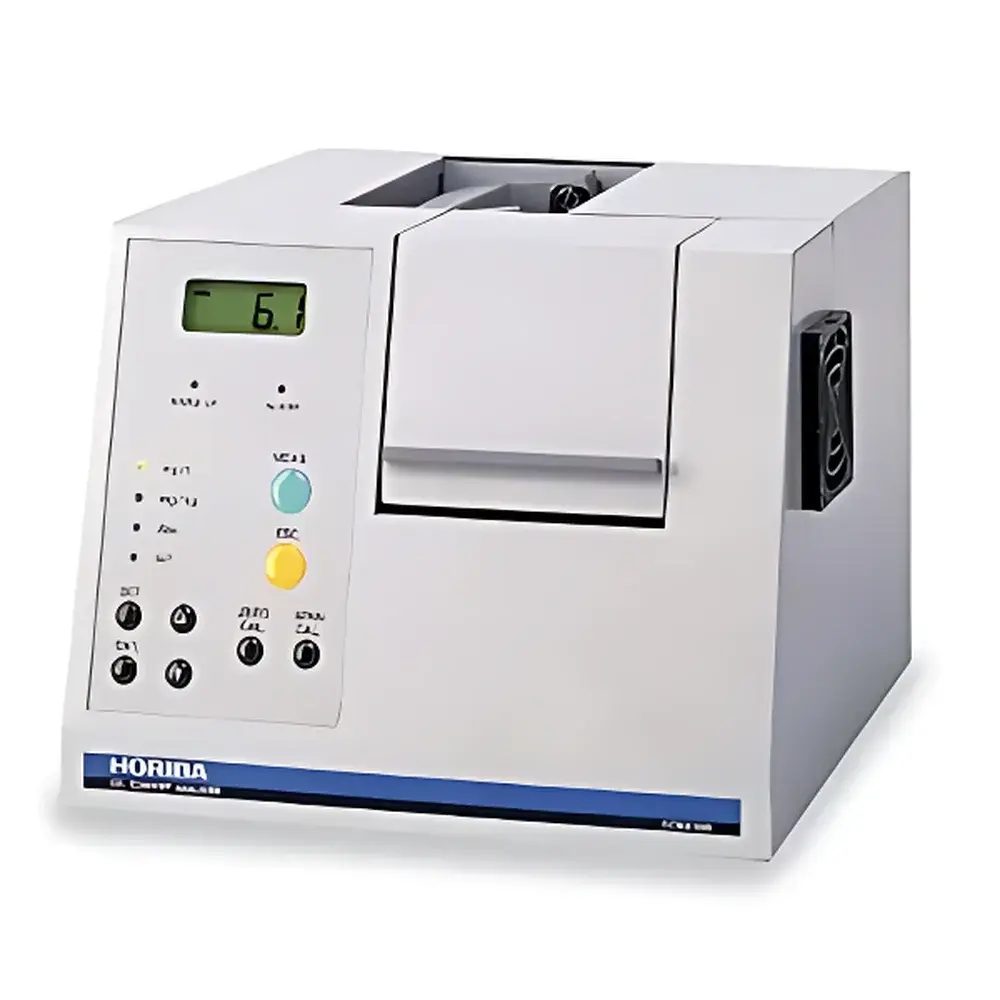
HORIBA OCMA-350 Oil-in-Water Analyzer
| Brand | HORIBA |
|---|---|
| Origin | Japan |
| Model | OCMA-350 / OCMA-355 |
| Instrument Type | Laboratory Water Quality Analyzer |
| Detection Parameter | Oil Content (Hydrocarbon) |
| Measurement Principle | Infrared Absorption Spectrophotometry at ~3.4 µm |
| Solvent Compatibility | S-316 (perchlorotrifluoroethane) |
| Detection Range | 0–200 mg/L (water), 0–200 mg/kg (soil), Absorbance mode |
| Detection Limit | 0.1 ppm (as hydrocarbon) |
| Calibration | Automatic zero calibration post initialization |
| Optional Accessory | SR-305 Solvent Regenerator |
Overview
The HORIBA OCMA-350 Oil-in-Water Analyzer is a laboratory-grade infrared spectrophotometer engineered for precise, trace-level quantification of hydrocarbon contaminants in aqueous and solid-phase environmental samples. It operates on the principle of mid-infrared absorption spectroscopy, specifically targeting the asymmetric C–H stretching vibration band near 3.4 µm — a spectral signature characteristic of aliphatic hydrocarbons commonly found in mineral oils, lubricants, cutting fluids, and petroleum derivatives. Unlike broad-spectrum UV-Vis methods, this wavelength-specific detection ensures high selectivity against interferences from humic substances, surfactants, or suspended solids. The system requires prior liquid–liquid extraction using S-316 solvent (1,1,2-trichloro-1,2,2-trifluoroethane), which exhibits negligible absorbance at 3.4 µm, thereby enabling direct photometric measurement of the extracted oil fraction without spectral background correction. Designed for regulatory-compliant environmental testing, the OCMA-350 delivers reproducible results aligned with established methodologies including EPA Method 1664 (revision B) and ISO 9377-2 for hydrocarbon determination in water.
Key Features
- Infrared photometric detection at 3.4 µm with fixed-wavelength optical path, eliminating need for scanning spectrometers or complex baseline algorithms
- Triple-unit display capability: concentration in mg/L (for water extracts), mg/kg (for soil extracts), or raw absorbance (Abs) — selectable via front-panel interface
- Integrated automatic zero calibration sequence triggered after instrument warm-up and solvent blank measurement
- Dedicated sample cell design optimized for S-316 compatibility, minimizing solvent evaporation and ensuring consistent optical path length
- Modular architecture supporting optional SR-305 Solvent Regenerator — a dual-bed column system utilizing activated carbon and activated alumina to remove polar impurities and hydrolysis byproducts from used S-316, extending solvent service life and reducing operational cost per analysis
- Robust thermal stabilization of optical components to maintain wavelength accuracy across ambient temperature fluctuations (15–30°C operating range)
Sample Compatibility & Compliance
The OCMA-350 accepts extract solutions prepared from diverse matrices: wastewater effluents, cooling tower blowdown, industrial process rinse waters, soil leachates, and swab extracts from machined metal surfaces or semiconductor wafers. Sample preparation follows standardized liquid–liquid extraction protocols compliant with ASTM D7066 and ISO 9377-2. For regulatory reporting, data integrity is supported through manual audit trail documentation; while the base OCMA-350 does not include electronic audit trails or 21 CFR Part 11 compliance features, its measurement output is fully compatible with external LIMS integration via analog voltage output (0–1 V) or RS-232 serial interface. All measurements are traceable to NIST-traceable hydrocarbon standards when calibrated using certified reference materials.
Software & Data Management
The OCMA-350 operates as a standalone benchtop analyzer with embedded firmware controlling measurement timing, signal averaging, and unit conversion. No proprietary PC software is required for routine operation; however, optional HORIBA Data Logger Software (v3.x) enables time-stamped export of absorbance values, concentration readings, and calibration history to CSV format. Raw absorbance data can be exported for secondary processing in third-party statistical packages (e.g., JMP, Minitab) to support GLP-aligned trend analysis, method validation (precision, linearity, LOD/LOQ), and QC charting. Internal memory retains up to 100 measurement records with timestamp and operator ID entry (via keypad).
Applications
- Monitoring oil content in treated industrial wastewater prior to discharge — verifying compliance with local limits (e.g., <10 mg/L total recoverable hydrocarbons)
- Assessing cleaning efficiency in precision manufacturing: quantifying residual draw die oil on stamped steel parts or grinding oil on silicon wafers
- Characterizing oil contamination in groundwater monitoring wells during site remediation projects
- Validating performance of oil–water separators and coalescing filters in petrochemical facilities
- Supporting ISO 14001 environmental management systems through documented, repeatable hydrocarbon testing protocols
- Quality control of ultrapure water systems in semiconductor fabrication where sub-ppm hydrocarbon levels impact wafer yield
FAQ
What extraction solvent is required for the OCMA-350?
S-316 (1,1,2-trichloro-1,2,2-trifluoroethane) is the specified solvent due to its transparency at 3.4 µm and efficient hydrocarbon solvation properties. Alternatives such as hexane or Freon-113 are incompatible and invalidate calibration.
Can the OCMA-350 measure emulsified oil without phase separation?
No. The method requires complete phase separation prior to analysis. Emulsified oil must first be broken using acidification, centrifugation, or thermal treatment per EPA 1664 guidelines.
Is the SR-305 Solvent Regenerator mandatory?
It is optional but recommended for laboratories performing >5 extractions per day. Regeneration reduces solvent consumption by ≥70% and minimizes hazardous waste disposal costs.
Does the OCMA-350 comply with US EPA Method 1664?
Yes — when used with validated S-316 extraction and the specified cell pathlength, it meets the instrumental performance criteria for gravimetric equivalence under Method 1664 Revision B.
How often does the instrument require recalibration?
A full calibration with primary standard is recommended every 6 months or after 200 analyses; daily verification uses a solvent blank and one mid-range standard.
Related Products







