
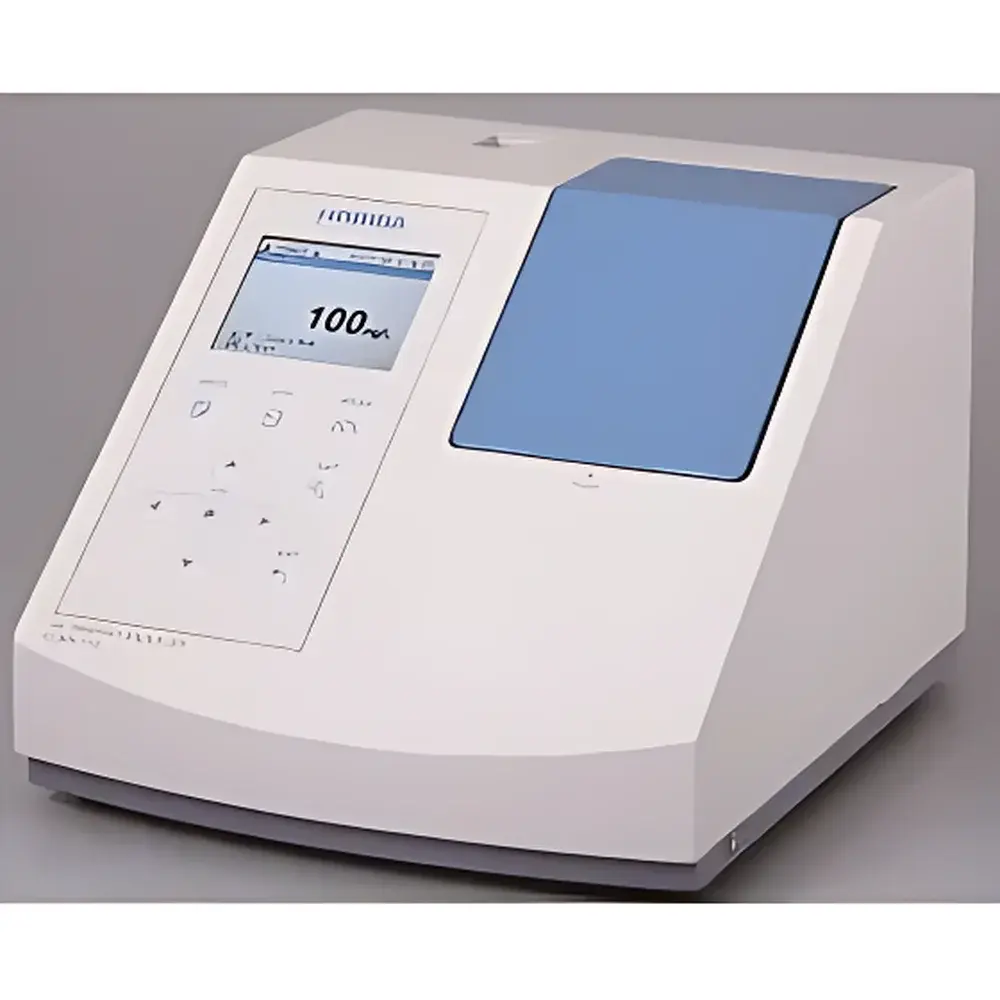
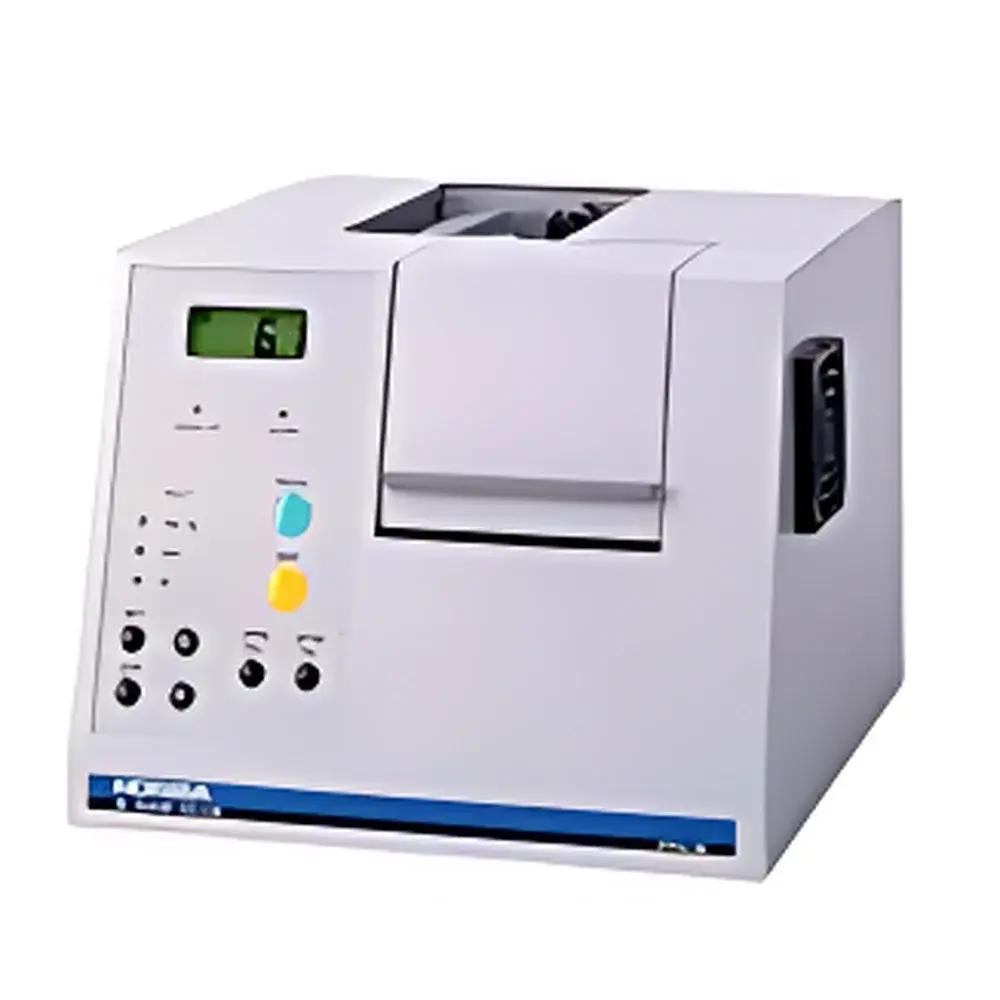
HORIBA OCMA-555 Oil Content Analyzer
| Brand | HORIBA |
|---|---|
| Origin | Japan |
| Model | OCMA-555 |
| Instrument Type | Laboratory |
| Measurement Principle | Fluorescence Spectrophotometry |
| Measurement Range | 0–200 mg/L |
| Detection Limit | <0.2 mg/L |
| Accuracy | ±0.1 mg/L (0–99.9 mg/L), ±1 mg/L (100–200 mg/L) |
| Resolution | ±0.4 mg/L ±1 digit (0–9.9 mg/L), ±2.0 mg/L ±1 digit (10–99.9 mg/L), ±4.0 mg/L ±1 digit (100–200 mg/L) |
| Measurement Frequency | 1 measurement per minute |
| Cell Material | Quartz |
| Path Length | 20 mm |
| Extraction Solvent | H-997 (reusable) |
| Solvent Volume | 6.5 mL |
| Display | 3.5-inch color LCD (320 × 240 pixels, backlight) |
| Data Storage | 300 measurement records |
| Interface | USB flash drive export |
| Power Supply | 100–240 V AC ±10%, 50/60 Hz |
| Dimensions | 253 × 253 × 195 mm (W × D × H) |
| Weight | 5 kg |
Overview
The HORIBA OCMA-555 Oil Content Analyzer is a precision laboratory instrument engineered for quantitative determination of hydrocarbon-based oil concentrations in aqueous and solid-phase samples—such as wastewater, soil extracts, metal parts, textiles, and food matrices. Unlike conventional infrared or gravimetric methods, the OCMA-555 employs fluorescence spectrophotometry following solvent extraction with H-997, a non-halogenated, low-toxicity, and recyclable extraction reagent. This principle delivers high selectivity for aromatic and aliphatic hydrocarbons while minimizing interferences from humic substances, chlorophyll, or turbidity commonly encountered in environmental and industrial effluents. The system operates on a fixed-path quartz cuvette (20 mm optical path), ensuring optical stability and long-term calibration integrity. Designed for compliance-driven laboratories, the OCMA-555 supports trace-level detection (<0.2 mg/L) across a linear dynamic range of 0–200 mg/L—making it suitable for regulatory monitoring under EPA Method 1664 (revision B), ISO 9377-2, and JIS K 0102 standards.
Key Features
- One-hand operation: Ergonomic top cover mechanism and integrated cuvette holder enable rapid placement and sealing of the quartz cell—critical for volatile oil analysis (e.g., residual machining oils on automotive components) without solvent loss or operator exposure.
- Real-time clock functionality: Timestamped measurements are automatically embedded in stored data records, supporting audit-ready documentation for GLP and ISO/IEC 17025 workflows.
- Low-boiling-point oil compatibility: Eliminates the need for solvent evaporation or distillation pre-treatment—enabling direct quantification of light hydrocarbons (e.g., gasoline-range organics, kerosene) post-extraction.
- 3.5-inch color LCD display: High-resolution (320 × 240), backlit interface with intuitive icon-based navigation; displays real-time fluorescence intensity, concentration, unit, timestamp, and system status.
- Multi-unit conversion: Supports on-device switching among mg/L (aqueous), mg/kg (soil), mg/g (solid surface), and particle count (PC) modes—configurable via user-defined measurement conditions.
- USB mass storage export: Raw and processed data—including timestamps, calibration IDs, operator tags, and diagnostic logs—are saved directly to FAT32-formatted USB drives for traceable transfer to LIMS or Excel-based QA/QC review.
- Embedded diagnostics & stability indication: Real-time self-checks for lamp intensity, detector linearity, cuvette alignment, and solvent blank drift; visual “Ready” indicator confirms measurement stability prior to result finalization.
Sample Compatibility & Compliance
The OCMA-555 accommodates diverse sample types through standardized external extraction protocols. Aqueous samples (e.g., industrial discharge, bilge water, tank washings) are extracted using 6.5 mL of H-997 solvent; solid matrices (soil, swabs, filter media, metal shavings) undergo Soxhlet-free manual agitation followed by phase separation. The instrument accepts only pre-filtered, clarified extracts—ensuring no particulate interference with fluorescence detection. All measurement procedures align with documented validation requirements for environmental laboratories accredited to ISO/IEC 17025:2017. While not FDA 21 CFR Part 11–certified out-of-the-box, the OCMA-555’s timestamped, non-editable USB data export and internal audit log (including zero/standard calibration events) provide foundational elements for Part 11–compliant implementation when paired with validated lab SOPs and electronic signature controls.
Software & Data Management
No proprietary PC software is required for basic operation—data management occurs exclusively via plug-and-play USB export. Each saved record includes: date/time stamp, sample ID (user-entered), measurement value, unit, calibration reference ID, solvent batch number (optional field), and system diagnostic flag. Files are stored in plain-text CSV format with UTF-8 encoding, enabling seamless import into statistical packages (Minitab, JMP), LIMS platforms, or custom Python/R scripts for trend analysis. Internal memory retains up to 300 records with overwrite protection enabled by default; older entries are archived only upon explicit user confirmation. Firmware updates are delivered via USB and include version-locked checksum verification to ensure integrity.
Applications
- Environmental monitoring: Quantification of total petroleum hydrocarbons (TPH) in groundwater, sediment pore water, and hazardous waste leachate at Superfund sites.
- Industrial wastewater compliance: Routine analysis of effluent from electroplating shops, metalworking facilities, and textile dye houses to verify discharge limits per local NPDES permits.
- Marine operations: Onboard verification of oily water separator (OWS) efficiency on vessels subject to MARPOL Annex I regulations.
- Petroleum refining & storage: Assessment of emulsion carryover in produced water and tank bottom sludge characterization during cleaning operations.
- Automotive & aerospace manufacturing: Surface oil residue testing on machined components prior to painting or assembly—meeting OEM specifications such as GM W3172 or Boeing D6-17487.
- Food safety labs: Detection of mineral oil saturated hydrocarbons (MOSH) in edible oils and packaging migration studies (per EU Commission Recommendation 2017/84).
FAQ
What extraction solvent is required, and is it reusable?
The OCMA-555 is validated exclusively for use with HORIBA H-997 extraction solvent—a proprietary, non-halogenated, low-volatility formulation. When used with the optional SR-305 solvent recovery unit (activated carbon + alumina dual-bed), H-997 can be regenerated for ≥5 reuse cycles without performance degradation.
Can the instrument measure oil in soil samples?
Yes—soil samples must first undergo manual solvent extraction (e.g., shaking with H-997), followed by centrifugation/filtration to obtain a clear extract. The OCMA-555 then reports results in mg/kg after applying the user-defined dilution and dry-weight correction factors.
Is calibration traceable to national standards?
Calibration is performed using certified mineral oil standards traceable to NIST SRM 2721 (or equivalent JCSS-certified reference materials). Zero calibration uses solvent-only blanks; span calibration employs two-point verification (e.g., 10 mg/L and 100 mg/L) per ISO 8466-1 guidance.
Does the instrument support remote data integration with LIMS?
While the OCMA-555 lacks Ethernet or RS-232 ports, its USB-exported CSV files conform to ASTM E1461-compliant data structure—enabling automated ingestion via middleware or scheduled script-based polling in validated LIMS environments.
What maintenance is required for long-term accuracy?
Annual verification of lamp output intensity and detector dark-current drift is recommended. Quartz cuvettes should be cleaned with H-997 followed by isopropanol rinse and nitrogen drying; optical surfaces must remain scratch-free and free of solvent residue to maintain photometric fidelity.
Related Products







