
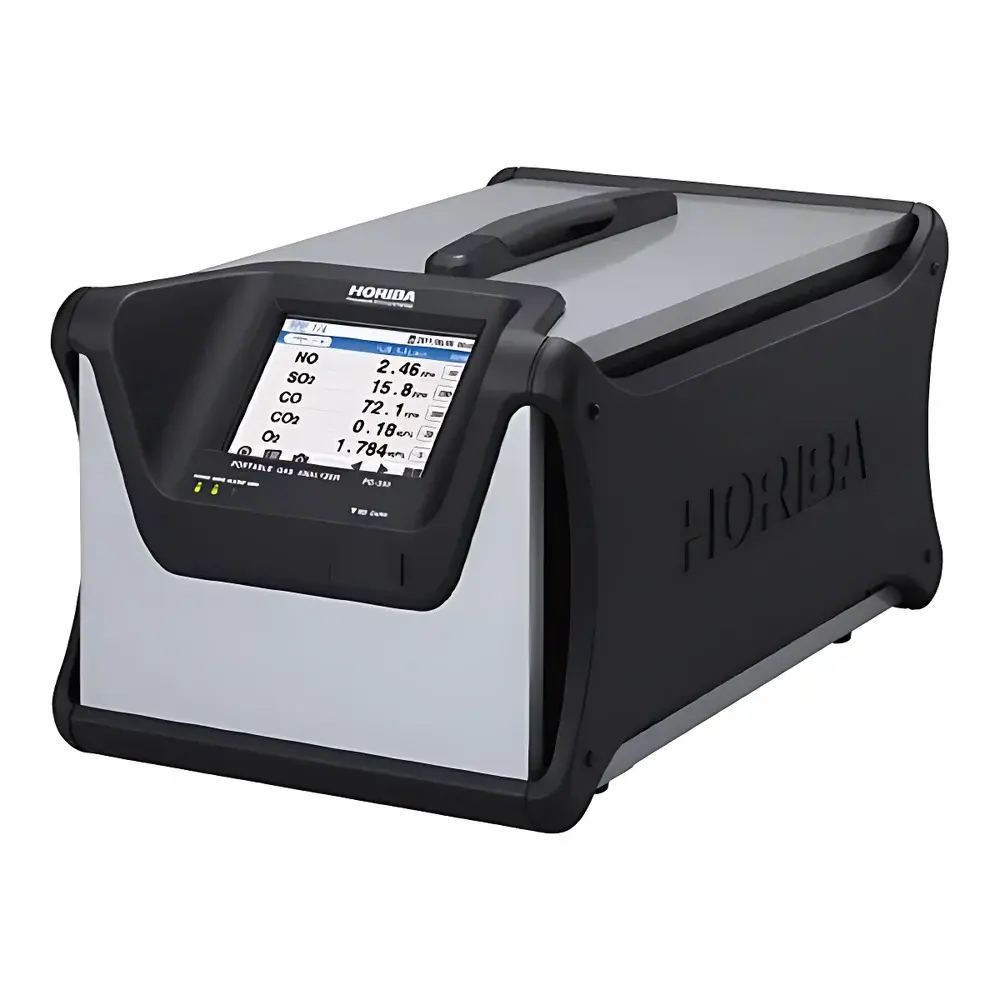
HORIBA PG-300 Series Portable Multicomponent Gas Analyzer
| Brand | HORIBA |
|---|---|
| Origin | Japan |
| Manufacturer Type | Manufacturer |
| Origin Category | Imported |
| Model | PG-300 Series |
| Product Type | Portable |
| Response Time | ≤45 s (SO₂: ≤180 s) |
| Repeatability | SO₂, NOₓ, CO, CO₂, O₂, CH₄ |
Overview
The HORIBA PG-300 Series Portable Multicomponent Gas Analyzer is an engineered field-deployable instrument designed for high-fidelity, real-time quantification of up to five critical gas species—NOₓ, SO₂, CO, CO₂, and O₂—in flue gas, combustion exhaust, and ambient air streams. Unlike conventional portable analyzers that sacrifice metrological rigor for mobility, the PG-300 integrates laboratory-grade optical and electrochemical detection principles into a ruggedized chassis. Its measurement architecture employs three complementary physical methods: alternating-flow modulated chemiluminescence (AFCM) for NOₓ; alternating-flow modulated non-dispersive infrared (NDIR) spectroscopy for SO₂, CO, and CH₄; dual-beam non-dispersive infrared absorption for CO₂; and galvanic cell electrochemistry for O₂. This hybrid sensor strategy ensures minimal cross-sensitivity, high long-term stability, and trace-level detection capability under variable temperature and humidity conditions typical of stack or mobile monitoring environments.
Key Features
- Compact, shock- and vibration-resistant housing—20% lighter than predecessor models without compromising structural integrity or thermal mass.
- Full-color capacitive touchscreen interface with intuitive icon-driven navigation and real-time graphical trend display (concentration vs. time).
- Integrated auto-calibration function with timestamped event logging—including zero/span verification, alarm triggers, and sensor diagnostics—stored on removable SD card.
- Configurable data logging interval (1 s to 60 min); simultaneous local storage (SD card) and analog output (4–20 mA) plus Ethernet connectivity for remote supervision and integration into SCADA or CEMS platforms.
- Onboard pre-conditioning system (heated sampling line, particulate filter, moisture trap) enables full-system calibration traceable to NIST or JIS standards.
- Compliant with international regulatory frameworks including EU MCERTS, US EPA Method 6C/7E/10, ISO 12039, EN 15267, and China’s JJG 968–2021 verification protocol.
Sample Compatibility & Compliance
The PG-300 accommodates gas matrices ranging from dry ambient air to hot, humid, particulate-laden flue gases (up to 200 °C inlet temperature with optional probe). It maintains accuracy across dynamic concentration ranges: NOₓ (0–500 ppm), SO₂ (0–2000 ppm), CO (0–10,000 ppm), CO₂ (0–25 vol%), O₂ (0–25 vol%), and optionally CH₄ (0–5000 ppm). All measurements adhere to GLP-compliant data integrity requirements: audit-trail-enabled firmware logs user actions, calibration history, and environmental metadata (temperature, pressure, flow rate). The device carries formal type approvals from TÜV Rheinland (EU), UK MCERTS, Russian GOST R, US EPA ETV, KOLAS (Korea), CNAS-accredited Chinese Metrology Certification, and Japan’s Ministry of Economy, Trade and Industry (METI) certification under JIS B 7981.
Software & Data Management
Data acquisition and reporting are managed via embedded firmware supporting CSV export, time-stamped waveform capture, and configurable alarm thresholds (high/low, rate-of-change). SD card records include raw detector signals, processed concentrations, diagnostic flags, and ambient sensor readings. Ethernet interface supports Modbus TCP and HTTP API for seamless integration with enterprise LIMS or cloud-based environmental dashboards. Firmware updates are performed via secure HTTPS download; all configuration changes are digitally signed and logged with operator ID and timestamp—meeting FDA 21 CFR Part 11 requirements for electronic records and signatures where applicable.
Applications
- CEMS backup verification and periodic compliance auditing per EPA PS-11 or EN 14181.
- In-situ combustion optimization in industrial boilers, kilns, and incinerators.
- Catalyst deactivation studies and emission profiling during catalyst screening trials.
- Mobile source testing: engine dynamometer exhaust analysis, fuel cell stack off-gas characterization, and hydrogen purity validation.
- Academic research in atmospheric chemistry, landfill gas monitoring, and biogas upgrading process control.
- Third-party environmental testing laboratories requiring accredited field instrumentation for ISO/IEC 17025 scope expansion.
FAQ
What gas species can the PG-300 measure simultaneously?
It measures NOₓ, SO₂, CO, CO₂, and O₂ concurrently; CH₄ is available as an optional channel.
Is the instrument suitable for hot, wet flue gas sampling?
Yes—when equipped with the heated sampling probe and integrated conditioning module, it handles gas streams up to 200 °C and 90% RH.
How is calibration traceability ensured?
Full-system calibration (including sample transport path) is supported using certified reference gases traceable to national metrology institutes; calibration certificates comply with ISO/IEC 17025 requirements.
Does the PG-300 meet regulatory requirements for CEMS verification?
Yes—it satisfies MCERTS QAL2, EPA PS-11, and China’s HJ 76–2017 technical specifications for portable reference analyzers.
Can data be exported for regulatory reporting?
All logged data are exportable in CSV format with ISO 8601 timestamps; audit trails and calibration records support GLP/GMP documentation workflows.
Related Products







