
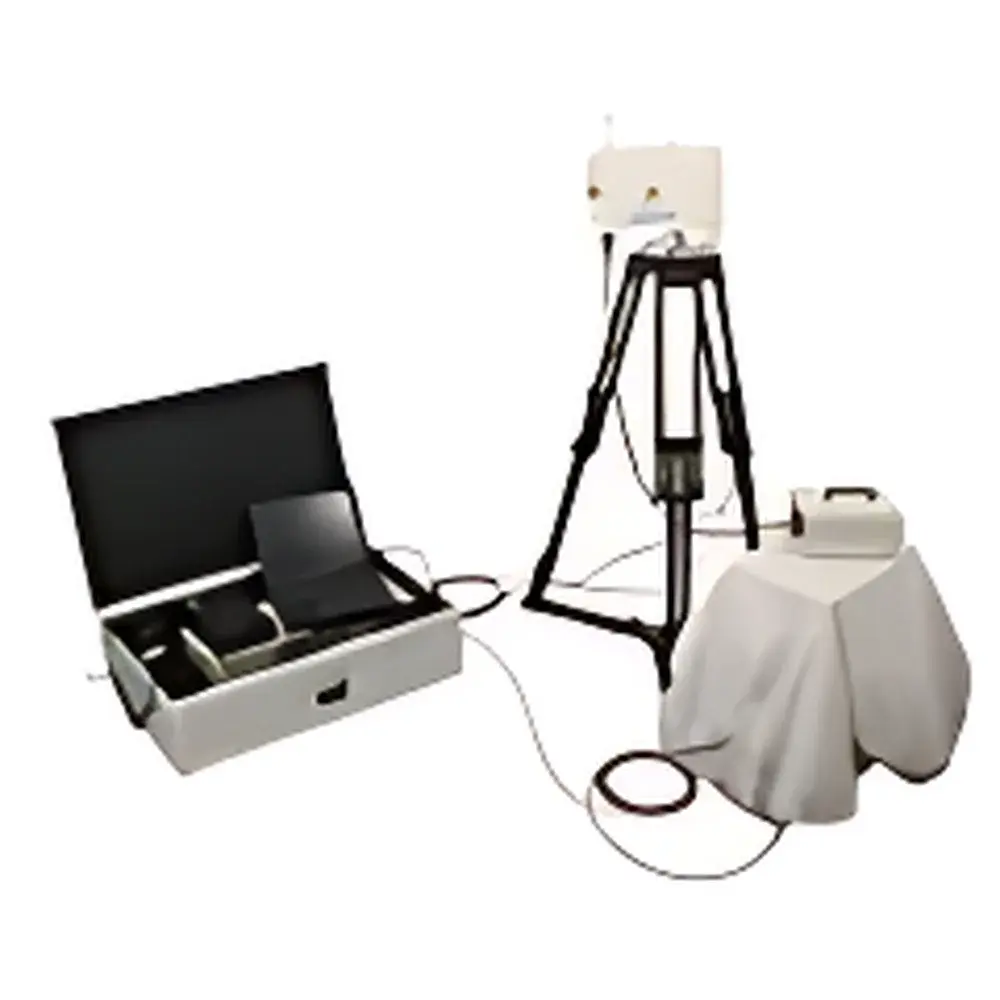
HORIBA HE Research-Grade Portable Raman Spectrometer
| Brand | HORIBA |
|---|---|
| Origin | France |
| Manufacturer Type | Manufacturer |
| Import Status | Imported |
| Model | HE |
| Instrument Type | Portable/Handheld Raman Spectrometer |
| Spectral Range | 100–3200 cm⁻¹ |
| Spectral Resolution | 3 cm⁻¹ |
| Minimum Wavenumber | 100 cm⁻¹ |
| Spectral Reproducibility | < 0.25 cm⁻¹ |
| Detector | 1024 × 256-pixel CCD (MPP mode) |
| Cooling | Peltier-cooled to –70 °C (air-cooled, no water required) |
| Read Noise | < 8 e⁻/pixel |
| Dark Current | < 0.01 e⁻/pixel/s |
| Laser Options | 532 nm, 633 nm, or 785 nm (output power 80–300+ mW) |
| Fiber Probe Support | Up to 4 simultaneous SuperHead™ probes |
| Optical Configurations | Standard, confocal, immersion, or microscope-coupled via 40 mm, 10×, or 50× long-working-distance objectives |
Overview
The HORIBA HE Research-Grade Portable Raman Spectrometer is a purpose-engineered, field-deployable analytical platform designed for high-fidelity Raman spectroscopy in both laboratory and demanding industrial environments. Operating on the principle of inelastic light scattering—where monochromatic laser excitation induces vibrational mode shifts in molecular bonds—the HE delivers quantitative and qualitative chemical identification with spectral fidelity across the 100–3200 cm⁻¹ range. Its solid-state optical architecture eliminates moving parts, ensuring mechanical stability and long-term calibration retention critical for process monitoring, quality assurance, and materials characterization. Unlike conventional benchtop systems, the HE integrates laboratory-grade performance into a ruggedized, transportable enclosure rated for continuous operation in controlled industrial settings—including cleanrooms, pilot plants, and manufacturing floors—without requiring vibration isolation or climate-controlled rooms.
Key Features
- Proprietary holographic concave grating optics delivering broad spectral coverage (100–3200 cm⁻¹) with uniform sensitivity and minimal stray light—enabling detection of low-intensity Raman bands such as lattice modes and weak organic vibrations.
- SuperHead™ fiber-optic probe system with interchangeable configurations: standard non-contact, confocal (spatial resolution ≤ 1 µm with 50× objective), immersion, or microscope-integrated options—supporting heterogeneous sample interrogation and depth-resolved analysis.
- Multi-probe capability: A single HE spectrometer can synchronize up to four independent fiber probes, allowing parallel acquisition from multiple process streams, reaction zones, or spatially distributed sampling points—ideal for PAT (Process Analytical Technology) deployment under ICH Q8/Q9 frameworks.
- Air-cooled, thermoelectrically stabilized CCD detector (1024 × 256 pixels, MPP mode) maintained at –70 °C, achieving sub-8 e⁻ read noise and < 0.01 e⁻/pixel/s dark current—ensuring high signal-to-noise ratio even during extended integration times (up to 300 s).
- Laser flexibility: Selectable excitation wavelengths (532 nm, 633 nm, 785 nm) with output power tunable from 80 mW to >300 mW—optimized for fluorescence suppression, resonance enhancement, or penetration depth requirements across pharmaceuticals, polymers, catalysts, and battery materials.
Sample Compatibility & Compliance
The HE accommodates diverse physical forms—including powders, tablets, liquids, gels, thin films, and bulk solids—via modular probe interfaces and optional motorized XYZ stages. Its optical design minimizes sample heating and photodegradation, particularly when using 785 nm excitation. The system complies with key regulatory expectations for analytical instrumentation used in GMP environments: full audit trail support in LabSpec software, user-access-level controls, electronic signature capability, and data integrity alignment with FDA 21 CFR Part 11 and EU Annex 11. All optical components meet ISO 9022-3 (environmental testing) and IEC 61000-6-2/6-3 (EMC immunity/emission) standards. Calibration verification follows NIST-traceable procedures using certified polystyrene and silicon standards.
Software & Data Management
Controlled exclusively through HORIBA’s LabSpec 6 software suite (Windows OS compatible), the HE provides intuitive instrument setup, real-time spectral preview, automated background subtraction, peak fitting (Voigt/Gaussian models), multivariate analysis (PCA, PLS), and batch processing workflows. Raw spectra are stored in vendor-neutral .spa format; metadata—including laser wavelength, power, integration time, probe ID, and operator credentials—is embedded per acquisition. Data export supports CSV, ASCII, and JCAMP-DX formats for third-party chemometric platforms (e.g., MATLAB, Unscrambler X). Software validation packages—including IQ/OQ documentation templates and change control logs—are available for regulated laboratories conducting method transfer or equipment qualification.
Applications
- Pharmaceutical Manufacturing: Real-time API polymorph identification, blend uniformity assessment, and coating thickness verification during tablet production—aligned with USP and ASTM E1840.
- Materials Science: In situ monitoring of carbon nanotube chirality, graphene layer count, and stress/strain distribution in composites under mechanical load.
- Energy Research: Operando analysis of Li-ion battery electrode degradation mechanisms, SEI formation kinetics, and cathode phase transitions during charge/discharge cycling.
- Forensics & Security: Non-destructive identification of explosives, narcotics, and counterfeit pharmaceuticals through spectral library matching (NIST, ATR-FTIR cross-referenced).
- Chemical Process Control: Continuous monitoring of reaction endpoints, impurity accumulation, and catalyst deactivation in multiphase reactors—integrated with DCS/SCADA via OPC UA protocol.
FAQ
Is the HE spectrometer suitable for GLP-compliant laboratories?
Yes. With full electronic audit trail, role-based access control, and 21 CFR Part 11–ready software modules, the HE meets core GLP data integrity requirements when deployed with validated SOPs.
Can the HE be integrated into an existing automation infrastructure?
Yes. It supports Ethernet-based remote control via TCP/IP and offers programmable APIs (LabVIEW, Python SDK) for seamless integration into MES, LIMS, or PAT frameworks.
What maintenance is required for long-term operational reliability?
The solid-state optical path and air-cooled detector eliminate routine alignment or coolant servicing. Annual calibration verification using NIST-traceable standards is recommended.
Does HORIBA provide application-specific method development support?
Yes. HORIBA Application Scientists offer remote and on-site assistance for spectral library creation, chemometric model development, and process-specific validation protocols.
How is laser safety managed during field deployment?
All HE configurations comply with IEC 60825-1 Class 3B laser safety standards. Interlocked probe housings, key-switch activation, and visible alignment beams ensure operator protection per OSHA and EN 60825-2 requirements.






