
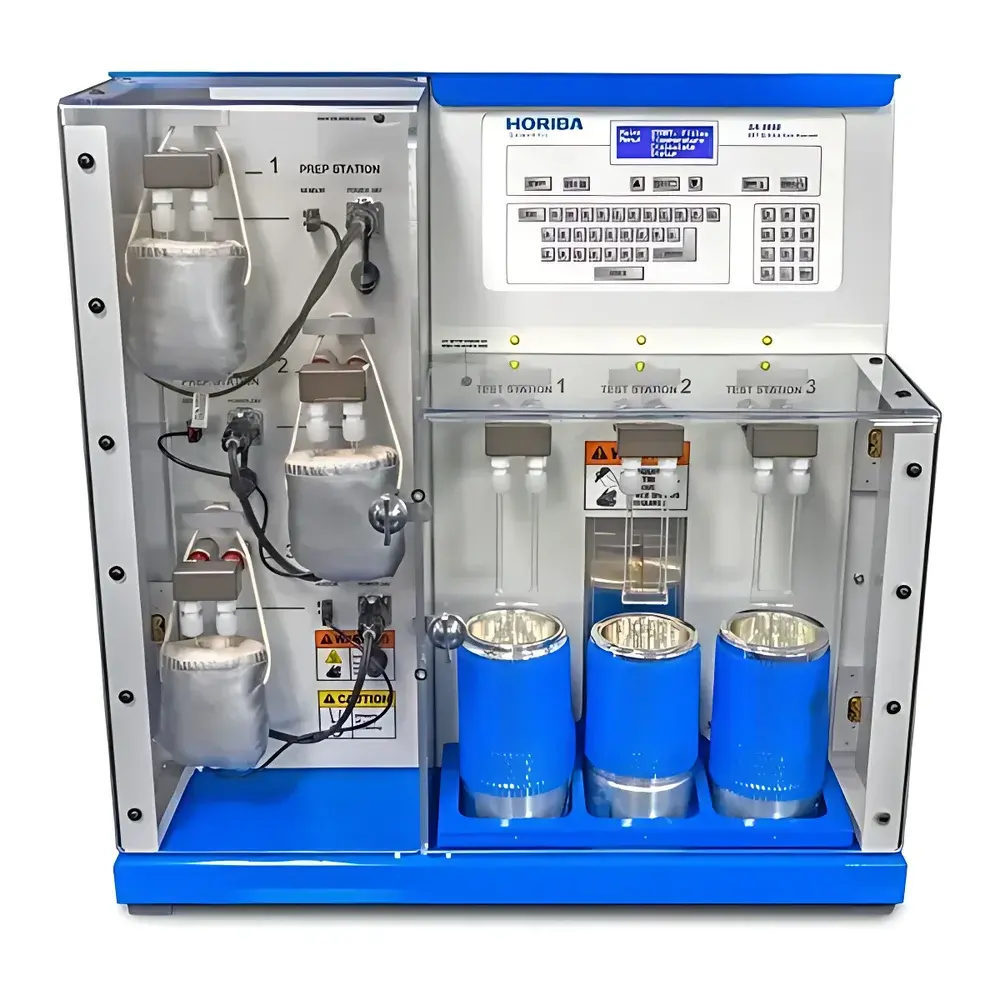
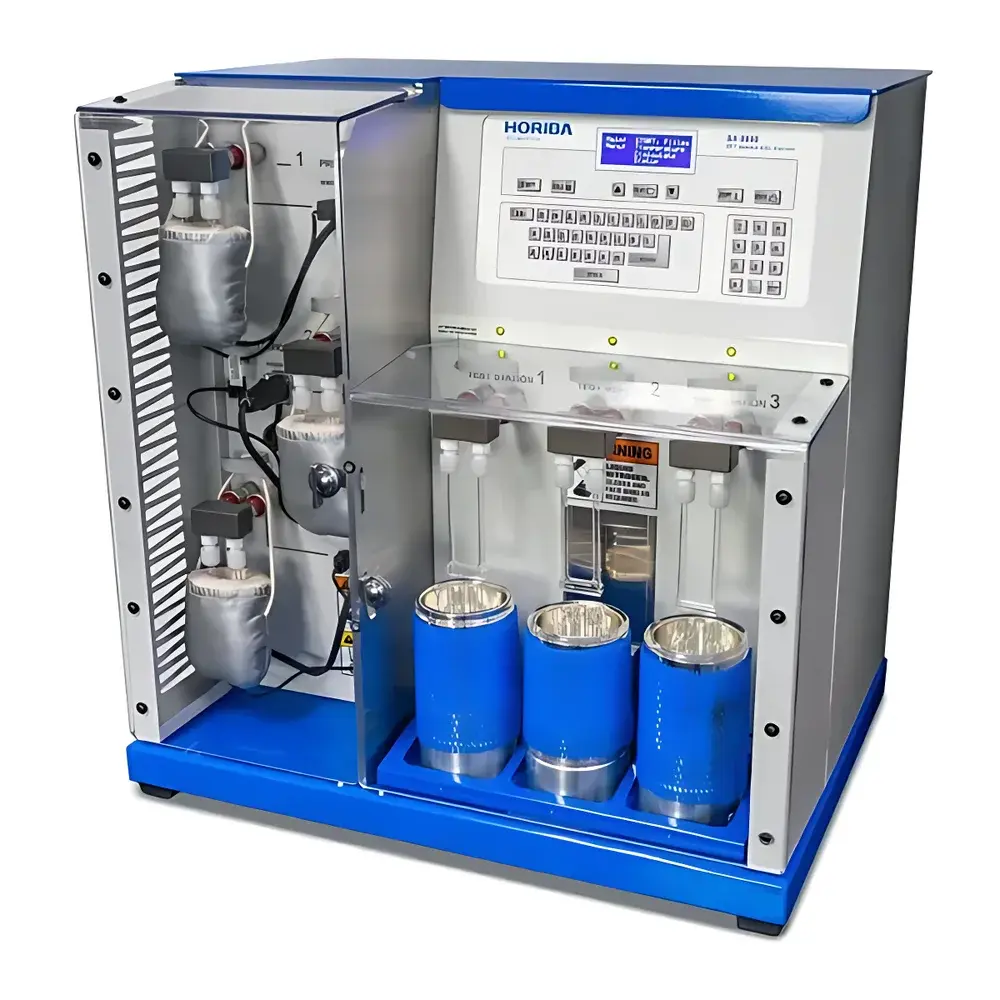
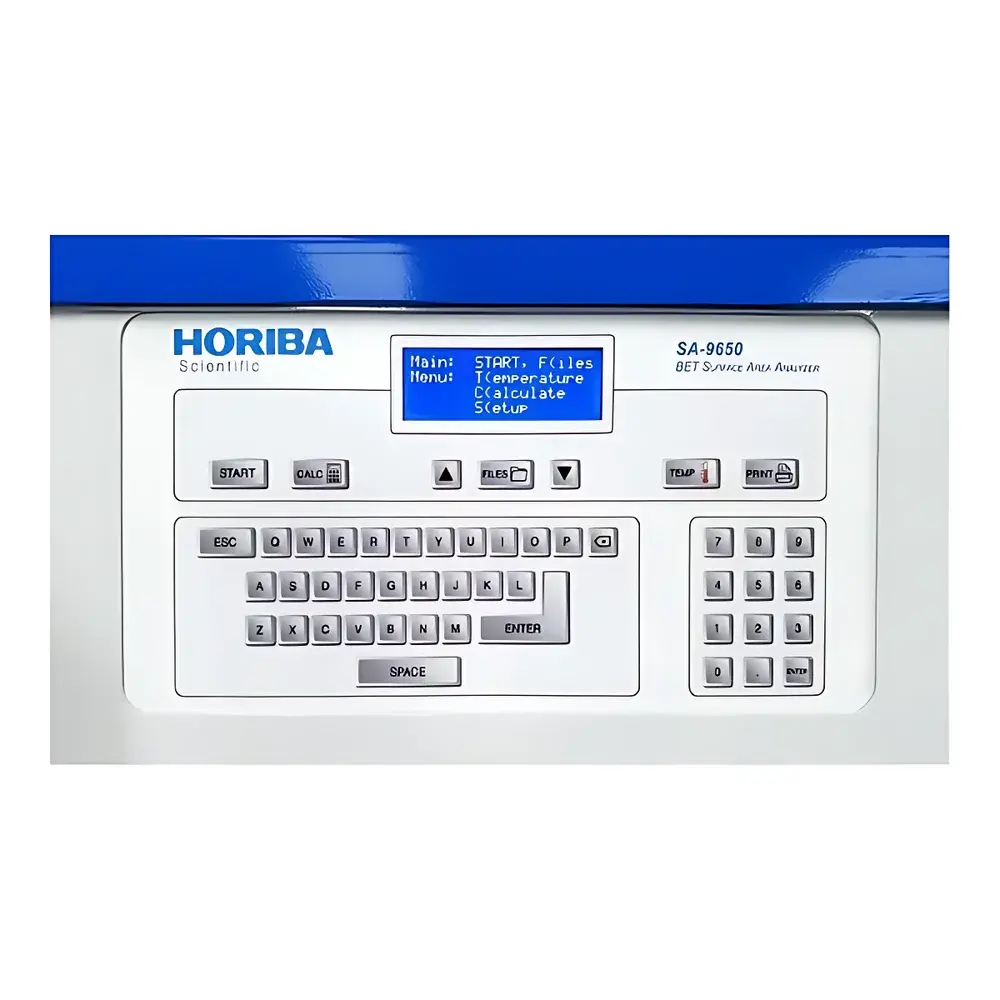
HORIBA SA-9650 Series Specific Surface Area Analyzer
| Brand | HORIBA |
|---|---|
| Origin | Japan |
| Manufacturer Type | Original Equipment Manufacturer (OEM) |
| Origin Category | Imported Instrument |
| Model | SA-9650 |
| Instrument Type | Specific Surface Area Analyzer |
| Measurement Principle | Dynamic Flow Method (Gas Adsorption) |
| Number of Analysis Stations | 1–3 |
| Specific Surface Area Range | 0.10 to >2000 m²/g |
| Repeatability | RSD < 1% |
Overview
The HORIBA SA-9650 Series Specific Surface Area Analyzer is an automated, flow-based gas adsorption instrument engineered for high-reproducibility determination of specific surface area via the Brunauer–Emmett–Teller (BET) theory. Unlike static volumetric analyzers that rely on precise dead-volume calibration and complex manifold evacuation protocols, the SA-9650 employs a dynamic flow method—measuring thermal conductivity changes in a continuously flowing nitrogen/helium gas stream as adsorption occurs on the sample surface at liquid nitrogen temperature (77 K). This principle eliminates the need for free-space volume measurement, sample tube calibration, or manual gas handling, significantly reducing operator dependency and systematic error sources. Designed for routine quality control and advanced materials research, the SA-9650 delivers traceable, GLP-compliant surface area data across a broad range (0.10–>2000 m²/g), with demonstrated repeatability better than 1% RSD and typical accuracy within ±5% against NIST-traceable reference materials.
Key Features
- Automated workflow: One-button initiation triggers full sequence—including automatic zero calibration, sample cooling via motorized liquid nitrogen Dewar lift, multi-point gas dosing, and real-time thermal conductivity detection.
- Integrated architecture: Compact, front-access cabinet houses all components—including built-in Windows computer with LCD touchscreen and full QWERTY keyboard—eliminating external PCs and auxiliary prep stations.
- Enhanced safety: Interlocked transparent safety doors disable heating during sample preparation and halt Dewar motion during analysis when opened; no compressed air required for valve actuation.
- Intelligent gas management: Mass flow controllers (MFCs) dynamically generate precise N₂/He mixtures on-demand for single-point or multi-point BET analysis—removing reliance on costly pre-mixed gases or external blending systems.
- Dewar reliability: Reinforced mechanical lift system ensures smooth, repeatable vertical positioning of the liquid nitrogen Dewar, minimizing thermal drift and vibration-induced noise.
- Detector protection: Automatic bypass loop diverts carrier gas flow away from the thermal conductivity detector (TCD) if the sample cell is absent or damaged—preserving sensor longevity and signal stability.
Sample Compatibility & Compliance
The SA-9650 accommodates powders, granules, monoliths, and thin-film substrates across diverse material classes—including catalysts, battery electrode materials, pharmaceutical excipients, ceramic precursors, activated carbons, metal–organic frameworks (MOFs), and filtration media. Sample mass requirements are minimized (as low as 0.1 m² total surface area), enabling analysis of precious or limited-availability samples. All configurations comply with CE marking requirements for electromagnetic compatibility (EMC) and low-voltage safety (LVD). The instrument supports audit-ready operation under GLP and GMP environments: software enforces user authentication, session logging, electronic signatures, and full audit trails per FDA 21 CFR Part 11 guidelines when operated via the enhanced SA-9650 PC software.
Software & Data Management
The SA-9650 operates via either its embedded Windows-based control system or external Windows PC connected via USB. The intuitive three-step interface—enter sample ID, select analysis mode (single-point or multi-point BET), and click “Start”—guides users through fully automated acquisition. Real-time plots display TCD voltage response during adsorption/desorption cycles, while integrated algorithms apply standard BET linearization (typically using P/P₀ = 0.05–0.30), t-plot, and Langmuir models. Reports include raw chromatograms, isotherm curves, regression statistics, uncertainty estimates, and customizable export formats (CSV, PDF, XML). Data files are timestamped, user-tagged, and stored with full metadata—including instrument configuration, gas composition, dewar position, and calibration history—for traceability and regulatory submission readiness.
Applications
- Pharmaceutical development: Quantifying surface area of active pharmaceutical ingredients (APIs) and excipients to predict dissolution rate, tablet compaction behavior, and chemical stability per USP & ICH Q5C guidelines.
- Catalysis R&D: Correlating Pt/Al₂O₃ or zeolite surface area with turnover frequency (TOF) and deactivation kinetics in hydroprocessing, SCR, or Fischer–Tropsch reactions.
- Battery materials: Characterizing cathode (e.g., NMC, LFP) and anode (e.g., silicon, graphite) powders to optimize slurry rheology, electrode porosity, and solid-electrolyte interphase (SEI) formation kinetics.
- Environmental engineering: Validating activated carbon and MOF adsorbents for VOC capture, CO₂ sequestration, and heavy metal removal per ASTM D3037 and ISO 9277.
- Advanced ceramics: Monitoring sintering progress in alumina, zirconia, or silicon nitride by tracking surface area loss during thermal treatment.
FAQ
What gas mixture is required for BET analysis on the SA-9650?
The instrument uses dynamically blended nitrogen/helium mixtures generated in situ via integrated mass flow controllers—no external gas blending or pre-mixed cylinders are needed.
Is sample degassing performed automatically by the SA-9650?
No—degassing is a prerequisite step conducted externally using a dedicated vacuum heating station (e.g., HORIBA SA-9600 series); typical conditions are 200 °C for 60 minutes under vacuum.
Can the SA-9650 measure pore size distribution?
No—the SA-9650 is optimized exclusively for specific surface area determination via dynamic flow BET. Pore size analysis requires static volumetric instruments capable of full isotherm acquisition and BJH/DFT modeling.
How many samples can be processed per day?
With three integrated preparation stations and 15–45 minute analysis times (depending on method), up to 20–30 surface area measurements can be completed in an 8-hour shift—assuming parallel degassing and sequential analysis.
Does the SA-9650 support compliance with ISO 9277:2010?
Yes—the dynamic flow methodology, calibration traceability, uncertainty quantification, and reporting structure align with the procedural and metrological requirements outlined in ISO 9277:2010 for BET surface area measurement.



