
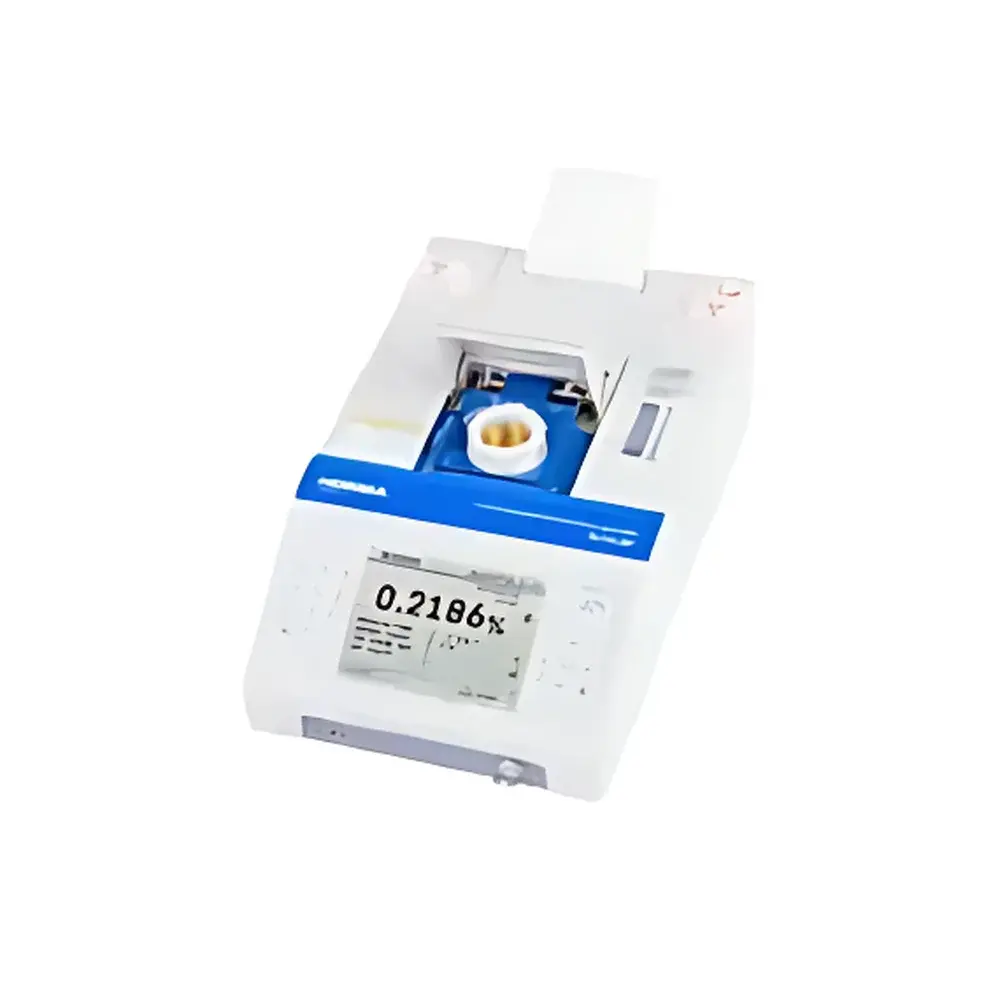
HORIBA SLFA-60 Portable X-ray Fluorescence Sulfur Analyzer
| Brand | HORIBA |
|---|---|
| Origin | Japan |
| Manufacturer Type | Original Equipment Manufacturer (OEM) |
| Product Category | Imported Instrument |
| Model | SLFA-60 |
| Detection Target | Total Sulfur |
| Measurement Principle | X-ray Fluorescence (XRF) Spectrometry |
| Detection Range | 0–10 wt% S |
| Detection Limit | 5 ppm |
| Precision | ±5 ppm (at 1.0% S), ±1.6 ppm (at 0% S) |
| Sample Volume | 4–10 mL per analysis |
| Measurement Time | Adjustable from 10 to 600 seconds |
| Sample Capacity | 8-position automated rotary stage |
| Sample Holder | Disposable liquid-specific film-bottom cup |
| Calibration Flexibility | Up to 20 calibration points across 5 stored curves (linear/nonlinear) |
| Environmental Operating Range | 5–35 °C, 30–85% RH |
| Power Supply | AC 100–240 V ±10%, 50/60 Hz |
| Power Consumption | 150 VA |
| Interface | RS-232C standard serial port |
| Dimensions | 430 × 500 × 230 mm |
| Weight | ~24 kg |
| Compliance | ASTM D4294, ISO 8754, JIS K2541 & B7995, GB/T 17040–1997, GB/T 17060–1998, SN/T 0509–1995 |
Overview
The HORIBA SLFA-60 Portable X-ray Fluorescence Sulfur Analyzer is an OEM-engineered benchtop instrument designed for rapid, non-destructive quantification of total sulfur in liquid hydrocarbon matrices. It operates on the fundamental principle of energy-dispersive X-ray fluorescence (ED-XRF), where primary X-rays excite sulfur atoms (Kα line at 2.307 keV) in the sample, and the emitted characteristic fluorescence is detected and quantified via a high-resolution Si-PIN semiconductor detector. Unlike combustion-based methods, XRF requires no reagents, no gas supply, and minimal sample preparation—making it ideal for field-deployable or lab-adjacent quality control in refineries, terminals, and third-party testing facilities. The SLFA-60 meets the metrological rigor demanded by regulatory frameworks governing fuel sulfur limits—including U.S. EPA Tier 3, IMO 2020, and EU Directive 2009/30/EC—and delivers trace-level accuracy without compromising operational robustness.
Key Features
- Automated 8-position rotary sample stage with precise motorized positioning and repeatable alignment—enabling unattended sequential analysis of up to eight samples.
- Disposable polypropylene film-bottom sample cups (4–10 mL volume), eliminating cross-contamination and reducing cleaning downtime; cup backs support manual annotation of sample ID, date, and concentration.
- Long-life X-ray tube with intelligent thermal management: standby mode maintains tube current below 30 µA, extending operational lifetime beyond 20,000 hours under typical usage.
- Real-time automatic gain control (AGC) compensates for X-ray tube aging by dynamically adjusting high voltage to stabilize spectral intensity—preserving calibration stability over time.
- Integrated environmental compensation: onboard temperature and barometric pressure sensors feed real-time corrections into the quantification algorithm, removing manual correction factors.
- Comprehensive self-diagnostic suite—including spectral health check, detector noise assessment, tube output verification, and hardware status logging—with printable diagnostic reports for preventive maintenance planning.
- Multi-curve calibration architecture supporting up to five independent working curves (linear or quadratic), each configurable with 2–20 reference points; auto-curve selection and extrapolation (marked with asterisk) ensure analytical continuity across diverse sample types.
- Embedded C/H ratio correction algorithm mitigates matrix effects when analyzing samples with carbon/hydrogen ratios deviating from calibration standards—critical for accurate sulfur reporting in naphthas, VGO, and residual fuels.
- Interference correction module automatically identifies and corrects for spectral overlaps from common heteroatoms (e.g., Cl, Ca, Ni, Fe) using empirical coefficients derived from certified reference materials.
- Full X-ray safety compliance: lead-shielded tube housing, interlocked front cover, and borosilicate glass observation window certified to IEC 61010-1 and JIS Z 4901; factory-issued radiation leakage report included with every unit.
Sample Compatibility & Compliance
The SLFA-60 is validated for direct analysis of low-to-high viscosity liquid petroleum products—including crude oil, naphtha, kerosene, diesel, marine fuel oil (MGO/MDO), heavy fuel oil (HFO), lubricating oil base stocks, and unleaded gasoline—without dilution or digestion. Its measurement range (0–10 wt% S) covers both ultra-low-sulfur diesel (ULSD, ≤15 ppm) and high-sulfur residual fuels (up to 5 wt%). All performance claims are traceable to NIST-traceable CRM series (e.g., NIST SRM 2723a, 2724a) and verified against ASTM D4294 Annex A1 precision statements. The analyzer conforms to GLP-compliant data integrity requirements: audit trail-enabled software logs all user actions, method changes, calibration events, and result modifications with timestamp and operator ID. Full compliance with ISO/IEC 17025:2017 clause 5.9 (assuring measurement traceability) and USP analytical instrument qualification protocols is supported through documented IQ/OQ/PQ templates.
Software & Data Management
The embedded firmware provides a bilingual (English/Japanese) GUI with intuitive touchscreen navigation and context-sensitive help. All measurement parameters—including dwell time, tube voltage/current, curve selection, and interference correction flags—are fully configurable and savable as method files. Raw spectral data (channel counts vs. energy) is exportable in ASCII format for offline peak deconvolution or multivariate modeling. The RS-232C interface supports bidirectional communication with LIMS systems via ASTM WK50312-compliant ASCII command sets. Audit trail records are immutable and stored in non-volatile memory for ≥12 months; exportable as CSV with digital signature hash for FDA 21 CFR Part 11 compliance when paired with validated PC-based data acquisition software.
Applications
- Refinery process control: real-time monitoring of desulfurization unit effluent and blendstock sulfur content prior to tank dispatch.
- Fuel terminal custody transfer: verification of sulfur compliance for marine bunker fuels against ISO 8217:2017 Table 2 specifications.
- Regulatory enforcement: field screening of retail gasoline and diesel for EPA 40 CFR Part 1093 and CARB diesel sulfur limits.
- R&D laboratories: rapid screening of catalyst performance in hydrotreating studies using spiked model compounds.
- Third-party certification labs: accredited testing per ISO/IEC 17025 for ISO 8754, ASTM D4294, and JIS K2541 test reports.
FAQ
Is the SLFA-60 suitable for solid or slurry samples?
No—the instrument is optimized exclusively for homogeneous liquid hydrocarbons. Suspended solids or phase-separated emulsions require pre-filtration or centrifugation to avoid spectral interference and cup contamination.
Can calibration be performed with in-house reference materials?
Yes—calibration supports user-defined standards with certified sulfur values; however, traceability to national metrology institutes (e.g., NIST, NMIJ) is required for accredited reporting.
What maintenance is required beyond routine cleaning?
Annual verification of X-ray tube output stability and detector resolution (FWHM at Mn Kα) is recommended; HORIBA-certified service engineers perform this during scheduled PM visits.
Does the instrument meet FDA 21 CFR Part 11 requirements?
The standalone unit does not include electronic signatures or role-based access control; full Part 11 compliance requires integration with validated PC software and administrative SOPs.
How is spectral drift compensated during extended operation?
The AGC system continuously monitors the Rh Kα escape peak intensity and adjusts tube voltage in real time to maintain constant excitation energy—ensuring long-term repeatability without manual recalibration.





