
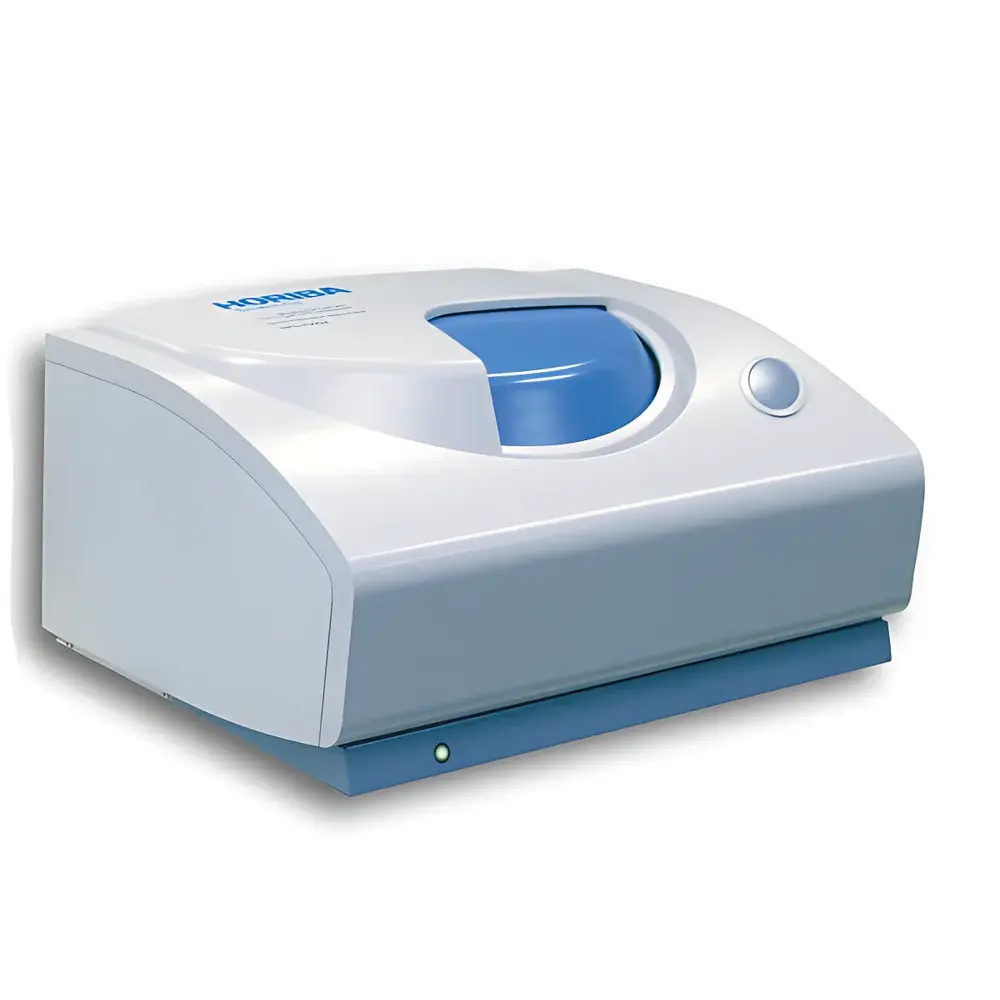
HORIBA SZ-100 V2 Nanoparticle Analyzer
| Brand | HORIBA |
|---|---|
| Origin | Japan |
| Manufacturer Type | Original Equipment Manufacturer (OEM) |
| Product Origin | Imported |
| Model | SZ-100 V2 |
| Dispersion Method | Wet Dispersion |
| Instrument Type | Laboratory Laser-Based Particle Characterization System |
| Size Range | 0.3 nm – 10 µm |
| Reproducibility | ±2% |
| Measurement Time | < 2 min |
| Zeta Potential Range | −500 mV to +500 mV |
| Molecular Weight Range | 1,000 – 2×10⁷ Da |
| Detection Angles | 90° and 173° (automatically or manually selectable) |
| Sample Volume | 12 µL – 1,000 µL |
| Measurement Principle for Size | Dynamic Light Scattering (DLS), also known as Photon Correlation Spectroscopy (PCS) |
| Zeta Potential Principle | Laser Doppler Electrophoresis |
| Molecular Weight Determination | Debye Plot Analysis |
| Second Virial Coefficient (A₂) | Yes |
| Integrated Auto-Titrator | Yes (for pH-controlled zeta potential studies) |
| Compliance | NIST-traceable calibration with 100 nm standard particles |
Overview
The HORIBA SZ-100 V2 Nanoparticle Analyzer is a fully integrated, benchtop instrument engineered for high-precision characterization of colloidal and macromolecular systems in solution. It combines three orthogonal measurement modalities—particle size distribution via Dynamic Light Scattering (DLS), surface charge quantification via Laser Doppler Electrophoresis (LDE) for zeta potential, and molecular weight determination using static light scattering (SLS) combined with Debye plot analysis—within a single optical platform. This tri-modal capability enables comprehensive physicochemical profiling of nanoparticles, protein therapeutics, synthetic polymers, liposomes, micelles, and submicron emulsions without requiring sample transfer between instruments. The system operates on the fundamental principles of Brownian motion (for DLS), electrophoretic mobility (for zeta potential), and angular dependence of scattered intensity (for Mw and A₂). Its dual-angle detection geometry (90° and 173°) enhances resolution across broad size distributions and mitigates artifacts associated with multiple scattering or fluorescence interference—particularly critical for turbid or highly concentrated samples up to 40% w/v.
Key Features
- Triple-parameter acquisition in one run: simultaneous or sequential measurement of hydrodynamic diameter, zeta potential, and molecular weight (Mw) with second virial coefficient (A₂)
- Dual-angle optical configuration (90° and 173°) optimized for accuracy across nanoscale regimes—from sub-1 nm biomolecules to 10 µm aggregates
- Micro-volume compatibility: accommodates sample volumes from 12 µL (capillary cell) to 1,000 µL (standard cuvette), minimizing reagent consumption and enabling precious-sample analysis
- Integrated automated titrator for precise, programmable pH ramping during zeta potential measurements—essential for isoelectric point (pI) mapping and colloidal stability assessment
- NIST-traceable calibration verified using certified 100 nm polystyrene latex standards; reproducibility maintained at ±2% RSD under controlled temperature conditions
- Robust thermal control (Peltier-based) ensuring measurement stability from 3°C to 60°C, critical for temperature-dependent aggregation or conformational studies
Sample Compatibility & Compliance
The SZ-100 V2 supports aqueous and organic solvent-based dispersions, including saline buffers, low-conductivity media, and mixed solvents compatible with common biomolecular and polymer formulations. It is routinely employed in QC environments adhering to USP , ISO 22412, and ASTM E2490 standards for nanoparticle size distribution. Zeta potential data comply with ISO 13099-1 for electrophoretic mobility reporting. For regulated biopharmaceutical applications, the instrument’s software architecture supports audit trail functionality, electronic signatures, and user access controls aligned with FDA 21 CFR Part 11 requirements when deployed with validated SOPs. All raw correlation functions and intensity distributions are retained in native format for GLP/GMP traceability.
Software & Data Management
The proprietary SZ-100 software provides a unified interface for method setup, real-time monitoring, batch processing, and report generation. It includes automated quality checks (e.g., count rate validation, autocorrelation fit residuals, phase analysis light scattering [PALS] signal integrity), customizable pass/fail criteria per parameter, and export options compliant with LIMS integration (CSV, XML, PDF). Advanced modules support Debye plot construction, Smoluchowski/Hückel model switching for zeta potential conversion, and polydispersity index (PdI) interpretation per ISO 22412 guidelines. Raw data files preserve full metadata—including laser power, temperature log, detector gain, and measurement duration—for retrospective reanalysis and regulatory submission readiness.
Applications
- Stability assessment of monoclonal antibodies and fusion proteins via zeta potential vs. pH profiling and A₂ evaluation
- Batch-to-batch consistency testing of lipid nanoparticles (LNPs) and polymeric micelles for mRNA delivery platforms
- Aggregation kinetics monitoring under thermal or mechanical stress conditions
- Surface modification verification of quantum dots, metal oxides, and carbon nanomaterials
- Formulation screening of surfactant-stabilized emulsions and nanostructured lipid carriers (NLCs)
- Characterization of viral vectors and exosomes in early-stage bioprocess development
FAQ
What measurement principles does the SZ-100 V2 employ for particle sizing?
It uses Dynamic Light Scattering (DLS), also known as Photon Correlation Spectroscopy (PCS), to determine hydrodynamic diameter based on Brownian diffusion coefficients.
Can the instrument measure zeta potential in high-salt solutions?
Yes—its patented PALS (Phase Analysis Light Scattering) detection mode maintains sensitivity even at conductivities up to 200 mS/cm, though optimal resolution is achieved below 100 mS/cm.
Is molecular weight determination applicable to non-spherical macromolecules?
The Debye plot method assumes spherical approximation; for rod-like or branched structures, results represent apparent Mw and should be interpreted alongside shape-sensitive techniques such as SEC-MALS or AFM.
Does the system support GMP-compliant data handling?
When configured with appropriate IT infrastructure and validated procedures, the software supports 21 CFR Part 11 compliance—including electronic records, audit trails, and role-based permissions.
How is sample concentration handled across the 0.3 nm–10 µm range?
The system employs adaptive signal processing and optional attenuators to maintain linear response across concentrations from dilute protein solutions (µg/mL) to dense colloidal suspensions (up to 40% w/v).



