
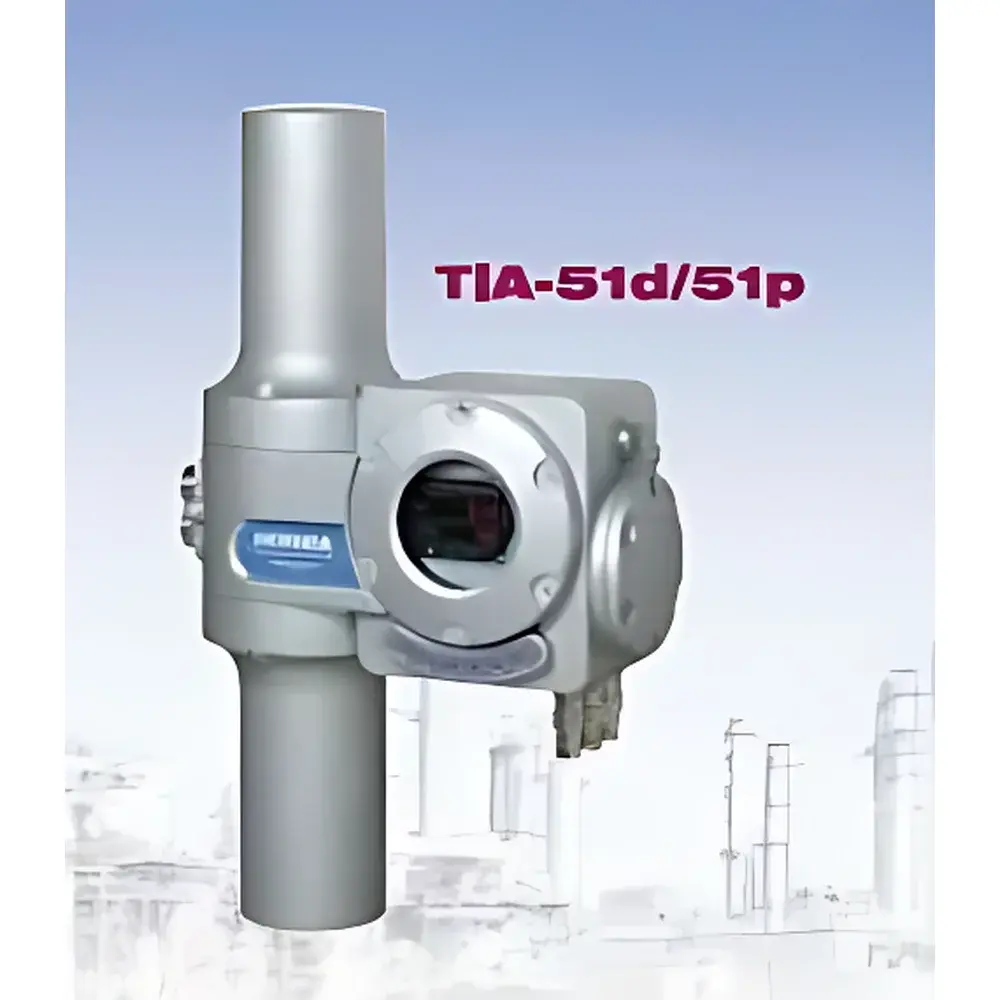
HORIBA TIA-51d/TIA-51p Intrinsically Safe Infrared Gas Analyzer
| Origin | Japan |
|---|---|
| Manufacturer Type | Authorized Distributor |
| Origin Category | Imported |
| Model | TIA-51d / TIA-51p |
| Pricing | Upon Request |
Overview
The HORIBA TIA-51d and TIA-51p are certified explosion-proof infrared gas analyzers engineered for continuous, high-reliability measurement of carbon monoxide (CO), carbon dioxide (CO₂), methane (CH₄), and other hydrocarbon gases in hazardous industrial environments. These analyzers employ non-dispersive infrared (NDIR) spectroscopy with interferent correction—a dual-detector optical architecture that simultaneously acquires measurement and reference signals within a single optical path. This design actively compensates for spectral interference from co-existing gases (e.g., water vapor, hydrocarbons), mechanical vibration, and long-term drift caused by source aging or cell contamination. The system is purpose-built for Zone 1/Zone 2 classified areas per IEC 60079 standards, supporting operation in atmospheres containing Group II B + H₂ or Group II C explosive gases, with a maximum surface temperature rating of T4 (≤135 °C). Unlike standard NDIR platforms, the TIA-51 series integrates intrinsic safety considerations at the hardware architecture level—not merely as an enclosure add-on—ensuring stable photometric performance under demanding process conditions.
Key Features
- Explosion-protection compliance: TIA-51d meets Ex d IIB+H₂ T4 (flameproof enclosure); TIA-51p meets Ex p II T4X (pressurized enclosure); hybrid configuration TIA-51p/d supports Ex px d IIC T4X for highest-risk applications.
- Interferent-corrected NDIR optics: Dual-channel detection (measurement + compensation) minimizes cross-sensitivity to H₂O, CO₂, and other IR-active species without requiring external scrubbers or multi-gas calibration matrices.
- Wide dynamic range: Configurable span ranges from 0–50 ppm to 0–100 vol% depending on target gas—enabling both trace-level emission monitoring and high-concentration process control.
- Robust sample handling: Stainless steel (SUS304/SUS316), gold-coated optical surfaces, and fluorocarbon (FKM) seals ensure chemical compatibility with aggressive industrial gas streams.
- Stable metrological performance: ±0.5% FS repeatability (standard range), ±1.0% FS linearity, and ≤±2.0% FS zero/span drift per week under controlled ambient conditions.
- T₉₀ response time ≤20 s (standard range) or ≤40 s (extended low-range configurations), validated per ISO 12039 and ASTM D6522 protocols.
Sample Compatibility & Compliance
The TIA-51 series is validated for use with dry, dust-free sample streams containing ≤21% O₂ and operating at inlet pressures ≥1.98 kPa (gauge) and flow rates of 500 mL/min. Sample contact materials include SUS304/SUS316 stainless steel, gold-plated mirrors, calcium fluoride (CaF₂) windows, and FKM elastomers—providing resistance to corrosion from acidic or halogenated compounds. All units comply with IEC 60079-0 (general requirements), IEC 60079-1 (flameproof “d”), and IEC 60079-2 (pressurized “p”) for equipment used in explosive atmospheres. Optional Modbus-RTU over RS-485 enables integration into SIL2-capable safety instrumented systems (SIS) per IEC 61511. The analyzer supports GLP/GMP-aligned audit trails when paired with HORIBA’s optional automatic calibration module (ACM), satisfying FDA 21 CFR Part 11 data integrity requirements for pharmaceutical and fine chemical manufacturing.
Software & Data Management
While the TIA-51 operates as a standalone field instrument with local push-button interface, its RS-485 port (Modbus-RTU, configurable baud rates: 1200–19200 bps) allows seamless integration into distributed control systems (DCS), SCADA platforms, or centralized environmental monitoring networks. Analog outputs (isolated 4–20 mA, load ≤750 Ω) support redundant signal routing to PLCs and safety relays. Optional analog alarm thresholds can be set across –10% to +110% of full scale, enabling fail-safe shutdown triggers. Firmware updates and configuration changes are performed via terminal emulation; no proprietary software license is required. Calibration history—including date/time stamps, span gas IDs, and pre-/post-calibration deviations—is retained in non-volatile memory for regulatory review.
Applications
- Refinery flare gas monitoring (CO, CO₂, CH₄) in Zone 1 enclosures adjacent to sour gas processing units.
- Landfill biogas upgrading plants requiring real-time CH₄ purity verification prior to pipeline injection.
- Hydrogen production facilities (electrolysis, SMR) where H₂/CO/CO₂ ratios must be continuously verified under Class I, Division 1 conditions.
- Chemical synthesis reactors with exothermic pathways involving CO intermediates—where rapid detection of CO breakthrough prevents thermal runaway.
- Incinerator stack emissions monitoring compliant with EU Industrial Emissions Directive (IED) and US EPA Method 10.
FAQ
What explosion protection certifications does the TIA-51d hold?
The TIA-51d is certified Ex d IIB+H₂ T4 per IEC 60079-1, suitable for use in factories handling ethylene, hydrogen, or similar Group II B + H₂ gases.
Can the TIA-51p measure hydrogen directly?
No—hydrogen lacks a permanent dipole moment and is IR-inactive; however, the TIA-51p may be deployed in H₂-rich environments where CO or CO₂ serve as surrogate indicators of process integrity.
Is automatic zero/span calibration available as a factory option?
Yes—HORIBA offers an integrated Automatic Calibration Module (ACM) with solenoid valves, certified zero/span gas cylinders, and scheduled calibration logic compliant with ISO 14064-3 QA/QC requirements.
What is the minimum detectable concentration for CO using the TIA-51 series?
With optional low-range configuration, the instrument achieves a lower detection limit of 0–50 ppm CO, with repeatability maintained at ±0.5% FS.
Does the analyzer require carrier gas during operation?
A nitrogen purge (0.5 L/min during operation; 10 L/min during cleaning cycles) is recommended to maintain optical path cleanliness and extend detector lifetime—especially in high-particulate or condensable-vapor applications.







