
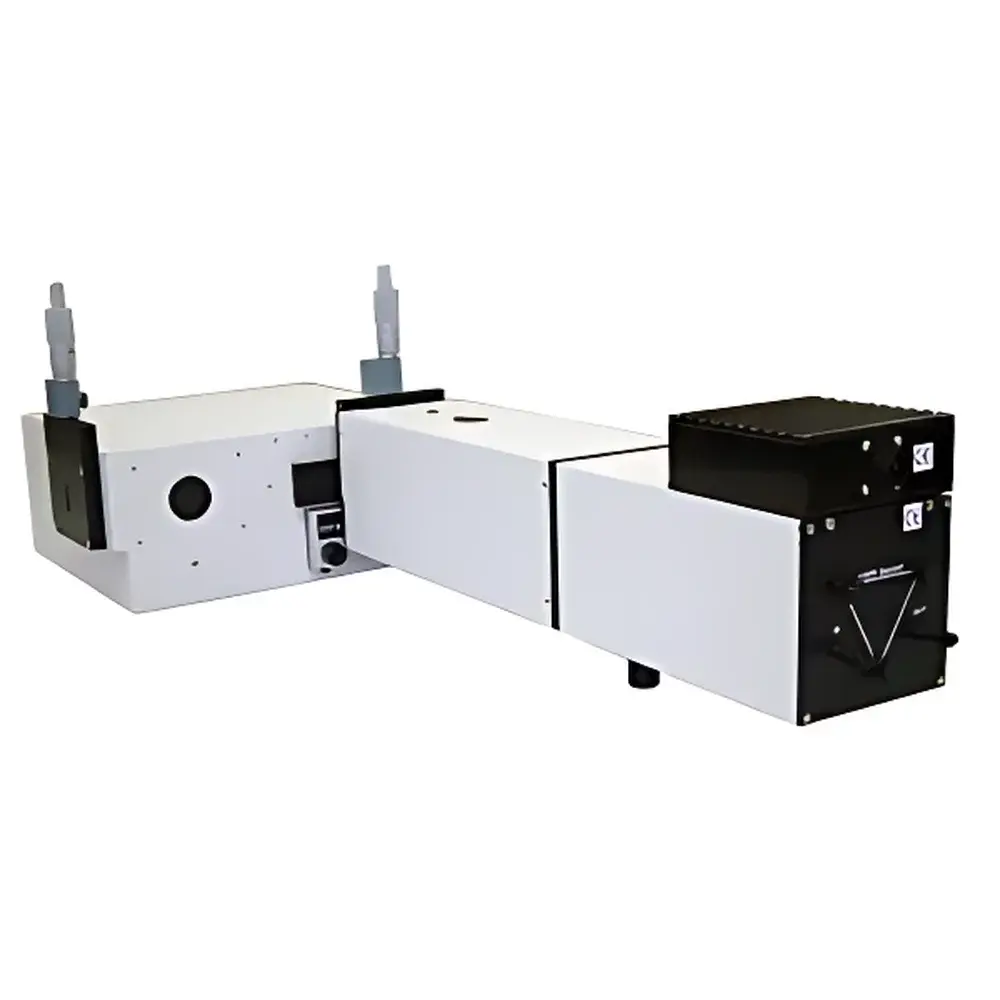
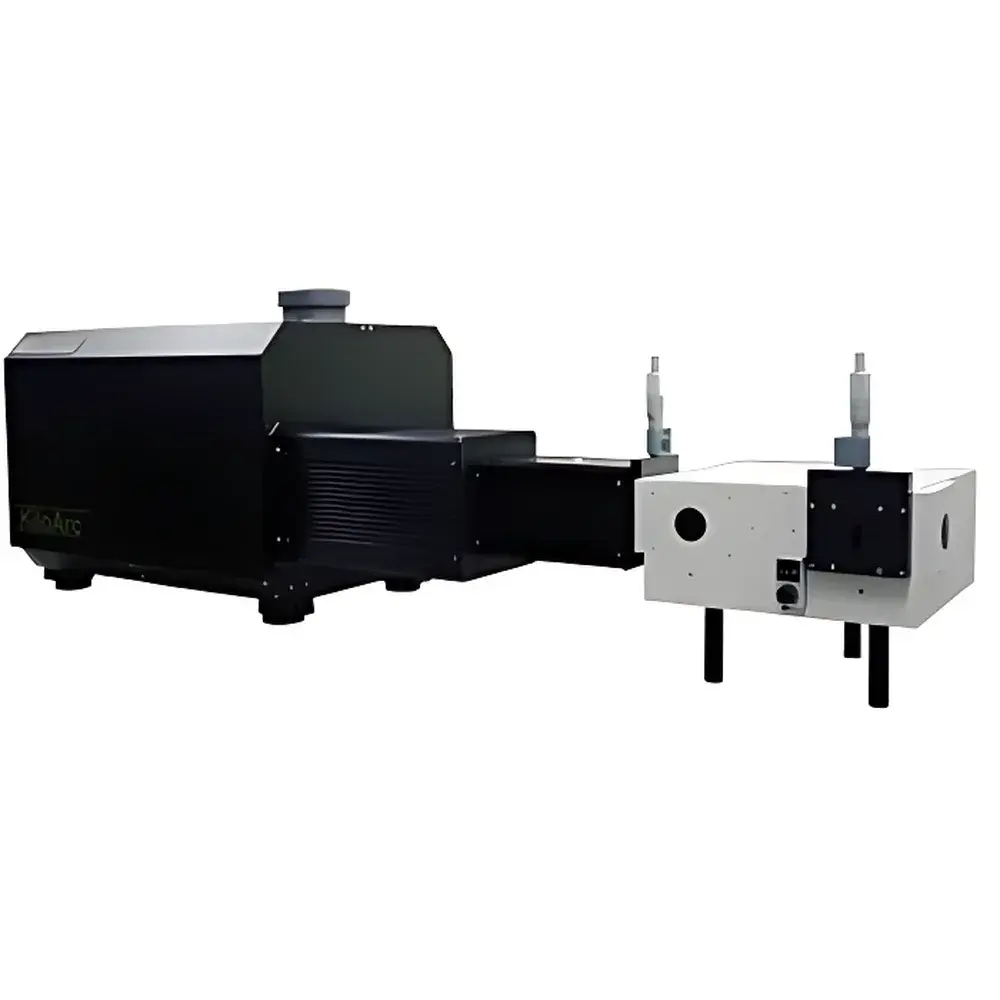
HORIBA Tunable PowerArc and Tunable KiloArc Adjustable Monochromatic Light Sources
| Brand | HORIBA |
|---|---|
| Origin | USA |
| Manufacturer Type | Manufacturer |
| Import Status | Imported |
| Model | Tunable PowerArc / Tunable KiloArc |
| Output Power (Tunable PowerArc) | Up to 20 mW (wavelength-, grating-, and bandwidth-dependent) |
| Output Power (Tunable KiloArc) | >300 mW (wavelength-, grating-, and bandwidth-dependent) |
| Beam Divergence | 14.5° (PowerArc) / 14.4° (KiloArc) |
| Numerical Aperture (N.A.) | 0.12 |
| Optical Noise | 0.07% RMS |
| Power Stability | ±0.2% (over 8 hours, temperature-controlled environment) |
| Spectral Range | 180–2200 nm |
| Bandwidth Tunability | 0–25 nm (continuously adjustable) |
| Lamp Options | 75 W to 1000 W Xenon arc lamps |
Overview
The HORIBA Tunable PowerArc and Tunable KiloArc are high-efficiency, broadband monochromatic light sources engineered for precision spectroscopic applications requiring stable, wavelength-selectable irradiance across the deep UV to near-infrared spectrum (180–2200 nm). These systems utilize a proprietary ellipsoidal mirror-based lamp housing architecture to maximize photon collection from xenon arc lamps—delivering 5–6× higher optical throughput compared to conventional parabolic or off-axis reflector designs. Unlike fixed-wavelength LEDs or filtered broadband sources, the Tunable PowerArc and Tunable KiloArc integrate a high-resolution Czerny–Turner monochromator with motorized grating selection and continuously variable slit control, enabling precise spectral isolation without mechanical filter wheels or external bandpass optics. The core measurement principle relies on dispersion-based wavelength selection combined with optimized radiometric coupling into free-space or fiber-coupled output paths, ensuring traceable irradiance delivery for quantitative photophysical experiments.
Key Features
- Ellipsoidal reflector lamp housing delivering ≥85% collection efficiency from xenon arc plasma—significantly exceeding standard parabolic collectors in étendue-matched configurations
- Continuous spectral tuning from 180 nm (vacuum UV, with optional purged or evacuated path) to 2200 nm, supporting both UV-Vis-NIR spectroscopy and photochemical activation studies
- Bandwidth adjustment from 0 nm (instrument-limited resolution) to 25 nm via synchronized entrance/exit slit control—enabling trade-offs between spectral purity and radiant flux
- Two platform variants: Tunable PowerArc (up to 20 mW output; ideal for low-flux fluorescence excitation and detector calibration) and Tunable KiloArc (≥300 mW output; suited for solar simulation, photoelectrochemical testing, and high-sensitivity absorption measurements)
- Optical stability of ±0.2% over 8 hours under active thermal management, meeting requirements for long-duration kinetic assays and GLP-compliant instrument qualification
- Low-noise performance (0.07% RMS intensity noise) achieved through regulated DC lamp power supplies and vibration-damped optical benches—critical for lock-in detection and quantum yield determinations
Sample Compatibility & Compliance
These monochromatic sources are compatible with standard 25.4 mm or 50.8 mm optical mounts and support free-space beam delivery, liquid light guide coupling (e.g., 600 µm core), and fiber-optic interfaces (SMA905 or FC/PC). The system operates within ISO/IEC 17025-aligned laboratory environments and supports audit-ready documentation for FDA 21 CFR Part 11 compliance when integrated with HORIBA’s Synapse software suite. All xenon lamp options meet IEC 62471 photobiological safety classifications (Risk Group 1 or 2 depending on output configuration), and vacuum-compatible versions (for sub-190 nm operation) conform to ASTM E2073 and ISO 9227 standards for UV exposure testing. No hazardous material declarations are required for standard operation under ambient atmospheric conditions.
Software & Data Management
HORIBA’s FluoroMax® and LabSpec® software platforms provide full remote control of wavelength, bandwidth, lamp intensity, and shutter state via USB 2.0 or Ethernet interfaces. Instrument drivers support LabVIEW™, MATLAB®, and Python (PyVISA) integration for automated spectral scanning, time-resolved irradiance logging, and multi-source synchronization. All parameter changes are timestamped and logged with user ID attribution, satisfying ALCOA+ data integrity principles. Audit trails include calibration history, lamp usage hours, and spectral output verification reports—exportable in CSV, XML, or PDF formats for regulatory submission. Firmware updates maintain backward compatibility with legacy monochromator controllers and comply with NIST-traceable radiometric calibration protocols.
Applications
- Excitation source for steady-state and time-resolved fluorescence spectroscopy—including single-molecule FRET and lifetime imaging (FLIM)
- Primary illumination for UV-Vis absorption spectrophotometers requiring tunable reference-grade monochromatic beams
- Light source for circular dichroism (CD) spectropolarimeters, especially in far-UV protein secondary structure analysis
- Radiometric calibration of photodetectors, CCD/CMOS sensors, and pyroelectric power meters across 180–2200 nm
- Spectral matching in solar simulator validation per IEC 60904-9 and ASTM E927-22 standards
- Controlled photoactivation in photopharmacology, optogenetics (with appropriate filtering), and photocatalytic reaction kinetics
- Quantitative actinometry for photochemical quantum yield determination using ferrioxalate or Aberchrome 540 methods
- In vivo and ex vivo photobiomodulation studies in dermatology and wound healing research
FAQ
What vacuum or purge requirements apply for operation below 190 nm?
Operation at wavelengths <190 nm requires either nitrogen purging (to reduce O2 absorption) or vacuum evacuation of the monochromator chamber. HORIBA offers factory-integrated purge ports and vacuum flanges compatible with standard turbomolecular pumping systems.
Can the Tunable KiloArc be fiber-coupled without significant power loss?
Yes—when equipped with the optional 0.22 NA multimode fiber adapter, ≥70% of the collimated output (at 500 nm, 5 nm bandwidth) couples into a 600 µm core fiber, verified by NIST-traceable power meter calibration.
Is lamp replacement user-serviceable?
Lamp exchange is performed via front-access panel with alignment-free mechanical registration; full recalibration is not required, though spectral output verification is recommended post-replacement.
How is radiometric output calibrated and maintained?
Each unit ships with a NIST-traceable spectral irradiance certificate measured at five representative wavelengths; annual recalibration services are available through HORIBA’s global metrology centers.
Does the system support synchronization with pulsed lasers or gated detectors?
TTL-compatible trigger outputs and inputs enable hardware-level synchronization with external devices, supporting pump-probe, time-gated luminescence, and modulated reflectance experiments.





