
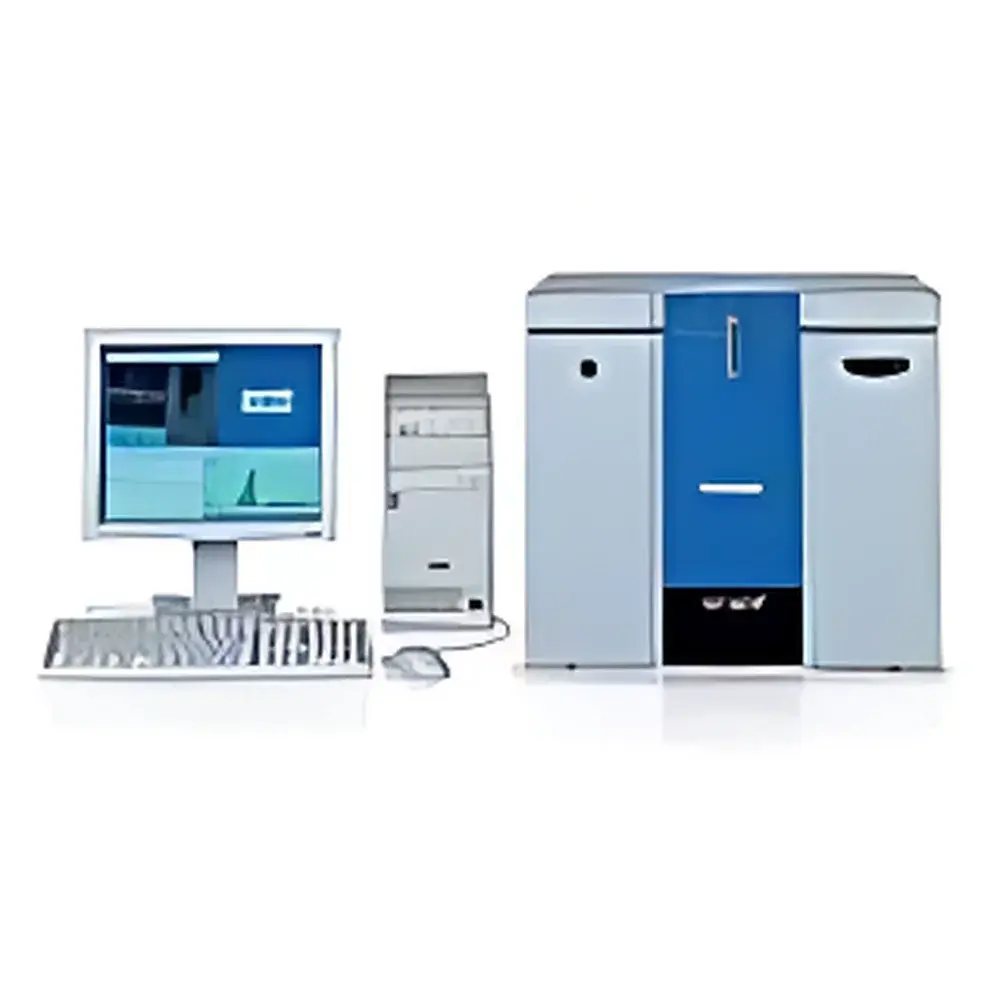
Horiba XGT-1000WR/1700WR X-ray Fluorescence Analyzer
| Origin | Japan |
|---|---|
| Manufacturer Type | Authorized Distributor |
| Origin Category | Imported |
| Model | XGT-1000WR/1700WR |
| Pricing | Available Upon Request |
Overview
The Horiba XGT-1000WR and XGT-1700WR are benchtop energy-dispersive X-ray fluorescence (ED-XRF) analyzers engineered for precise, non-destructive elemental quantification in electronics manufacturing, RoHS compliance screening, and materials quality control. Based on fundamental X-ray fluorescence physics—where primary X-rays excite characteristic secondary (fluorescent) X-rays from sample atoms—the system delivers trace-level detection of regulated hazardous substances without sample preparation or destruction. Designed specifically for regulatory testing workflows, the instrument complies with ISO 17025–accredited laboratory practices and supports method validation per IEC 62321-5:2013 and ASTM F2617–22 for RoHS-constrained element analysis. Its dual-model architecture (XGT-1000WR for standard throughput; XGT-1700WR for enhanced sensitivity and larger sample handling) integrates patented X-ray guiding tube (XGT) optics to confine excitation to sub-millimeter areas while maintaining high photon flux—enabling spatially resolved mapping of Pb, Hg, Cd, Br, and Cr across heterogeneous surfaces.
Key Features
- Patented 1.2 mm and 3.0 mm X-ray guiding tube (XGT) optics for micro-zone analysis with minimized background scatter and improved signal-to-noise ratio
- Dual-detector configuration: High-resolution silicon drift detector (SDD) with Peltier cooling and ultra-thin polymer window for optimal light-element transmission
- Large sample chamber (460 × 360 × 150 mm) accommodating PCBs, connectors, molded plastic housings, coated metals, and layered assemblies
- Coaxial X-ray/optical imaging system featuring 50× magnification CCD camera—enabling real-time visual targeting aligned precisely with X-ray beam position (industry-first coaxial alignment)
- Automated spectral deconvolution with built-in matrix correction algorithms for inter-element interference (e.g., As–Pb, Sb–Sn overlaps) and substrate thickness compensation
- One-touch measurement protocol with pre-configured RoHS method templates, eliminating manual parameter setup for routine screening
Sample Compatibility & Compliance
The XGT-1000WR/1700WR accepts solid, flat, or moderately curved samples up to 5 kg—including printed circuit boards (PCBs), solder joints, plastic casings, metal alloys, painted surfaces, laminates, and composite packaging materials. No digestion, coating, or vacuum requirements are needed: all analyses occur under ambient air conditions. The system meets essential regulatory requirements for restricted substance monitoring, including full alignment with EU RoHS Directive 2011/65/EU Annex II concentration limits (1000 ppm for Pb, Hg, Cd, Cr(VI), Br in PBB/PBDE), China RoHS II, and JEITA EG0201. Measurement uncertainty is traceable to NIST SRM reference materials, and software audit trails comply with GLP/GMP documentation standards per FDA 21 CFR Part 11 when configured with user authentication and electronic signature modules.
Software & Data Management
Horiba’s proprietary XGT Analysis Suite provides intuitive workflow-driven operation—from sample registration and region-of-interest (ROI) definition to automated reporting. All spectra, calibration curves, and raw counts are stored in a relational database with time-stamped metadata. Quantitative results export natively to Microsoft Excel (.xlsx) with embedded formula logic for pass/fail evaluation against user-defined specification limits (e.g., <100 ppm Cd). Batch reporting supports multi-sample comparison, statistical process control (SPC) charting, and trend analysis over time. Software validation packages—including IQ/OQ documentation, test scripts, and traceability matrices—are available for regulated environments requiring formal instrument qualification.
Applications
- Routine RoHS screening of incoming electronic components and finished goods prior to shipment
- Failure analysis of plating inconsistencies, solder contamination, or coating delamination
- Verification of supplier declarations for material composition and substance declarations (IMDS, IPC-1752A)
- Process validation of lead-free reflow profiles and cleaning efficacy post-assembly
- Forensic investigation of non-compliant lots using spatially resolved elemental mapping
- Research-grade elemental profiling of multilayer thin films and nanocomposite coatings
FAQ
What is the detection limit for chromium (Cr) compared to other RoHS elements?
The system achieves a typical detection limit of 5 ppm for Cr(VI) analogues in polymer matrices and 2 ppm for Pb, Hg, Cd, and Br—verified using certified reference materials under standardized measurement conditions (600 s counting time, 50 kV excitation).
Can the XGT analyze irregularly shaped or tall samples?
Yes—the open-top chamber design and motorized Z-stage accommodate samples up to 150 mm in height; optional tilt-stage accessories enable analysis of angled surfaces without repositioning.
Is spectral library matching supported for unknown material identification?
While primarily optimized for quantitative RoHS analysis, the software includes a semi-quantitative “unknown mode” that ranks probable compositions based on peak intensity ratios and stoichiometric constraints—intended for preliminary screening only.
How does the system handle overlapping peaks from complex matrices like brominated flame retardants?
The analyzer applies iterative least-squares fitting with physical model-based background subtraction and empirically derived interference coefficients—validated against interlaboratory round-robin data per IEC 62321-5 Annex C.
Does Horiba provide method transfer support for laboratory accreditation?
Yes—Horiba offers application-specific method development services, including SOP drafting, uncertainty budgeting per GUM (JCGM 100:2008), and participation in proficiency testing schemes coordinated by LGC or BAM.




