
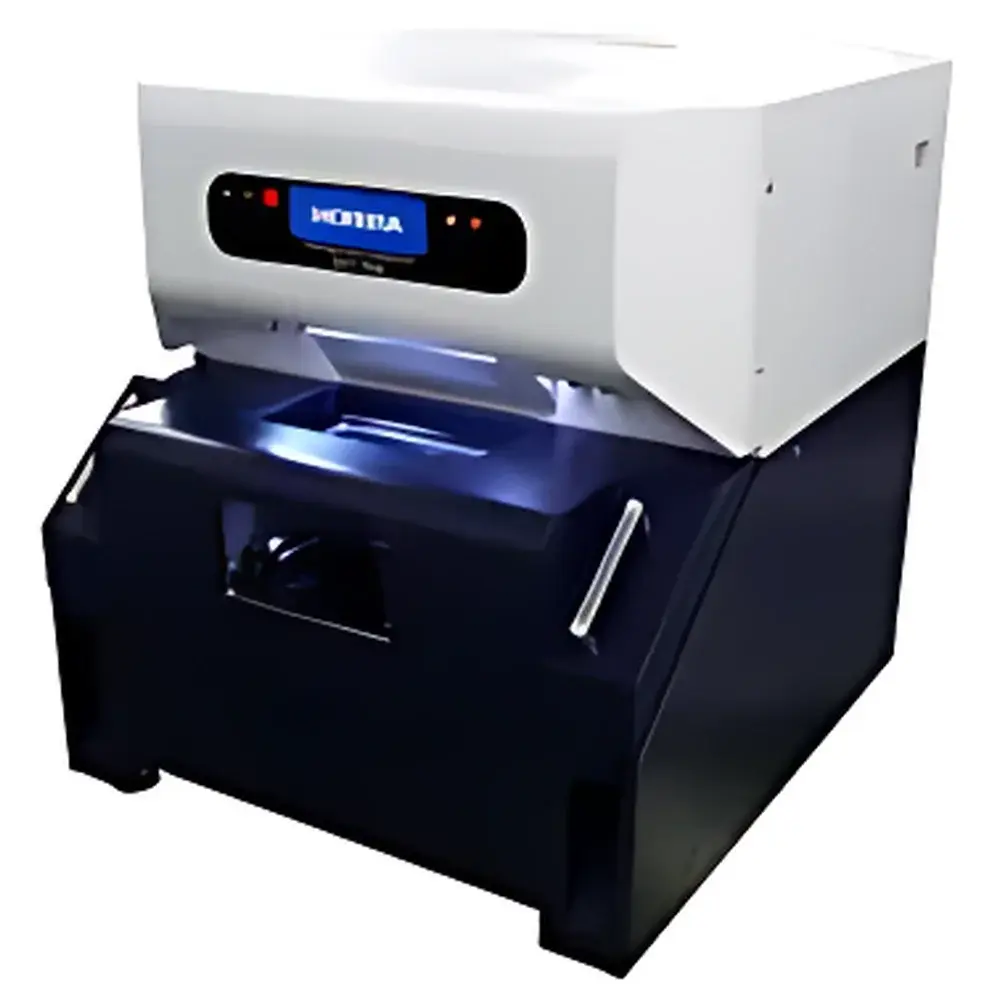
HORIBA XGT-7000V Energy Dispersive X-Ray Fluorescence Microscope
| Brand | HORIBA |
|---|---|
| Origin | Japan |
| Model | XGT-7000V |
| Detector | Silicon Drift Detector (SDD) |
| X-ray Source | Rh anode, 50 kV / 1 mA |
| Spatial Resolution | Down to 10 µm |
| Measurement Range | Na (11) to U (92) |
| Vacuum Modes | Full vacuum & local vacuum (switchable in <5 s) |
| Optical Imaging | Co-axial CCD with macro/micro view |
| Sample Chamber | 300 mm × 300 mm × 80 mm (full vacuum), XY stage: 100 mm × 100 mm |
| Software | SmartMap™ for hyperspectral mapping, INCA™ pulse processor, GLP-compliant data handling |
| Quantification Methods | Fundamental Parameters (FP), single-standard FP, calibration curve, multilayer thin-film analysis (nm–µm scale) |
| Elemental Mapping | Pixel-resolved full-spectrum acquisition, offline reprocessing, RGB overlay, line scan, ROI masking |
Overview
The HORIBA XGT-7000V is a benchtop energy dispersive X-ray fluorescence (ED-XRF) microscope engineered for high-spatial-resolution elemental microanalysis and non-destructive internal structural imaging. Unlike conventional bulk ED-XRF systems, the XGT-7000V integrates micro-focused X-ray excitation (down to 10 µm spot size), co-axial optical microscopy, and simultaneous XRF/X-ray transmission imaging within a single platform. Its core measurement principle relies on characteristic X-ray emission following inner-shell ionization by a focused Rh-target microfocus X-ray tube (50 kV, 1 mA), detected via a liquid-nitrogen-free silicon drift detector (SDD) offering high count-rate capability (>100,000 cps) and energy resolution <125 eV at Mn Kα. The system supports quantitative analysis across the elemental range from sodium (Na, Z=11) to uranium (U, Z=92), with detection limits reaching sub-ppm levels for many elements under optimized vacuum conditions. Designed for laboratory environments requiring regulatory traceability, the XGT-7000V architecture complies with foundational requirements of ISO/IEC 17025, ASTM E1621, and USP <233> for elemental impurity testing—particularly relevant in electronics quality control, failure analysis, and materials forensics.
Key Features
- Microfocus X-ray optics with interchangeable capillary probes (10 µm and 100 µm nominal focal spots), enabling seamless transition between micro-area and macro-area analysis without hardware realignment.
- Dual-vacuum chamber design: full vacuum mode (<10 Pa) for enhanced light-element sensitivity (e.g., Na, Mg, Al, Si); localized vacuum mode maintains ambient pressure around hydrated or delicate samples (e.g., biological tissues, archaeological artifacts) while evacuating only the detector path—ensuring stable SDD performance and minimizing sample dehydration.
- Co-axial high-resolution CCD optical imaging system providing real-time visual correlation between optical morphology and elemental distribution, with zoom functionality supporting both wide-field overview and precise region-of-interest (ROI) selection.
- Simultaneous acquisition of XRF elemental maps and X-ray transmission radiographs using a NaI(Tl) scintillation detector—enabling non-invasive visualization of internal density variations, layer interfaces, voids, or embedded features independent of elemental composition.
- Advanced signal processing powered by a digital INCA™ pulse processor, delivering real-time dead-time correction, pile-up rejection, and spectral deconvolution for accurate peak identification and intensity quantification.
Sample Compatibility & Compliance
The XGT-7000V accommodates diverse sample geometries and physical states: solid wafers, PCB cross-sections, metal alloys, geological thin sections, polymer films, and fragile cultural heritage specimens up to 10 cm × 10 cm in footprint and 80 mm in height. Its large-volume sample chamber and programmable XYZ stage allow full-sample interrogation without sectioning. For regulated industries—including semiconductor manufacturing, medical device QA, and pharmaceutical packaging—the system supports audit-ready operation: all analytical parameters (voltage, current, dwell time, vacuum status, detector gain), raw spectra, and processed results are timestamped and stored with immutable metadata. Data export formats (CSV, CDF, .spc) comply with FDA 21 CFR Part 11 requirements when deployed with validated electronic signature workflows and role-based access controls. Instrument qualification documentation aligns with IQ/OQ protocols per GMP Annex 15 and ISO 15189 Annex B.
Software & Data Management
SmartMap™ software serves as the unified interface for instrument control, experiment design, and multidimensional data interpretation. It enables fully automated point, line, and area scans; supports user-defined ROI masking and batch processing of multi-location datasets (up to 5,000 points). Hyperspectral mapping acquires a complete XRF spectrum at every pixel, permitting post-acquisition extraction of any element map—or combination thereof—without re-scanning. Quantitative modules include fundamental parameter (FP) algorithms with matrix correction, standardless FP, empirical calibration curves, and dedicated multilayer film analysis (capable of resolving individual layer thicknesses from sub-nanometer to several micrometers). All spectral processing—peak deconvolution, background subtraction, interference correction—is traceable and reproducible. Export functions generate Excel®-ready reports with statistical summaries, detection limit calculations, and uncertainty propagation per ISO 11843-7.
Applications
The XGT-7000V delivers actionable insights across multiple technical domains. In electronics manufacturing, it identifies solder joint contamination (e.g., Cl, Br), verifies conformal coating uniformity, and performs failure root-cause analysis of electromigration-induced voids. For tribology and engine wear studies, it maps metallic debris composition on oil filters to infer component degradation mechanisms. In cultural heritage science, its local vacuum mode preserves moisture-sensitive pigments while mapping pigment stratigraphy and corrosion products in ancient manuscripts or painted ceramics. Geological laboratories use its high-resolution mapping to resolve zoning patterns in silicate minerals and quantify trace-element partitioning. Additionally, it supports regulatory compliance testing for RoHS-restricted substances (Pb, Cd, Hg, Cr⁶⁺, Br), ELV directives, and IEC 62321-5 screening protocols—all without sample digestion or destruction.
FAQ
Does the XGT-7000V require liquid nitrogen cooling for the SDD detector?
No. The integrated silicon drift detector operates at thermoelectrically stabilized temperatures and does not require cryogenic cooling.
Can the system analyze light elements such as sodium or magnesium in air?
Light-element detection below aluminum (Z<13) requires full vacuum mode to minimize atmospheric absorption of low-energy X-rays.
Is thin-film thickness quantification validated against reference standards?
Yes—multilayer analysis routines are traceable to NIST SRM standards (e.g., NIST 2135a, 2136) and support uncertainty estimation per ISO/IEC Guide 98-3.
What data security features are included for regulated environments?
Role-based user authentication, electronic audit trails, data integrity validation (SHA-256 checksums), and optional integration with LIMS via ASTM E1467-compliant APIs.
How is spatial calibration verified and maintained?
Calibration is performed using certified microgrid standards (e.g., NIST SRM 2062) and verified daily via automated alignment checks embedded in SmartMap™ diagnostic routines.





