
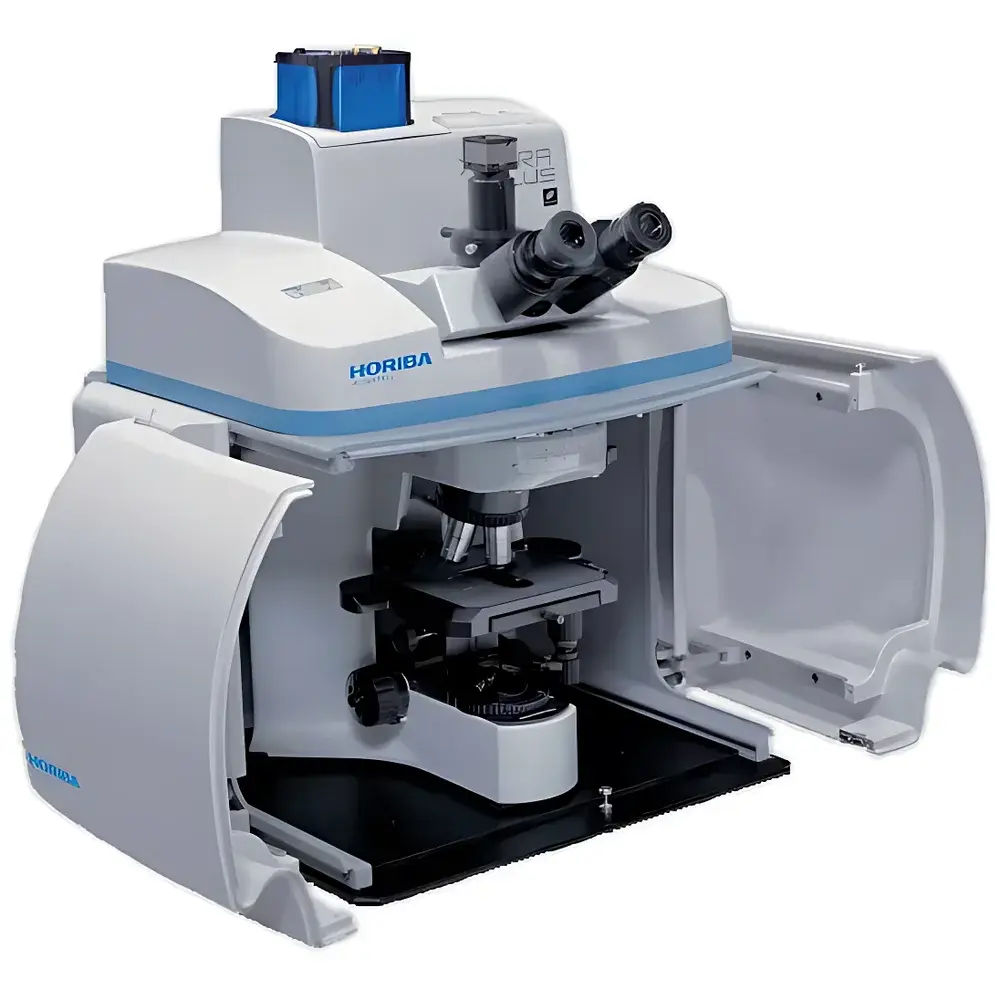
HORIBA XploRA PLUS Ultra-Fast Confocal Raman Imaging Spectrometer
| Brand | HORIBA |
|---|---|
| Origin | France |
| Manufacturer Type | Original Equipment Manufacturer (OEM) |
| Import Status | Imported |
| Model | XploRA PLUS |
| Instrument Type | Confocal Micro-Raman Spectrometer |
| Spectral Range | 50–9000 cm⁻¹ |
| Spectral Resolution | 1 cm⁻¹ |
| Spatial Resolution | Lateral 0.4 µm, Axial 1.5 µm |
| Minimum Wavenumber | 50 cm⁻¹ |
| Spectral Reproducibility | ≤ ±0.03 cm⁻¹ |
Overview
The HORIBA XploRA PLUS is a fully automated, research-grade confocal micro-Raman imaging spectrometer engineered for high-fidelity chemical mapping, structural characterization, and spatially resolved molecular analysis. Based on confocal laser Raman spectroscopy—a non-destructive, label-free technique that relies on inelastic scattering of monochromatic light—the XploRA PLUS delivers quantitative vibrational fingerprinting with sub-micron spatial registration. Its optomechanical architecture integrates a high-stability inverted microscope platform with a precision XYZ motorized stage, thermally stabilized spectrograph, and low-noise CCD detector, enabling robust acquisition across diverse sample types—from single-crystal semiconductors to heterogeneous pharmaceutical tablets and biological tissues. Designed for multi-user laboratory environments, the system supports walk-up operation without manual realignment, ensuring consistent data quality across shifts and operators.
Key Features
- SWIFT™ Fast Imaging Technology: Accelerates Raman mapping by up to 10× versus conventional point-by-point acquisition—achieved through synchronized stage motion, spectral readout, and hardware-triggered exposure control—without compromising signal-to-noise ratio or spectral fidelity.
- True Confocal Optical Design: Employs a dynamically adjustable pinhole and telecentric scan optics to maintain diffraction-limited resolution (0.4 µm lateral, 1.5 µm axial) across full spectral range (50–9000 cm⁻¹), eliminating out-of-focus contributions even at high-speed raster scanning.
- OneClick™ Intelligent Analysis Suite: Integrates real-time spectral preprocessing (cosmic ray removal, baseline correction, normalization), automated peak detection, and multivariate clustering—enabling rapid identification of chemical phases directly from raw maps.
- NIST-Traceable Auto-Calibration: Built-in Ne/Ar lamp and motorized calibration mirror ensure daily wavenumber accuracy within ±0.03 cm⁻¹ reproducibility—fully compliant with ISO 17025 and ASTM E1840 requirements for analytical instrument qualification.
- Modular Excitation Architecture: Supports simultaneous integration of multiple lasers (e.g., 532 nm, 638 nm, 785 nm) via dichroic steering optics—optimized for fluorescence suppression, resonance enhancement, and depth-profiling in layered materials.
- Optical Microscope Integration: Fully functional upright/inverted microscope with Köhler illumination, DIC, and fluorescence modules—enabling correlative optical, topographic, and chemical imaging on the same platform.
Sample Compatibility & Compliance
The XploRA PLUS accommodates solid, liquid, powder, thin-film, and embedded biological specimens—including air-sensitive or temperature-sensitive samples when interfaced with environmental stages (optional). Its open-sample chamber design allows direct mounting of SEM stubs, TEM grids, or custom holders. All firmware and software comply with FDA 21 CFR Part 11 for electronic records and signatures, supporting audit trails, user access control, and electronic signature workflows required under GLP and GMP-regulated environments. System validation documentation—including IQ/OQ/PQ protocols and uncertainty budgets—is available upon request to meet ISO/IEC 17025 accreditation criteria.
Software & Data Management
Controlled by HORIBA’s LabSpec 6 software, the XploRA PLUS provides a unified interface for acquisition, processing, and reporting. Data are stored in vendor-neutral HDF5 format with embedded metadata (excitation wavelength, objective magnification, grating, integration time, stage coordinates), ensuring FAIR (Findable, Accessible, Interoperable, Reusable) compliance. The ParticleFinder™ module enables automated particle detection, size distribution analysis, and component-specific Raman classification—validated against USP guidelines for particulate matter analysis in injectables. Export options include CSV, ASCII, and MIA-compatible formats for integration with third-party chemometrics tools (e.g., MATLAB, Python scikit-learn).
Applications
- Pharmaceutical: Polymorph screening, API-excipient interaction mapping, counterfeit drug detection, and tablet coating uniformity assessment per ICH Q5A and USP .
- Materials Science: Strain/stress profiling in 2D materials (graphene, TMDCs), phase segregation in battery cathodes, and defect density quantification in SiC wafers.
- Geosciences: In-situ fluid inclusion analysis, mineral assemblage identification, and metamorphic grade determination using calibrated Raman geobarometers.
- Life Sciences: Label-free cell typing, lipid droplet distribution in adipocytes, and amyloid fibril conformational mapping in neurodegenerative tissue sections.
- Nanotechnology: Plasmonic hotspot mapping, TERS (Tip-Enhanced Raman Scattering) coupling alignment, and nanocomposite dispersion homogeneity evaluation.
FAQ
Is the XploRA PLUS compatible with external AFM systems?
Yes—via HORIBA’s standardized mechanical and electrical interfaces, the XploRA PLUS supports seamless integration with commercial AFM platforms for correlated topographical, mechanical, and chemical imaging.
Does the system support automated long-term stability monitoring?
Yes—LabSpec 6 includes scheduled auto-calibration routines and drift-compensation algorithms that log thermal/optical drift metrics hourly, generating QC reports aligned with ISO 9001 preventive maintenance protocols.
Can spectral libraries be customized and validated for regulated use?
Yes—users may build, version-control, and lock proprietary libraries; all library matches generate traceable confidence scores and residual spectra, satisfying FDA requirement for documented identification confidence in regulated submissions.
What environmental controls are available for in situ experiments?
Optional stages include heating/cooling (−190 °C to +600 °C), humidity control (5–95% RH), and gas purging (N₂, Ar, O₂)—all managed through LabSpec 6 with synchronized spectral acquisition triggers.
How is data integrity ensured during networked multi-user operation?
Role-based access control (RBAC), encrypted HDF5 storage, and immutable audit logs—including user ID, timestamp, parameter changes, and raw file checksums—are enforced at the OS and application layers to meet ALCOA+ principles.




