
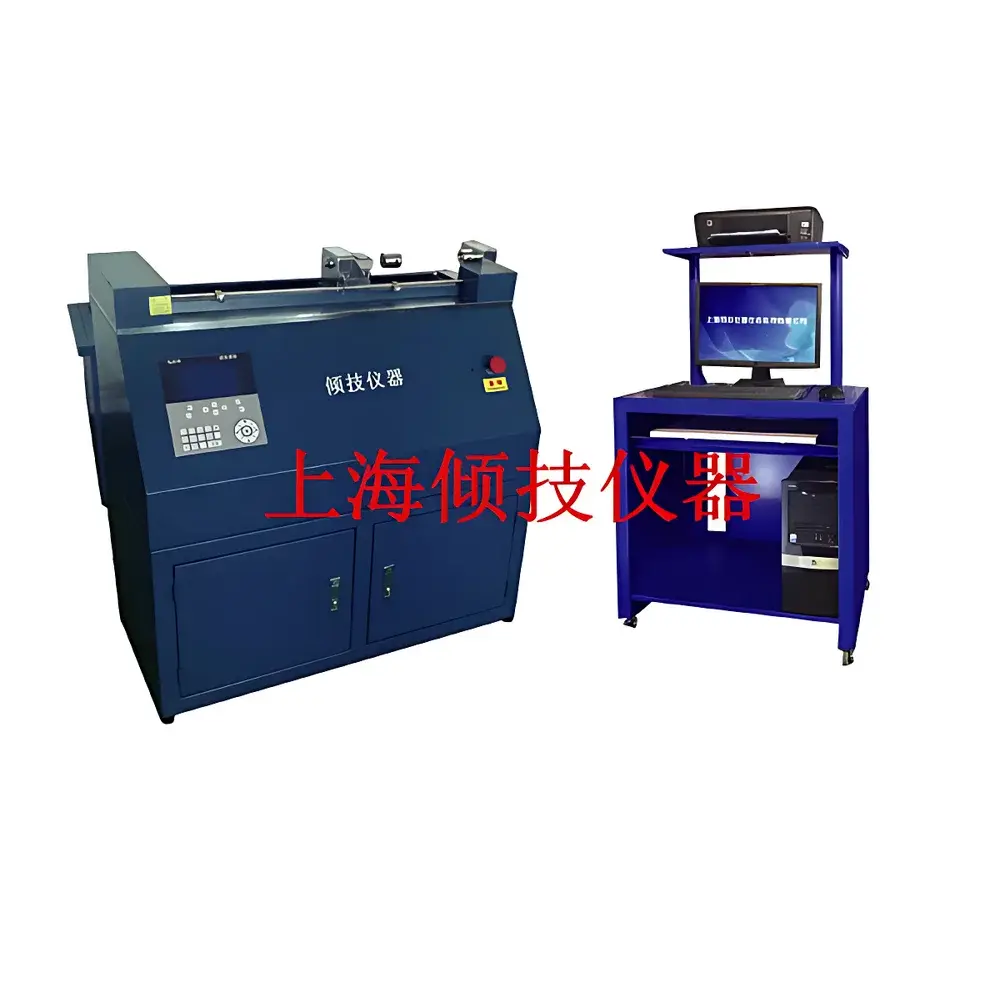
Horizontal Terminal Pull-Off and Peel Testing Machine
| Key | Origin: Shanghai, China |
|---|---|
| Manufacturer Type | Authorized Distributor |
| Product Origin | Domestic (PRC) |
| Model | Pull-Off |
| Instrument Type | Electromechanical Universal Testing Machine |
| Load Capacity | 10 kN |
| Load Cell Accuracy | ±0.01% FS |
| Force Measurement Accuracy | ±0.5% of reading |
| Test Speed Range | 0.001–300 mm/min |
| Effective Test Stroke | ≥200 mm |
| Power Supply | AC 220 V, 50/60 Hz |
| Dimensions (W×D×H) | 600 × 300 × 300 mm |
| Weight | ~40 kg |
Overview
The Horizontal Terminal Pull-Off and Peel Testing Machine is an electromechanical universal testing system engineered specifically for quantitative mechanical evaluation of retention strength in electrical interconnects and adhesive interfaces. Designed to comply with standardized test methodologies including IEC 60512-2, IPC-TM-650 2.4.1, USCAR-21, and ISO 11339, this horizontal-configured tester applies controlled tensile force along the axis of terminal engagement—mimicking real-world disengagement conditions encountered during assembly, service, or environmental stress. Unlike vertical testers, its horizontal layout eliminates gravitational interference on delicate specimens (e.g., crimped wire terminals, PCB-mounted connectors, or thin-film adhesive bonds), ensuring high reproducibility in low-force peel and pull-off measurements. The system employs a precision-ground ball screw actuator driven by a servo-motor, coupled with a calibrated load cell traceable to national metrology standards, enabling stable force application across sub-newton to 10 kN ranges.
Key Features
- Horizontal loading architecture optimized for axial pull-off testing of wire harness terminals, automotive connectors, and surface-mount device (SMD) solder joints
- High-resolution load cell with ±0.01% full-scale accuracy and digital signal conditioning compliant with ASTM E4 and ISO 7500-1 Class 0.5 requirements
- Adjustable crosshead speed from 0.001 mm/min (for creep-sensitive adhesives) up to 300 mm/min (for rapid qualification screening), programmable in closed-loop velocity control
- Integrated 7-inch TFT-LCD controller with real-time graphical display of force–displacement curves, peak load capture, and automatic yield point detection
- Rigid structural frame fabricated from CNC-machined steel with powder-coated enclosure, designed for long-term dimensional stability under cyclic loading
- Standard RS-232 and USB 2.0 interfaces for bidirectional communication with Windows-based PC software supporting data export in CSV, PDF, and XML formats
Sample Compatibility & Compliance
This tester accommodates a broad range of specimen geometries without reconfiguration: insulated or bare wire terminations (AWG 30–8), molded plastic housings (e.g., AMPMODU, Molex Mini-Fit), LED lamp bases, flexible printed circuit (FPC) connectors, and pressure-sensitive adhesive (PSA) tapes per ASTM D3330 and PSTC-101. Fixture adaptability includes interchangeable pneumatic clamps, wedge grips, and custom-designed terminal holders certified to UL 486E and EN 60998-2-1 mechanical retention criteria. All hardware and firmware meet CE marking requirements under the Machinery Directive 2006/42/EC and EMC Directive 2014/30/EU. Calibration certificates are provided with NIST-traceable documentation.
Software & Data Management
The included PC software supports GLP-compliant operation with user-level access control, electronic signature capability, and full audit trail functionality aligned with FDA 21 CFR Part 11 Annex 11 expectations. Test methods can be saved as reusable templates—including pre-defined ramp-hold cycles, multi-step sequences, and pass/fail logic based on force thresholds or displacement limits. Raw data files retain metadata such as operator ID, environmental temperature/humidity (via optional sensor input), calibration date, and instrument serial number. Reporting modules generate ISO/IEC 17025-compliant test reports with embedded statistical summaries (mean, SD, CV%, min/max) and graphical overlays for comparative analysis across batches or material lots.
Applications
- Quantitative validation of crimp joint integrity per SAE J1920 and IPC-A-610 Class 3 acceptance criteria
- Peel strength assessment of conformal coatings and die-attach adhesives used in automotive ECUs
- Retention force measurement of USB-C and HDMI receptacles subjected to repeated mating cycles
- Quality assurance of medical device cable assemblies (ISO 13485 environments) where terminal pull-out resistance directly impacts patient safety
- Process development support for ultrasonic welding parameters in battery tab bonding applications
- Supplier qualification testing for Tier-1 automotive harness suppliers requiring PPAP submission packages
FAQ
Is this machine suitable for testing micro-connectors with sub-1N pull-off forces?
Yes—the load cell’s resolution and low-speed capability (0.001 mm/min) enable precise measurement down to 0.05 N with <±0.5% linearity error.
Does the system support automated batch testing with pass/fail decision logic?
Yes—programmable test sequences include conditional branching, tolerance band enforcement, and auto-generated non-conformance alerts.
Can the machine be integrated into a factory MES or QMS platform?
Yes—OPC UA and Modbus TCP protocols are supported via optional industrial communication module for real-time data streaming to Siemens SIMATIC or Rockwell FactoryTalk systems.
What maintenance intervals are recommended for long-term accuracy retention?
Load cell recalibration is advised annually; ball screw lubrication and grip jaw inspection should occur every 6 months or after 5,000 test cycles, whichever comes first.
Are custom fixtures available for proprietary connector designs?
Yes—our engineering team provides fixture design consultation and rapid prototyping (CNC aluminum or 3D-printed polymer) validated against your CAD models and functional test specifications.



