
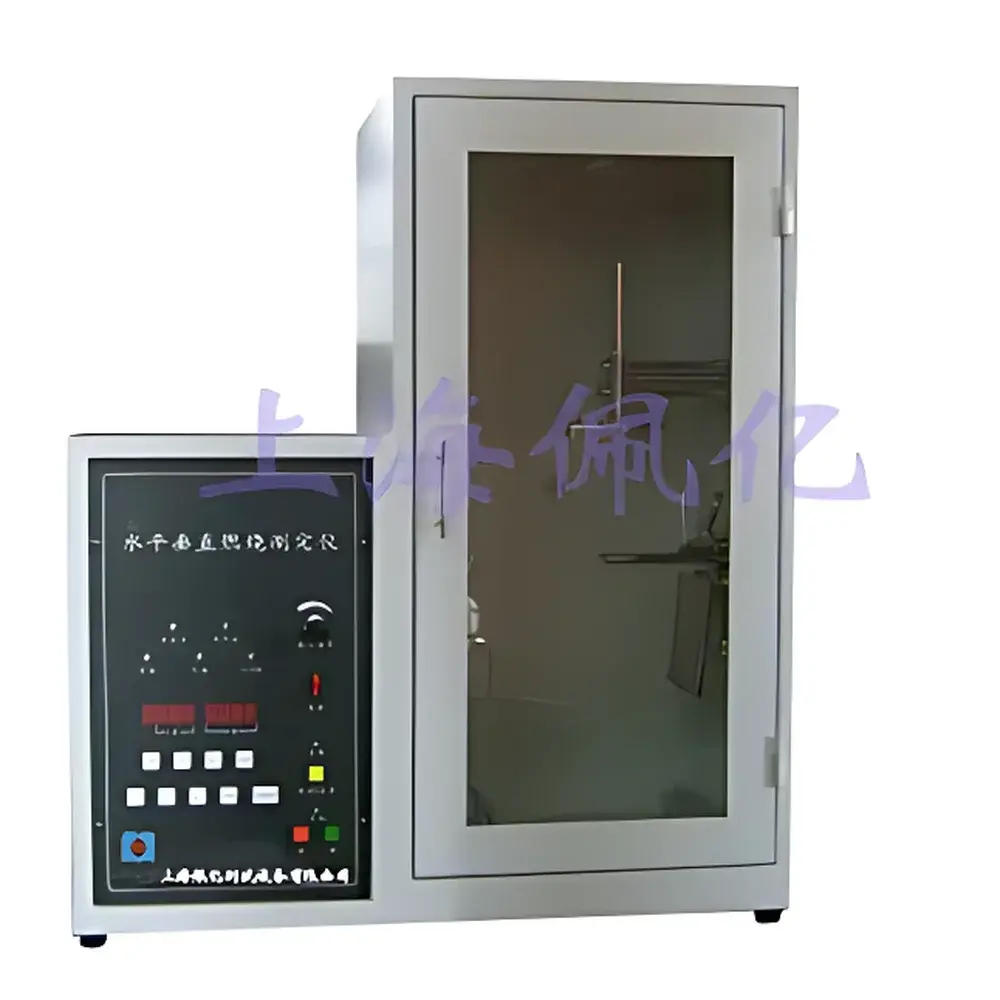
Horizontal and Vertical Burning Tester PY-SP01 by Peiyi
| Brand | Peiyi |
|---|---|
| Model | PY-SP01 |
| Standard Compliance | GB/T 2408–1996, GB 5455–1985, GB 2408–1980, GB 4609–1984 |
| Flame Application Time Options | 10 s, 12 s, 30 s (±0.2 s accuracy) |
| Bunsen Burner Inner Diameter | 9.5 mm ± 0.3 mm |
| Adjustable Burner Tilt Angle | 0–45° |
| Adjustable Blue Flame Height | 15–45 mm |
| Specimen Clamp Max Thickness Capacity | ≤13 mm |
| Vertical Clamp Travel Range | ≤100 mm |
| Horizontal Clamp Travel Range | ≤70 mm |
| Horizontal Clamp Foldable Angle | 90° |
| Fuel Compatibility | Methane, Natural Gas, Liquefied Petroleum Gas (LPG), Town Gas |
Overview
The Peiyi PY-SP01 Horizontal and Vertical Burning Tester is a precision-engineered laboratory instrument designed to evaluate the flammability characteristics of polymeric and textile materials under controlled small-flame ignition conditions. It operates in strict accordance with the principles defined in ISO 5657 (equivalent technical basis for GB/T 2408–1996) and ASTM D3801, implementing the standardized horizontal (HB) and vertical (V-0, V-1, V-2) burning test protocols. The device subjects conditioned specimens to a calibrated Bunsen burner flame—adjusted to specified height and stoichiometry—for predetermined durations, then quantifies critical fire-response parameters including afterflame time (AFT), afterglow time (AGT), and char length (burn distance). Its microcontroller-based architecture ensures repeatable flame exposure timing, consistent burner positioning, and objective endpoint detection—essential for comparative flame-retardancy grading in R&D, quality assurance, and regulatory compliance workflows.
Key Features
- Microprocessor-controlled test sequence with automatic start/stop triggering upon flame application and extinction detection
- Precise flame duration selection: 10 s, 12 s, or 30 s, with timing accuracy maintained within ±0.2 s via high-stability quartz oscillator circuitry
- Adjustable Bunsen burner assembly featuring ±0.3 mm tolerance on inner diameter (9.5 mm) and fine-threaded vertical/horizontal translation stages for reproducible specimen-to-flame geometry
- Calibrated blue flame height adjustment (15–45 mm) supported by integrated stainless-steel scale ruler and pre-aligned gas flow regulator
- Dual-axis specimen holder system: vertical travel up to 100 mm and horizontal travel up to 70 mm, enabling precise alignment relative to burner tip per standard specimen orientation requirements
- Modular clamp design accommodating rigid plastics (max thickness 13 mm) and flexible textiles via optional textile-specific fixture kit
- Integrated audible alarm signaling flame withdrawal completion and test termination
- Non-volatile memory storage of up to 99 test records with timestamp, flame duration, AFT, AGT, and char length values
Sample Compatibility & Compliance
The PY-SP01 supports standardized test specimens per GB/T 2408–1996 (plastics), GB 5455–1985 (textiles), and harmonized methodologies referenced in UL 94, IEC 60695-11-10, and EN 60695-11-10. Specimens include injection-molded bars (125 × 13 × 3.2 mm), extruded sheets, foams, and woven/nonwoven fabrics mounted on rigid backings. The instrument’s mechanical repeatability and flame stability meet GLP documentation requirements for audit-ready testing environments. All operational parameters—including burner angle (0–45°), flame height, and gas supply pressure—are traceable to internal calibration logs, supporting ISO/IEC 17025-compliant laboratory accreditation.
Software & Data Management
While the PY-SP01 operates as a standalone benchtop unit with embedded firmware, its data output interface (RS-232 or optional USB-to-serial adapter) enables seamless integration with laboratory information management systems (LIMS). Stored test records export in CSV format for post-processing in Excel, MATLAB, or statistical analysis platforms. Timestamped entries include operator ID field (manually entered), ambient temperature/humidity metadata (via external sensor input), and pass/fail flags aligned with UL 94 classification thresholds. Audit trail functionality complies with FDA 21 CFR Part 11 requirements when paired with validated third-party data capture software.
Applications
- Flame-retardant additive formulation screening for engineering thermoplastics (e.g., PC/ABS, PP, PA66)
- Comparative evaluation of halogen-free vs. brominated flame retardants in cable jacketing compounds
- Pre-certification testing for UL 94 HB, V-0, V-1, and V-2 ratings prior to formal third-party submission
- Quality control of flame-resistant workwear textiles per GB 5455–1985 and NFPA 2112
- Fire safety assessment of interior automotive components (dashboards, seat trims, insulation foams)
- Academic research on pyrolysis kinetics and char-forming behavior under piloted ignition
FAQ
What fuel gases are compatible with the PY-SP01?
Methane, natural gas, liquefied petroleum gas (LPG), and town gas—all supplied at regulated pressure (typically 1.5–2.5 kPa) via certified regulators and flashback arrestors.
Is the instrument suitable for UL 94 certification testing?
Yes, when operated strictly per UL 94 Section 5 (Horizontal Burning) and Section 6 (Vertical Burning), using calibrated burners and traceable environmental monitoring; final certification requires testing in an ILAC-accredited laboratory.
Can test data be exported for regulatory reporting?
Yes—CSV exports include all measured parameters, timestamps, and operator inputs, supporting traceability for ISO 9001, IATF 16949, and REACH documentation packages.
Does the system support automated pass/fail judgment?
It displays real-time AFT, AGT, and char length; pass/fail logic must be applied externally per applicable standard criteria (e.g., UL 94 V-0: AFT ≤ 10 s, total AFT ≤ 50 s, no dripping igniting cotton).
What maintenance is required for long-term accuracy?
Quarterly verification of burner orifice diameter (with go/no-go gauge), annual calibration of timer circuitry against NIST-traceable stopwatch, and biannual inspection of gas line integrity and seal condition.



