
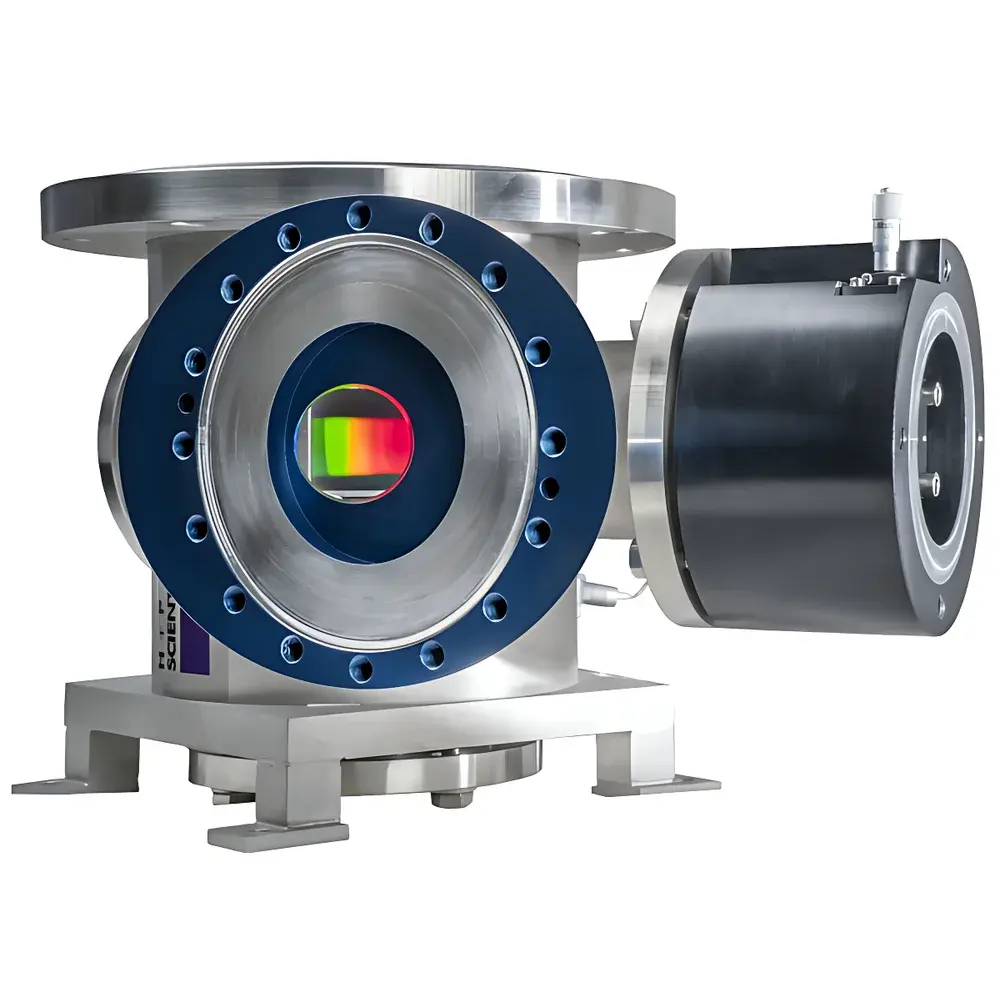
HP Spectroscopy easyLIGHT VUV Compact Vacuum Ultraviolet Spectrometer
| Brand | HP Spectroscopy |
|---|---|
| Origin | Germany |
| Type | Aberration-Corrected Normal-Incidence Spectrometer |
| Wavelength Range | 80–300 nm |
| Vacuum Compatibility | <10⁻⁶ mbar (UHV version available) |
| Slit Width | 0–4 mm (manual or motorized) |
| Grating Positioning | Closed-loop motorized stage |
| Dispersion | ~2.5 nm/mm |
| Resolution | <0.1 nm |
| Wavelength Accuracy | <0.05 nm |
| Deviation Angle | 64° |
| f/# | 4.2 |
| Detector Options | VUV-optimized CCD, MCP, CMOS, or PMT |
| Data Interface | USB or Ethernet |
| Software Support | Windows GUI + LabVIEW, VB, C, C++ SDK |
| Optional Features | Filter insertion unit, non-magnetic construction, rotational geometry |
Overview
The HP Spectroscopy easyLIGHT VUV Compact Vacuum Ultraviolet Spectrometer is an aberration-corrected, normal-incidence spectrometer engineered for high-fidelity spectral acquisition in the demanding vacuum ultraviolet (VUV) region (80–300 nm). Unlike conventional grazing-incidence or off-axis designs, its optimized optical architecture minimizes astigmatism and coma across the full operational range, delivering superior image quality and photometric accuracy at wavelengths where atmospheric absorption and detector quantum efficiency pose fundamental challenges. The instrument operates under ultra-high vacuum (UHV) conditions (<10⁻⁶ mbar), eliminating oxygen and water vapor absorption bands that otherwise obscure critical spectral features below 190 nm. Its compact, modular footprint—measuring less than 300 × 200 × 150 mm—enables seamless integration into constrained experimental environments, including space-qualified LIBS testbeds, plasma diagnostics chambers, and synchrotron beamlines. The core optical path employs a single, high-efficiency holographic grating with peak diffraction efficiency exceeding 43% at 121.6 nm (Lyman-α), significantly enhancing signal-to-noise ratio without compromising resolution or wavelength fidelity.
Key Features
- Aberration-corrected normal-incidence optical design ensures uniform spectral focus and minimal line broadening across 80–300 nm
- Closed-loop motorized grating positioning enables sub-0.01 nm wavelength repeatability and long-term stability under thermal drift
- Continuously variable entrance/exit slits (0–4 mm), manually or motorized, supporting both high-throughput and high-resolution measurement modes
- Three auxiliary vacuum ports facilitate direct integration of turbomolecular pumps, capacitance manometers, and feedthroughs for laser or electrical diagnostics
- Slitless operation mode available for maximum light throughput in low-flux applications such as pulsed plasma emission
- Modular detector interface accommodates interchangeable VUV-optimized sensors: back-thinned CCD (highest spatial resolution and dynamic range), microchannel plate (MCP) intensified arrays (nanosecond gating capability), CMOS detectors (broadband coverage up to 300 nm), or side-on PMTs (for scanning-based intensity calibration)
- UHV-compatible construction using non-magnetic stainless steel and metal-sealed flanges; optional non-magnetic configuration available for magnetic confinement experiments
Sample Compatibility & Compliance
The easyLIGHT VUV is designed for gas-phase, plasma, and laser-ablated sample analysis under controlled vacuum environments. It complies with ISO 17025 requirements for calibration traceability when used with NIST-traceable VUV emission standards (e.g., deuterium lamp lines at 121.6 nm, 164.0 nm). Its mechanical and vacuum integrity meets ASTM E2913-19 specifications for UHV optical instrumentation. For regulated environments—including GLP-compliant materials characterization labs and space instrumentation development facilities—the system supports audit-ready data logging via timestamped metadata embedding (wavelength, slit width, integration time, detector gain, vacuum pressure). Full 21 CFR Part 11 compliance is achievable through optional software validation packages, including electronic signature enforcement and immutable audit trails for all parameter changes and spectral acquisitions.
Software & Data Management
The instrument ships with a native Windows-based GUI offering real-time spectrum preview, multi-channel background subtraction, and wavelength calibration using known atomic emission lines (He, Ne, Ar). A comprehensive SDK provides native drivers for LabVIEW, Visual Basic, and C/C++, enabling custom automation of sequential measurements, pump-probe delay scans, or closed-loop feedback control in plasma stabilization setups. All spectra are saved in HDF5 format with embedded metadata compliant with the IUPAC Spectral Data Exchange Standard (SDX-1.2). Raw data streams support direct ingestion into Python-based analysis pipelines (e.g., SciPy, Astropy) for line-fitting, Boltzmann plot analysis, or principal component regression of time-resolved plasma decay profiles.
Applications
- Laser-induced breakdown spectroscopy (LIBS) in planetary surface simulation—demonstrated detection of sulfur at 0.5 at.% in lunar regolith analogs using VUV-emission lines at 92.4 nm and 180.7 nm
- Time-resolved plasma diagnostics: measurement of excited-state kinetics in fusion-relevant hydrogen/deuterium plasmas via Lyman series monitoring
- VUV photochemistry studies: quantification of radical intermediates (e.g., OH*, O*, N*) in low-pressure reaction chambers
- Calibration source characterization: spectral validation of synchrotron bending magnet outputs and laser harmonic generators
- Space instrument prototyping: qualification of optical coatings, gratings, and detectors for upcoming ESA Mars missions and NASA Artemis payloads
FAQ
What vacuum level is required for stable operation below 115 nm?
Operation below 115 nm requires sustained pressure ≤5×10⁻⁷ mbar to suppress O₂ Schumann–Runge absorption; standard configuration achieves <10⁻⁶ mbar with integrated turbomolecular pumping.
Can the easyLIGHT VUV be retrofitted with a different grating for extended range?
Yes—grating exchange is supported via standardized kinematic mounts; HP Spectroscopy offers custom blazed gratings for optimized efficiency at specific lines (e.g., 102.6 nm for He II, 97.3 nm for H-Lyman-β).
Is remote operation supported over Ethernet in industrial cleanroom environments?
Yes—Ethernet interface includes deterministic packet timing, hardware-triggered acquisition, and TLS-encrypted command protocol for secure integration into factory automation networks.
How is wavelength calibration maintained during thermal cycling?
Closed-loop grating positioning combined with on-board temperature-compensated reference diode monitoring ensures <0.05 nm absolute accuracy across ±5°C ambient fluctuations.
Are OEM integration services available for embedding into larger analytical platforms?
Yes—HP Spectroscopy provides mechanical CAD models, API documentation, and joint design reviews for turnkey integration into mass spectrometers, plasma etch tools, or spaceflight payloads.
Related Products




