
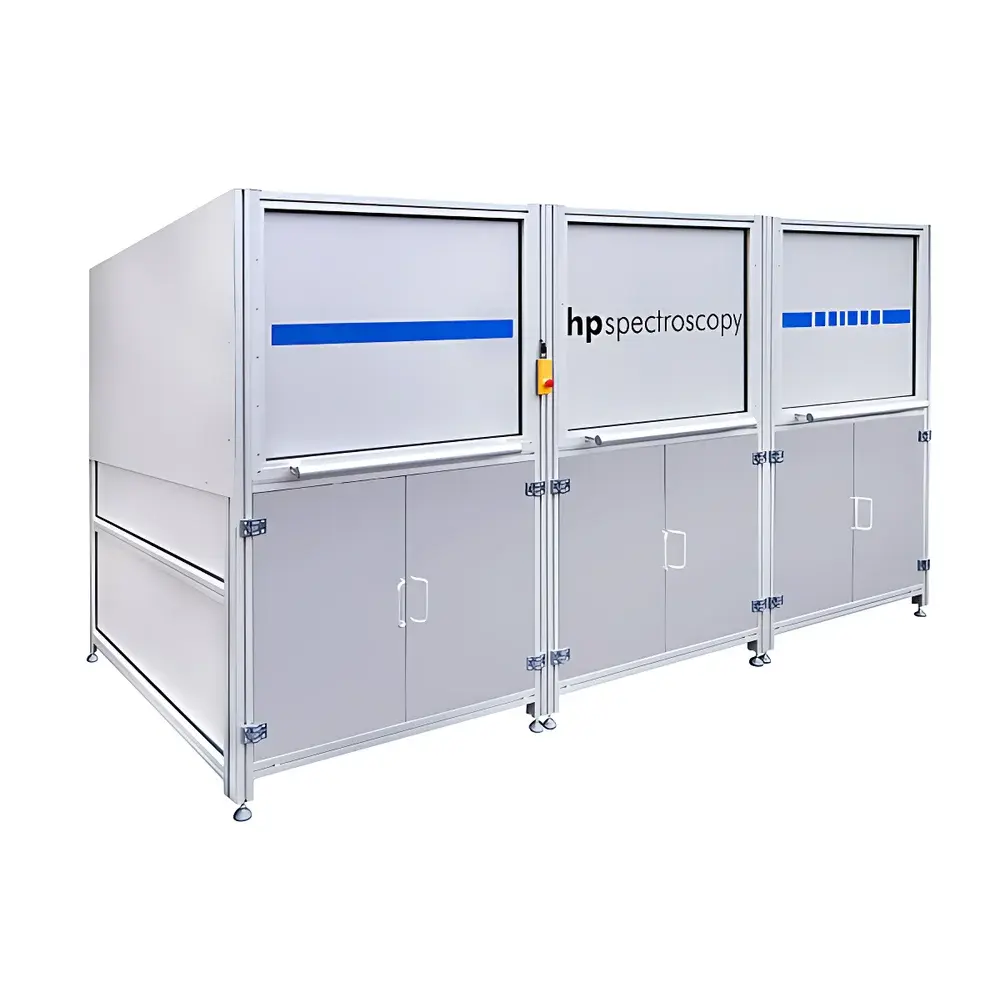
HP Spectroscopy hiXAS Benchtop X-ray Absorption Fine Structure (XAFS) Spectrometer
| Brand | HP Spectroscopy |
|---|---|
| Origin | Germany |
| Manufacturer Type | Authorized Distributor |
| Import Status | Imported |
| Model | hiXAS |
| X-ray Energy Range | 5–12 keV |
| Minimum Detectable Element Concentration | Low to several wt% |
| XAFS Acquisition Time | 3–8 min (depending on sample concentration and normalization requirements) |
| Spectral Resolution (E/ΔE) | Constant 4000 across full energy range |
| Detector | Photon-counting pixelated X-ray detector |
| Monochromator | HAPG-based von Hamos geometry spectrometer |
| Footprint | 2.0 m × 1.0 m |
| Sample Handling | Motorized sample wheel with multi-position mounting |
Overview
The HP Spectroscopy hiXAS is a laboratory-scale, benchtop X-ray Absorption Fine Structure (XAFS) spectrometer engineered for high-fidelity EXAFS (Extended X-ray Absorption Fine Structure) and XANES (X-ray Absorption Near Edge Structure) measurements without reliance on synchrotron radiation facilities. It operates on the fundamental principle of core-level X-ray absorption spectroscopy: monochromatic X-rays are scanned across an element-specific absorption edge, and the resulting fine structure in the absorption coefficient—arising from backscattering of photoelectrons from neighboring atoms—is recorded and quantitatively analyzed to extract local structural parameters including coordination numbers, bond distances, disorder (Debye–Waller factor), and oxidation state. The system integrates a sealed-tube X-ray source, a high-efficiency HAPG (Highly Annealed Pyrolytic Graphite) von Hamos spectrometer, and a photon-counting pixelated detector into a compact 2.0 m × 1.0 m footprint. Its 5–12 keV operational energy window encompasses K-edges of first-row transition metals (e.g., Fe, Co, Ni, Cu, Zn), making it particularly suited for catalysis, battery materials, environmental speciation, and geochemical research where metal-centered coordination chemistry is central.
Key Features
- Lab-based XAFS capability eliminating dependence on synchrotron beamtime allocation and scheduling delays
- HAPG-based von Hamos spectrometer delivering constant spectral resolution of E/ΔE = 4000 across the entire 5–12 keV range
- Photon-counting pixelated detector enabling high dynamic range, low-noise detection, and efficient dead-time correction
- Motorized sample wheel supporting up to 12 heterogeneous solid or powder samples with automated positioning and alignment
- Optimized optical design achieving signal-to-noise ratios comparable to third-generation synchrotron beamlines for diluted samples (≥ few wt% elemental concentration)
- Robust mechanical architecture with active thermal stabilization for long-term spectral reproducibility and drift mitigation
Sample Compatibility & Compliance
The hiXAS accommodates a broad range of sample forms—including pressed pellets, thin films, foils, powders, and frozen solutions—without requiring vacuum compatibility for routine operation (ambient He or N₂ purge optional). All components conform to IEC 61000 electromagnetic compatibility standards and meet EU Machinery Directive 2006/42/EC safety requirements. Data acquisition and processing workflows support audit-ready documentation aligned with GLP (Good Laboratory Practice) and ISO/IEC 17025 traceability frameworks. While not intrinsically 21 CFR Part 11 compliant, the software architecture permits integration with validated electronic lab notebook (ELN) systems for regulated environments upon customer-specific qualification.
Software & Data Management
The integrated control and analysis suite provides unified instrument orchestration, real-time spectrum visualization, energy calibration (using reference foils such as Cu, Ni, or Fe), background subtraction, μ(E) normalization, and Fourier transform analysis. Preconfigured modules support standard EXAFS fitting using FEFF-based theoretical scattering paths and Artemis-compatible input generation. All raw and processed data are stored in HDF5 format with embedded metadata (energy step, dwell time, sample ID, detector gain, monochromator angle), ensuring FAIR (Findable, Accessible, Interoperable, Reusable) principles. Batch processing scripts and Python API access enable automation of repetitive analyses and integration into larger data pipelines.
Applications
- Chemical speciation of transition metals in heterogeneous catalysts under operando or ex situ conditions
- Quantitative determination of oxidation state distributions in mixed-valence battery electrode materials (e.g., Mn, Ni, Co in layered oxides)
- Local coordination environment mapping in amorphous or nanocrystalline metal–organic frameworks (MOFs) and single-atom catalysts
- Short-range order analysis in glassy alloys and melt-quenched metallic systems
- Environmental speciation of heavy metals (e.g., As, Cr, Se) in soils, sediments, and biochar matrices
- Validation of DFT-predicted structures through experimental bond-length and coordination-number constraints
FAQ
Does the hiXAS require cryogenic cooling or ultra-high vacuum?
No. The system operates under ambient or inert-gas-purged conditions; vacuum is optional and only recommended for highly air-sensitive samples or enhanced signal-to-noise in low-energy regions.
Can the hiXAS measure L-edges of heavier elements?
Not within its standard configuration. The 5–12 keV range covers K-edges up to Cd (26.7 keV) only partially; L₃-edges of elements like Pt (11.5 keV) or Ir (11.2 keV) fall near the upper limit but require customized detector calibration and extended acquisition times.
How is energy calibration performed and maintained?
Calibration uses certified metal foil standards (e.g., Cu K-edge at 8979 eV) mounted on the sample wheel. A motorized stage enables automatic insertion during setup; daily verification is supported via internal reference spectra and linear interpolation algorithms.
Is remote operation supported?
Yes. The control software includes secure SSH-based remote desktop access and RESTful API endpoints for triggering acquisitions, retrieving spectra, and monitoring instrument status in real time.
What level of expertise is required to interpret EXAFS data generated by hiXAS?
Basic training in XAFS theory and data reduction (e.g., Athena/Artemis workflows) is recommended. HP Spectroscopy offers application-specific workshops and co-analysis support contracts for method development and validation.




