
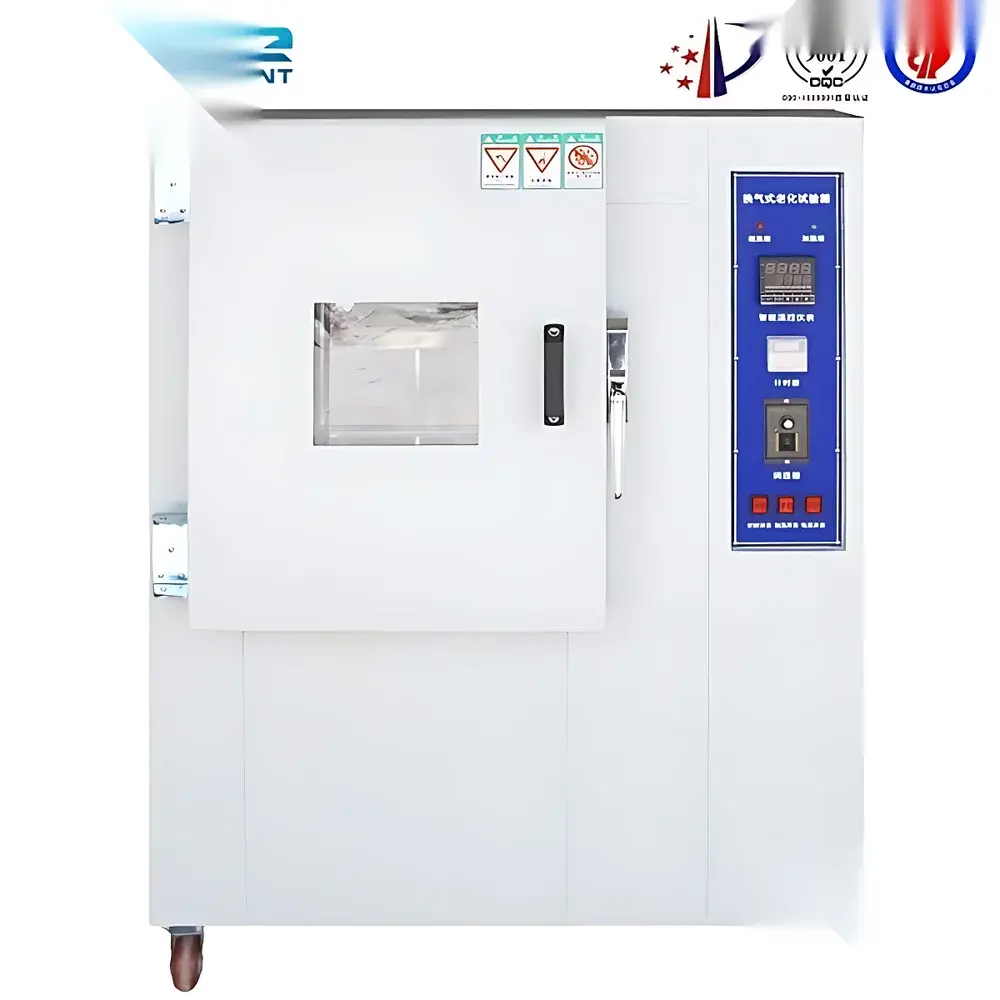
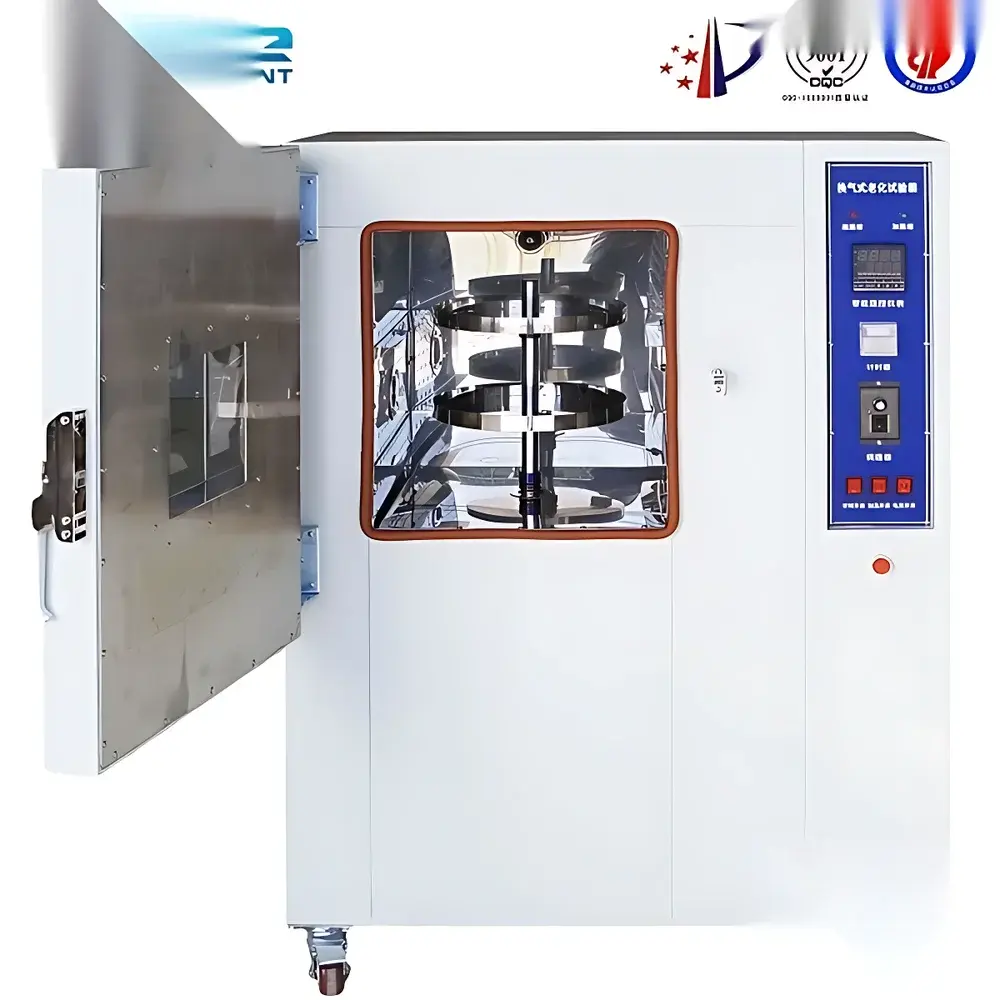
OK-HQ Series Forced-Air Thermal Aging Test Chamber
| Brand | OK Instruments |
|---|---|
| Origin | Imported |
| Manufacturer Type | Authorized Distributor |
| Temperature Range | RT+10°C to 200°C / 300°C |
| Temperature Uniformity | ±2°C |
| Temperature Stability | ±0.5°C |
| Air Exchange Rate | 2–100 cycles/hour (measurable and adjustable at 80°C) |
| Air Exchange Timing | 1 min – 99 h programmable |
| Internal Dimensions (L×W×H, mm) | 450×450×500 to 800×1000×1000 |
| Power Consumption | 4.0–9.0 kW |
| Rotating Sample Platform | Ø250–Ø700 mm, 8–10 rpm |
| Compliance | ASTM D5423-09 (Type II), ASTM D5374-05, UL 1581, IEC 60811, JIS K7212, GB/T 2951, VDE 0472 |
Overview
The OK-HQ Series Forced-Air Thermal Aging Test Chamber is an engineered environmental simulation system designed for accelerated thermal aging evaluation of polymeric, elastomeric, and insulating materials under controlled, continuously refreshed atmospheric conditions. Based on the principle of forced convection and regulated air exchange, the chamber maintains precise temperature profiles while dynamically replacing internal air at user-defined rates—critical for replicating real-world oxidative degradation mechanisms in cables, wire insulation, rubber compounds, textiles, and plastic components. Unlike static ovens, this system complies with ASTM D5423-09 (Type II) requirements for laboratory forced-ventilation ovens used in electrical insulation testing, ensuring thermally stable, reproducible aging environments where oxygen replenishment directly influences oxidation kinetics. Its architecture supports both short-term qualification tests and long-duration stability studies under standardized thermal stress protocols.
Key Features
- High-precision microprocessor-based PID controller with LED digital display, offering 0.1°C resolution for both setpoint and actual temperature indication.
- Forced horizontal airflow system featuring high-temperature-resistant centrifugal blower and dual-side baffle-adjusted ducting to achieve ±2°C temperature uniformity across the working chamber.
- Dual-mode air exchange control: programmable cycle timing (1 minute to 99 hours) and adjustable volumetric exchange rate (2–100 air changes per hour), calibrated per JIS K7212 via integrated digital watt-hour meter and timer.
- Robust stainless steel (SUS304) interior chamber with argon-arc welded seams and electrophoretic A3 steel exterior with powder coating for corrosion resistance and cleanroom-compatible surface integrity.
- Insulated construction using ultra-fine glass fiber blanket (≥100 mm thickness) minimizing thermal leakage and energy consumption during extended operation.
- Rotating sample platform (Ø250–Ø700 mm, 8–10 rpm) with detachable design to ensure uniform thermal exposure of cylindrical or asymmetrical specimens.
- Multi-safety architecture including over-temperature cut-off, motor overheat protection, leakage current interruption, short-circuit suppression, and visual status indicators for all operational modes.
- Standard 50 mm diameter test port (left side), multi-layer vacuum-insulated observation window with halogen lighting, and lockable casters for lab mobility and positioning.
Sample Compatibility & Compliance
The OK-HQ chamber accommodates a broad range of specimen geometries—including insulated wires, cable jackets, rubber sheets, textile laminates, and molded polymer parts—without requiring custom fixtures. Its validated airflow dynamics and thermal homogeneity meet the spatial and temporal criteria defined in ASTM D5374-05 (Standard Practice for Electrical Insulation Thermal Aging) and UL 1581 (Reference Standard for Wire and Cable). It further satisfies test condition requirements for IEC 60811-1-2 (polymeric insulations), GB/T 2951.12 (Chinese national standard for cable aging), VDE 0472 Part 812, and JIS C 3005. All models undergo factory verification per ISO/IEC 17025-aligned calibration procedures for temperature uniformity and air exchange rate traceability.
Software & Data Management
While the base configuration employs a standalone LED/PID controller, optional RS485 communication interface enables integration with centralized lab data acquisition systems (e.g., LabVIEW, SCADA, or LIMS platforms). The built-in digital watt-hour meter and timer provide auditable records for air exchange rate calculation per JIS K7212 methodology—supporting GLP-compliant documentation workflows. All safety interlocks and operational states are logged via discrete relay outputs, facilitating 21 CFR Part 11–compatible electronic record generation when paired with validated third-party software.
Applications
- Accelerated aging of PVC, PE, XLPE, EPR, and silicone rubber insulation in wire & cable manufacturing QA/QC labs.
- Oxidative stability assessment of automotive gaskets, under-hood hoses, and elastomeric seals per SAE J2045.
- Thermal endurance classification of insulating materials per IEC 60216 and IEEE 98.
- Pre-compliance screening for UL, CSA, and CE marking of low-voltage wiring systems.
- Material shelf-life modeling and Arrhenius-based lifetime extrapolation studies.
FAQ
What standards does the OK-HQ chamber specifically support for wire insulation testing?
It meets ASTM D5423-09 (Type II oven specification), ASTM D5374-05, UL 1581 Section 1060, and IEC 60811-1-2 for thermal aging of electric cables.
Can air exchange rate be verified independently of the built-in watt-hour meter?
Yes—JIS K7212 permits validation using tracer gas (e.g., CO₂) dilution methods; the chamber’s sealed construction and calibrated inlet/outlet ports support such third-party verification.
Is the rotating platform compatible with weight-bearing samples?
The turntable is rated for ≤5 kg distributed load at full speed; heavier loads require static placement on fixed shelves.
Does the chamber support ramp-and-soak temperature profiling?
No—the standard controller supports only single-setpoint operation with timer-based dwell; multi-step profiling requires optional programmable controller upgrade.
What maintenance intervals are recommended for sustained accuracy?
Calibration of temperature sensors and air exchange verification are advised every 6 months or after 500 operational hours, per ISO/IEC 17025 guidance.



