
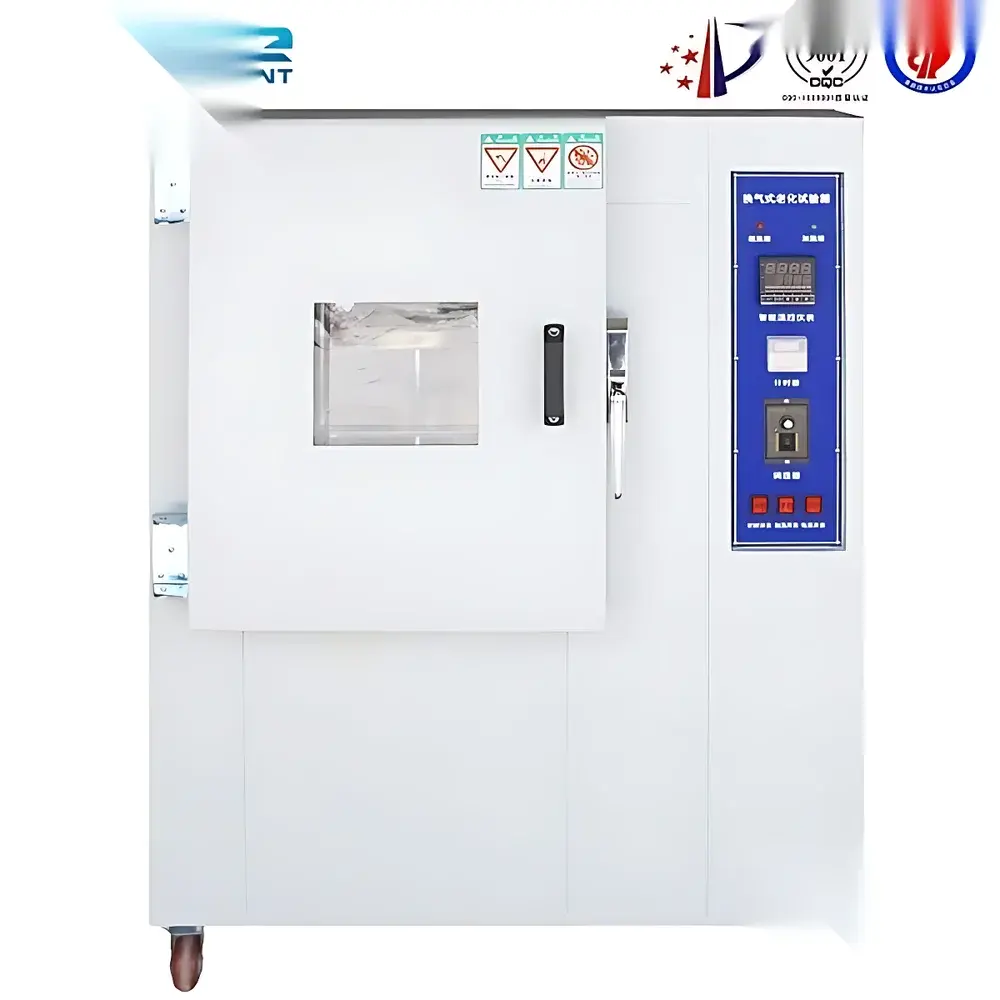
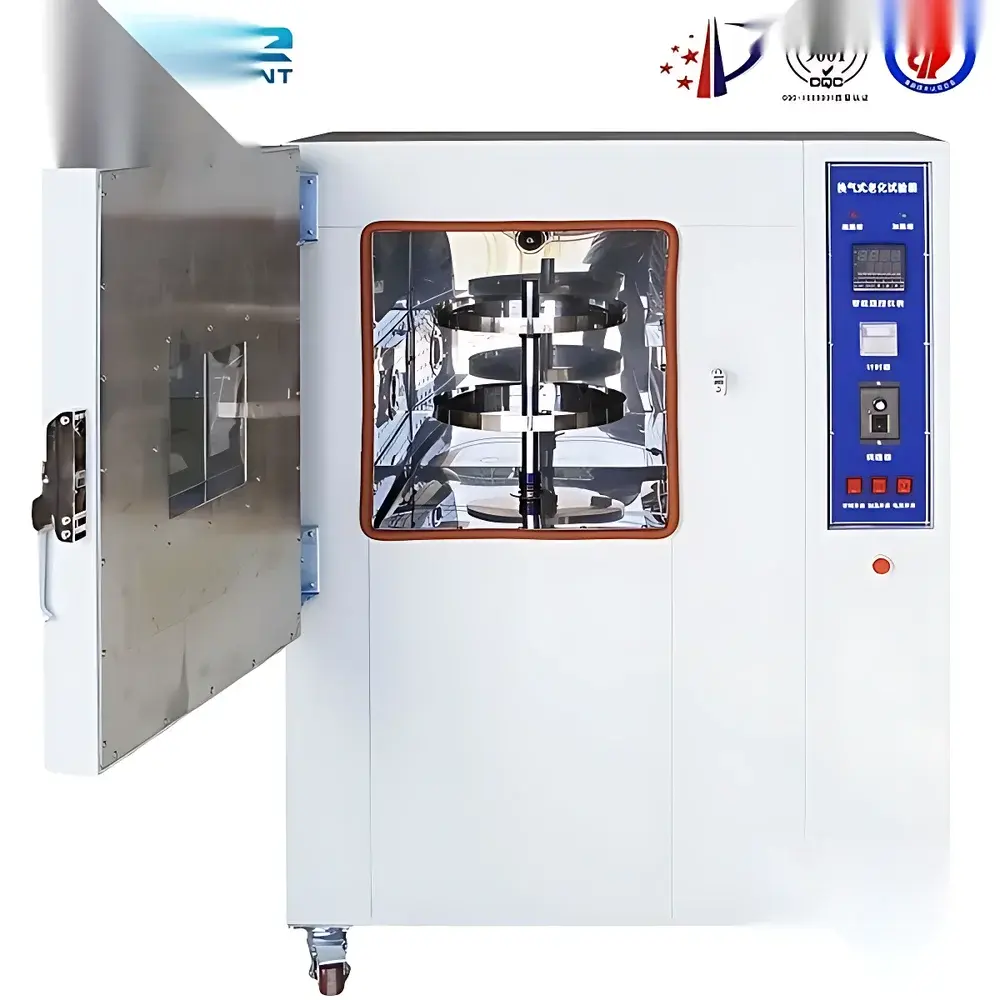
OK-HQ Series High-Temperature Cycling Aging Test Chamber
| Brand | Other Brands |
|---|---|
| Origin | Imported |
| Manufacturer Type | Authorized Distributor |
| Price | USD 2,700 (Reference Only) |
| Temperature Range | RT+10°C to 200°C / 300°C |
| Temperature Uniformity | ±2°C |
| Temperature Stability | ±0.5°C |
| Air Exchange Rate | 2–100 cycles/hour (measurable per JIS K 7212 at 80°C) |
| Air Exchange Timer | 1 min – 99 h adjustable |
| Power | 4.0–9.0 kW (model-dependent) |
| Internal Chamber Dimensions (W×D×H, mm) | 450×450×500 to 800×1000×1000 |
| Rotating Turntable Diameter | Φ250–Φ700 mm |
| Control System | LED Digital PID + SSR Microcomputer Controller |
| Compliance | ASTM D5423-09 (Type II), ASTM D5374-93(2005), UL 1581, IEC 60811, GB/T 2951, JIS C 3005, VDE 0472 |
Overview
The OK-HQ Series High-Temperature Cycling Aging Test Chamber is an engineered environmental simulation system designed for accelerated thermal aging evaluation of polymeric and elastomeric materials under controlled, repeatable air exchange conditions. Based on the principle of forced-convection thermal aging—where specimens are subjected to elevated temperatures while undergoing regulated ambient air replacement—the chamber replicates long-term service degradation mechanisms such as oxidation, chain scission, and crosslinking in electrical insulation, wire & cable sheathing, rubber compounds, textiles, and plastic components. Unlike static oven environments, this system incorporates a calibrated, traceable air exchange mechanism compliant with ASTM D5423-09 (Type II laboratory oven specification) and JIS K 7212 for quantitative air change rate determination via power consumption measurement. Its dual-zone airflow architecture—comprising horizontal forced circulation and side-mounted flow baffles—ensures spatial temperature uniformity within ±2°C across the working volume, critical for inter-laboratory reproducibility in QC/QA and R&D validation protocols.
Key Features
- Precision-engineered air exchange regulation system enabling programmable air renewal rates from 2 to 100 cycles per hour—calibrated per JIS K 7212 using integrated digital watt-hour meter and timer.
- Microcomputer-based PID + SSR temperature controller with 0.1°C resolution for both setpoint and display; ±0.5°C stability under steady-state operation.
- Horizontal forced-air circulation system with high-temperature-rated low-noise motor and multi-blade centrifugal impeller, ensuring uniform thermal distribution without hot/cold stratification.
- Stainless steel (SUS304) interior chamber with argon-arc welded seams and mirror-polished surface; A3 steel exterior with electrostatic powder coating for corrosion resistance and cleanroom-compatible hygiene.
- Removable rotating turntable (Φ250–Φ700 mm, 8–10 rpm) for dynamic exposure of cylindrical or asymmetrical specimens—standard with detachable mounting hardware.
- 50 mm diameter test port on left sidewall (with silicone gasket seal) for external power/signal line feedthrough during real-time monitoring or in-situ electrical testing.
- Multi-layer vacuum-insulated observation window with built-in halogen illumination for continuous visual assessment without thermal interruption.
- Comprehensive safety architecture: over-temperature cut-off, leakage current protection, motor overheat detection, short-circuit interruption, and audible/visual fault indication.
Sample Compatibility & Compliance
The OK-HQ chamber accommodates a broad range of non-volatile, thermally stable specimens—including insulated wires, molded rubber gaskets, PVC/PET film reels, textile laminates, and composite insulation tapes—without risk of outgassing interference or condensation-induced artifacts. Its design satisfies the mechanical and thermal performance criteria defined in ASTM D5423-09 (Type II forced-ventilation laboratory oven), ASTM D5374-93(2005), UL 1581 Section 1060 (heat aging of wire insulation), IEC 60811-1-2, GB/T 2951.12, JIS C 3005, and VDE 0472 Part 803. All units undergo factory calibration verification against NIST-traceable reference standards, and documentation supports GLP-compliant audit trails for ISO/IEC 17025-accredited laboratories.
Software & Data Management
While the base configuration employs a standalone LED digital controller with manual parameter entry, optional RS485/Modbus RTU interface enables integration into centralized lab data acquisition systems (e.g., LabVIEW, SCADA, or LIMS platforms). The embedded timer logs cumulative aging duration and air exchange cycles independently, supporting traceable recordkeeping aligned with FDA 21 CFR Part 11 requirements when paired with validated electronic signature modules. All operational events—including temperature deviations exceeding ±1.0°C, air exchange timing errors, or safety interlock activations—are timestamped and stored in non-volatile memory for post-test forensic review.
Applications
- Accelerated aging of automotive wiring harnesses per SAE J1128 and ISO 6722.
- Thermal endurance evaluation of photovoltaic module encapsulants (EVA, POE) per IEC 61215-2 MQT 10.
- Pre-qualification testing of aerospace-grade elastomers under MIL-DTL-83528C.
- QC release testing for medical device polymer housings (ISO 10993-12).
- Material screening for industrial conveyor belts, gaskets, and sealing compounds per DIN 7716.
FAQ
What standards does this chamber specifically meet for air exchange rate verification?
It complies with JIS K 7212 for indirect air change calculation via electrical power consumption measurement, and satisfies the airflow uniformity and temperature control requirements of ASTM D5423-09 (Type II) and UL 1581.
Can the turntable speed be adjusted beyond 8–10 rpm?
No—the standard motor-driven turntable operates at fixed 8–10 rpm for mechanical stability and thermal equilibrium preservation; variable-speed retrofitting is not supported due to torque and bearing thermal limitations.
Is the 50 mm test port rated for vacuum or pressure differential use?
No—it is designed solely for atmospheric-pressure signal/power line feedthrough; no pressure rating is assigned, and it must not be used under sub-atmospheric or overpressure conditions.
Does the chamber support automated data logging without external hardware?
The base controller stores only elapsed time and cycle count; full datalogging (temperature vs. time, air exchange events) requires optional RS485 interface and third-party software.
What maintenance intervals are recommended for long-term reliability?
Inspect and clean air intake filters every 200 operating hours; verify thermocouple calibration annually or after 1,000 h of cumulative use; replace glass wool insulation if compressed or moisture-contaminated.



