
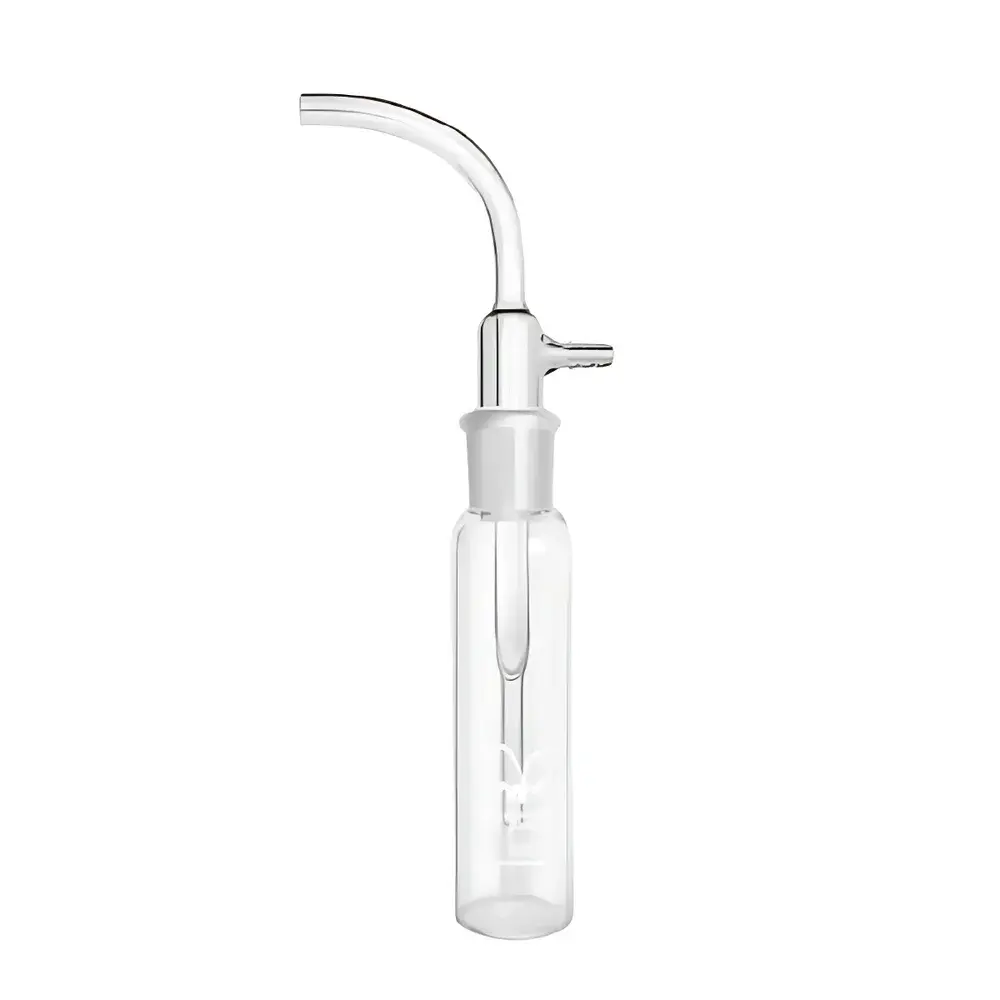
HRH-1 Impactor-Based Biological Aerosol Sampler
| Brand | Huironghe |
|---|---|
| Origin | Beijing, China |
| Model | HRH-1 |
| Rated Flow Rate | 12.5 L/min (range: 12.3–12.6 L/min) |
| Sampling Liquid Volume | 20 mL |
| Recommended Sampling Duration | 10–30 min |
| Nozzle-to-Collection Surface Distance | 30 mm |
| Inlet Diameter | 11 mm |
| Outlet Diameter | 8 mm |
| Sterilization Compatibility | Autoclavable (121 °C, 20 min) |
Overview
The HRH-1 Impactor-Based Biological Aerosol Sampler is an engineered solution for the quantitative collection of viable and non-viable airborne microorganisms—including bacteria, fungal spores, and viral particles—into liquid suspension for downstream analysis. It operates on the principle of inertial impaction: aerosol-laden air is accelerated through a precision-machined nozzle and directed perpendicularly onto the surface of a liquid medium (typically 20 mL of sterile buffer or growth medium) contained within the sampler’s collection chamber. Particles with sufficient aerodynamic diameter (>0.5 µm) possess inertia that prevents them from following the abrupt airflow turn, resulting in direct impaction into the liquid phase. This mechanism preserves microbial viability more effectively than dry-impact or filter-based methods, minimizing desiccation stress and enabling subsequent culturing, PCR, qPCR, or metagenomic sequencing.
Designed for field-deployable and laboratory-based environmental monitoring, the HRH-1 delivers consistent performance at a nominal flow rate of 12.5 L/min—within the ISO 14698-1 recommended range for bioaerosol sampling in cleanrooms and controlled environments. Its compact, all-stainless-steel construction ensures chemical resistance and compatibility with standard autoclaving protocols (121 °C, 20 min), supporting strict biosafety and cross-contamination control requirements.
Key Features
- High-efficiency inertial impaction design optimized for biological particle recovery across the 0.5–10 µm aerodynamic diameter range
- Autoclavable stainless-steel body and internal components—validated for repeated sterilization without dimensional or functional degradation
- Precision-machined nozzle with fixed 30 mm standoff distance to liquid surface, ensuring reproducible impaction kinetics and minimal splash-induced re-aerosolization
- Standardized 20 mL liquid collection volume compatible with common microbiological assay formats (e.g., plate counts, membrane filtration, nucleic acid extraction)
- Integrated inlet (11 mm ID) and outlet (8 mm ID) ports designed for seamless connection to certified flow controllers and vacuum sources meeting ISO 21501-4 calibration traceability
- No moving parts or consumable filters—reducing operational complexity and total cost of ownership over extended deployment cycles
Sample Compatibility & Compliance
The HRH-1 is validated for use with aqueous sampling media including phosphate-buffered saline (PBS), tryptic soy broth (TSB), and viral transport media (VTM). Its impaction geometry supports compliance with key methodological frameworks: it aligns with the physical sampling principles referenced in ISO 14698-1 (Biological contamination control — General principles and methods), ASTM D6077 (Standard Practice for Bioaerosol Sampling), and EU GMP Annex 1 (2022) requirements for environmental monitoring in aseptic processing zones. While the sampler itself is not CE-marked or FDA-cleared as a medical device, its design enables integration into GLP- and GMP-compliant workflows when paired with validated air pumps, flow calibrators, and analytical methods.
Software & Data Management
The HRH-1 is a hardware-only sampling device and does not include embedded firmware or proprietary software. It is intended for use with external, user-supplied flow control instrumentation—such as mass flow controllers (MFCs) with NIST-traceable calibration certificates—and time-synchronized data loggers. All operational parameters (flow rate, duration, ambient temperature/pressure) must be recorded manually or via third-party systems to satisfy audit requirements under 21 CFR Part 11 (electronic records and signatures) and ISO/IEC 17025 (competence of testing and calibration laboratories). Documentation templates for sampling logs, calibration records, and maintenance histories are available upon request to support quality system integration.
Applications
- Environmental monitoring in pharmaceutical cleanrooms (Grade A–D), isolators, and RABS
- Healthcare-associated infection (HAI) risk assessment in hospitals, clinics, and long-term care facilities
- Field-based surveillance of airborne pathogens in agricultural, wastewater, and livestock settings
- Validation and routine monitoring of HVAC filtration efficiency and room air exchange rates
- Research on aerosolized virus transmission dynamics (e.g., influenza, SARS-CoV-2) under controlled exposure conditions
- Testing of personal protective equipment (PPE) and respirator filtration efficacy using standardized challenge aerosols
FAQ
Is the HRH-1 suitable for collecting viruses?
Yes—the impaction efficiency for particles ≥0.3 µm aerodynamic diameter exceeds 80% at 12.5 L/min, making it appropriate for enveloped and non-enveloped viruses typically carried on respiratory droplet nuclei or larger carrier particles.
Can the sampler be used with viscous media such as glycerol-PBS mixtures?
No—viscosities exceeding 2.5 cP may reduce impaction efficiency and increase droplet rebound; only low-viscosity aqueous media (≤1.5 cP at 25 °C) are recommended.
What flow calibration standards are required for regulatory compliance?
A primary-standard flow calibrator traceable to NIST or equivalent national metrology institute (e.g., ISO 6145-1 or ISO 6145-2) must be used prior to each sampling campaign, with documented uncertainty ≤±2% of reading.
Does the HRH-1 include a built-in pump or flow meter?
No—it requires an external, calibrated vacuum source and flow control unit; no integrated electronics or sensors are present.
How often should the internal surfaces be inspected for residue buildup?
Visual inspection and cleaning with 70% ethanol or 0.5% sodium hypochlorite solution are recommended after every 10 sampling cycles or immediately following high-biomass exposures.
Related Products







