
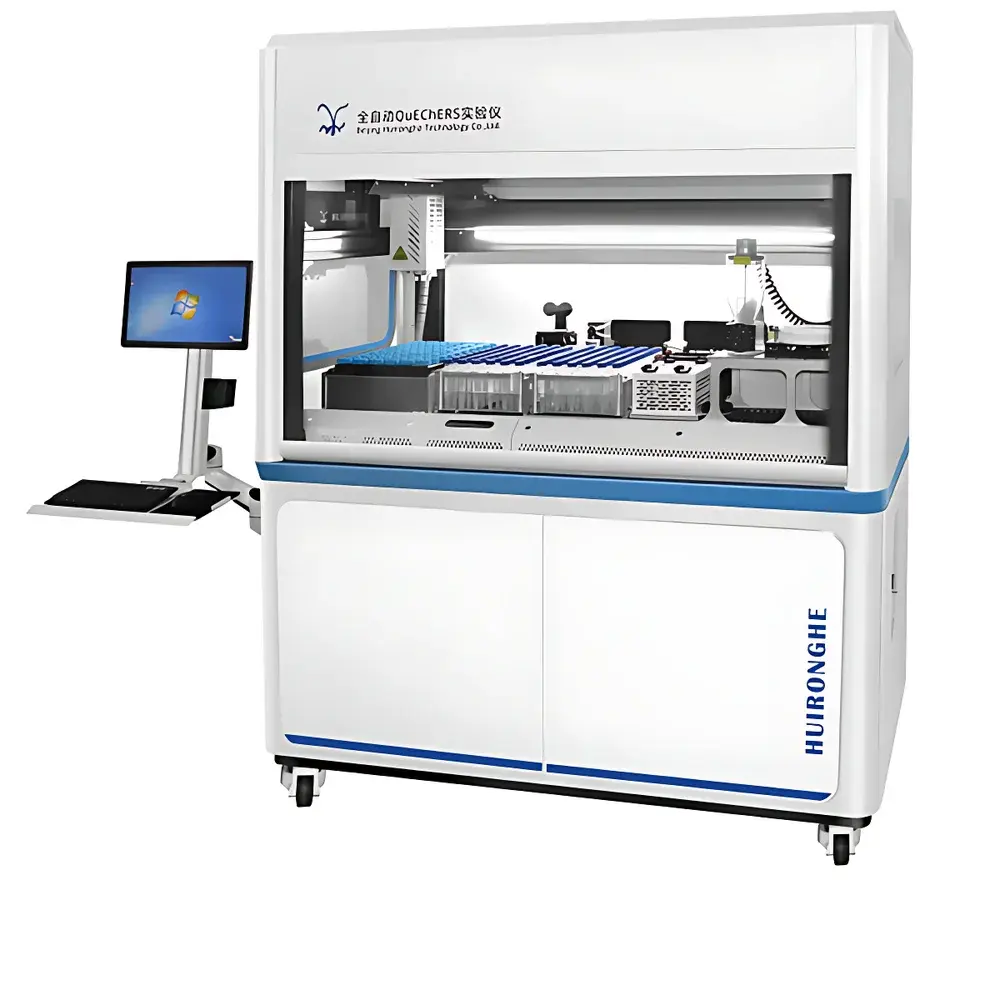
HRH-Q32/Q40/Q60 Automated QuEChERS Sample Preparation Workstation
| Brand | HRH |
|---|---|
| Origin | Beijing, China |
| Model | HRH-Q32 / HRH-Q40 / HRH-Q60 |
| Throughput | 32 / 40 / 60 samples per run |
| Compliance | GB 23200.113–2018, GB 23200.121–2021, ChP 2020 Vol. IV (2341), AOAC 2007.01, EN 15662:2008 |
| Integrated Modules | Precision liquid dispensing, salt addition, ceramic homogenization bead loading, vertical shaking, vortex mixing, horizontal centrifugation (4-position rotor), ice bath (0–4 °C), tip ejection, liquid-level sensing pipetting, real-time fault monitoring, optional filtration & nitrogen evaporation modules |
| Software | Method-driven GUI with audit trail, user permission levels, and instrument status logging |
Overview
The HRH-Q32/Q40/Q60 Automated QuEChERS Sample Preparation Workstation is an integrated, method-compliant platform engineered for high-throughput, reproducible execution of the QuEChERS (Quick, Easy, Cheap, Effective, Rugged, Safe) sample preparation protocol. Designed specifically for pesticide residue analysis in plant-based matrices—including fruits, vegetables, tea, herbal medicines, tobacco, and imported agricultural commodities—the system replaces manual, multi-step benchtop workflows with a fully automated sequence grounded in first-principles fluid handling, mechanical agitation, and phase separation physics. It implements the core QuEChERS chemistry—acetonitrile extraction followed by partitioning with magnesium sulfate and sodium acetate—while maintaining strict adherence to regulatory extraction kinetics, temperature control, and mass balance requirements defined in GB 23200.113–2018, GB 23200.121–2021, Chinese Pharmacopoeia 2020 Edition (Section 2341), AOAC Official Method 2007.01, and EN 15662:2008. The workstation operates without operator intervention after sample and consumable loading, delivering trace-level analytical readiness for downstream GC-MS/MS or LC-MS/MS quantification.
Key Features
- Fully programmable, method-embedded automation: Pre-configured workflows for QuEChERS extraction, cleanup, and phase separation conform to national and pharmacopoeial standards—no scripting or external method development required.
- Multi-axis precision liquid handling: Dual independent syringe pumps with 4- or 8-port valve switching enable accurate reagent delivery (acetonitrile, internal standards, solvents) with real-time tubing-level monitoring and pressure-compensated dispensing.
- Automated solid-phase addition: Programmable dosing of MgSO₄, NaOAc, and custom salt blends; synchronized ceramic homogenization bead loading into each tube ensures consistent mechanical disruption of plant tissue.
- Vertical orbital shaking module: Adjustable speed (200–1200 rpm) and duration (1–30 min); compatible with both 15 mL and 50 mL conical polypropylene tubes.
- Horizontal centrifugation module: 4-position swing-bucket rotor supporting simultaneous centrifugation of 15 mL or 50 mL tubes at speeds up to 4,500 × g (adjustable time: 1–15 min).
- Multi-channel vortex mixing: Independently actuated vortex heads per position; dwell time and intensity programmable to optimize emulsion breaking and aqueous/organic phase separation.
- High-fidelity pipetting arm: Equipped with capacitive liquid-level detection and dynamic Z-axis surface-following; accuracy ±1.5% CV at 100 µL, precision <1.0% CV across 10–1000 µL range.
- Single-use tip management: Automatic tip ejection and reloading between all liquid transfers eliminates cross-contamination risk—critical for multi-analyte pesticide panels.
- Active ice bath: Maintains sample temperature at 0–4 °C during extraction and centrifugation steps, satisfying ChP 2020 Section 2341 thermal stability requirements for thermolabile analytes.
- Comprehensive fault diagnostics: Real-time monitoring of lid actuation, tube presence, centrifuge load imbalance, bead dispensing success, and robotic arm positioning—with visual alerts and log-tagged event timestamps.
Sample Compatibility & Compliance
The HRH-Q series accommodates heterogeneous solid and semi-solid botanical matrices—including dried herbs, ground tea leaves, leafy greens, fruit pulps, and tobacco lamina—without pre-grinding or slurry dilution. Tube compatibility spans standard 15 mL and 50 mL polypropylene centrifuge tubes meeting ISO 10993 biocompatibility criteria. All hardware and software components comply with GLP-aligned data integrity principles: electronic records include full audit trails (user ID, timestamp, parameter changes), role-based access control (administrator, analyst, reviewer), and immutable method versioning. Instrument validation documentation supports IQ/OQ/PQ protocols aligned with ISO/IEC 17025 and FDA 21 CFR Part 11 requirements for regulated laboratories conducting pesticide residue testing under national food safety surveillance programs.
Software & Data Management
The embedded Windows-based control software provides a method-centric interface with drag-and-drop workflow configuration, real-time instrument telemetry visualization, and remote desktop access via secure HTTPS. Each run generates a structured .csv and .pdf report containing sample IDs, timestamps, executed parameters (shaking speed, centrifugation g-force, vortex duration), error logs, and calibration verification records. Data export conforms to ASTM E1915-21 (Standard Practice for Data Exchange in Analytical Chemistry) and is directly importable into LIMS platforms supporting HL7 or ASTM E1467 formats. Optional camera integration enables live video streaming of internal operations with timestamp-synchronized recording—facilitating remote troubleshooting and training verification.
Applications
- Routine pesticide multiresidue screening in national food safety laboratories performing GB 23200.121–2021–compliant analyses.
- Pharmaceutical quality control of traditional Chinese medicinal materials per ChP 2020 Section 2341 (Methods IV and V).
- Export certification testing for EU MRL compliance using EN 15662:2008–aligned extraction conditions.
- Research-scale metabolomic studies requiring standardized, low-variance matrix extraction prior to LC-HRMS profiling.
- Contract testing laboratories managing >100 daily QuEChERS samples across diverse crop types and regulatory jurisdictions.
FAQ
What throughput options are available, and how are they physically implemented?
The HRH-Q32, Q40, and Q60 models differ in carousel capacity and robotic arm reach—not in fundamental architecture. All share identical module specifications; only tray layout and scheduling logic scale to accommodate 32, 40, or 60 tubes per batch.
Does the system support method customization beyond pre-loaded QuEChERS protocols?
Yes. Advanced users may define custom liquid transfer sequences, shaking profiles, centrifugation gradients, and conditional branching (e.g., “if tube weight > X g, extend vortex time by Y sec”) via the script editor—while retaining full audit trail capture.
Is nitrogen blow-down integration validated for final solvent exchange steps?
The optional nitrogen evaporation module is designed to meet USP <467> residual solvents methodology requirements; it includes temperature-controlled heating blocks, mass-flow-controlled N₂ delivery, and endpoint detection via weight loss rate monitoring.
How is carryover assessed and mitigated during high-volume operation?
Carryover validation follows ICH Q2(R2) guidance: blank runs interspersed every 10 samples confirm <0.05% carryover for chlorpyrifos-methyl and carbendazim—two high-affinity reference compounds—using LC-MS/MS detection at LOQ.
Can the workstation interface with third-party LIMS or chromatography data systems?
Yes. Native API support for RESTful JSON calls enables bidirectional communication with major LIMS vendors (e.g., LabVantage, STARLIMS) and CDS platforms (e.g., Thermo Chromeleon, Waters Empower) for sample queue ingestion and result auto-population.



