
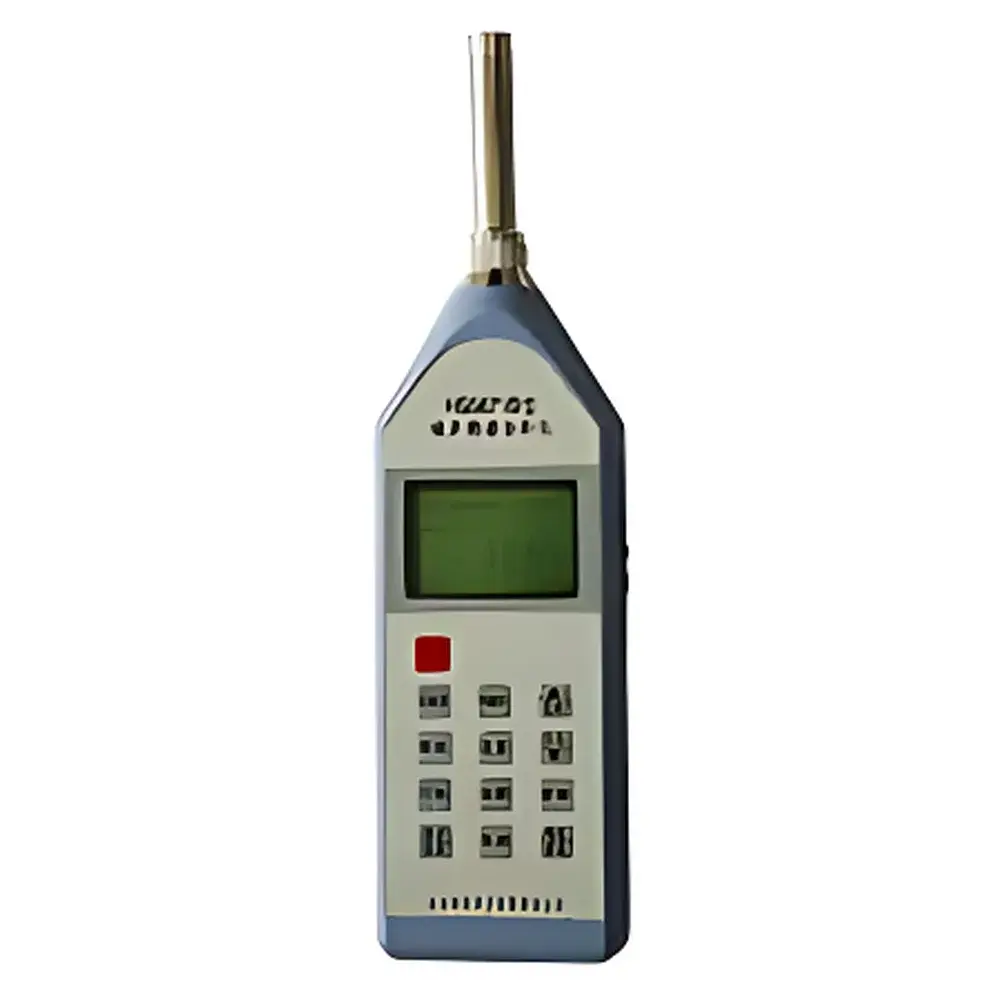
HS5671B Precision Noise Spectrum Analyzer
| Origin | Jiangsu, China |
|---|---|
| Manufacturer Type | Authorized Distributor |
| Origin Category | Domestic (PRC) |
| Model | HS5671B |
| Pricing | Available Upon Request |
Overview
The HS5671B Precision Noise Spectrum Analyzer is a Class 1 integrated sound level meter engineered for compliance with international acoustical metrology standards, including IEC 61672-2002 (Parts 1 & 2) and GB/T 17181–1997. It functions simultaneously as an exponential time-weighted sound level meter, an integrating-averaging sound level meter (Leq), a sound exposure level (SEL) meter, and a statistical sound level analyzer (LN series). Its architecture supports real-time 1/1-octave and 1/3-octave band spectral analysis per IEC 61260-1:2014 and GB/T 3241–2010, enabling frequency-domain characterization of complex noise sources in occupational, environmental, and industrial settings. The instrument employs digital true-RMS detection with high dynamic range (>105 dB), low drift, and stable sensitivity across its full 10 Hz–20 kHz measurement bandwidth—critical for accurate assessment of impulsive, tonal, or broadband noise under variable ambient conditions.
Key Features
- Class 1 performance certified per IEC 61672-2002 and GB/T 17181–1997, with RF immunity classified as X-class per IEC 61672 Annex E
- Dual-mode operation: instantaneous time-weighted (Fast/Slow), integrating (Leq, SEL), and statistical (L5, L10, L50, L90, L95) measurements
- Three selectable input ranges (High: 60–130 dB; Medium: 40–110 dB; Low: 25–90 dB), each offering ≥60 dB linear dynamic span
- Integrated 1/1-octave and 1/3-octave real-time filter banks compliant with IEC 61260-1:2014 Class 1 requirements
- 128×64 dot-matrix LCD with backlight, supporting analog-style needle simulation, real-time parameter display, and clock-based timestamping (year/month/day/hour/minute/second)
- Digital true-RMS detector with Φ12.7 mm (½″) pre-polarized condenser microphone (sensitivity ≈30 mV/Pa, flat response 10 Hz–20 kHz)
- Onboard memory storage: 512 single-event records, 8 full-day (24 h) time-history sets, 100 spectral filter measurement groups, 200 reverberation time (Tr) datasets, and 1 dedicated data acquisition buffer
- RS-232 serial interface (9600 baud) for bidirectional communication with PC-based analysis software using Microsoft Access database architecture
- Extended battery life: 24 hours continuous operation on four LR6 (AA) alkaline cells; optional 6 V DC external power supply (mutually exclusive with internal batteries)
Sample Compatibility & Compliance
The HS5671B is designed for field-deployable acoustic monitoring in diverse regulatory contexts. Its 1/1- and 1/3-octave spectral capabilities support source identification, noise mapping, and frequency-specific control strategy development per ISO 1996-2:2017 (acoustics — description, measurement and assessment of environmental noise). It meets the technical prerequisites for occupational noise assessments under OSHA 29 CFR 1910.95 and EU Directive 2003/10/EC. The instrument’s A-, C-, and Linear (Lin) frequency weightings align with ANSI S1.4–2014 and IEC 61672 definitions, ensuring traceable comparability across global reporting frameworks. All stored measurement metadata—including calibration status, microphone orientation (axial reference), and environmental timestamps—is retained to support GLP-compliant audit trails.
Software & Data Management
The proprietary PC application provides automated COM port detection, firmware version verification, and secure retrieval of device-specific identifiers (e.g., factory serial number). Measurement datasets are imported into a structured Microsoft Access database schema, enabling SQL-based querying, batch export to CSV or Excel, and generation of standardized reports (e.g., daily Leq, Lden, Ldn, Tr). The software supports time-synchronized overlay of multiple measurement sessions, spectral waterfall plots, and percentile-based histogram visualization. Audit logging records all user-initiated configuration changes, calibrations, and data exports—facilitating 21 CFR Part 11–aligned validation where required.
Applications
- Ongoing environmental noise monitoring near transportation corridors, industrial facilities, and residential boundaries
- Workplace noise surveys for hearing conservation program compliance (OSHA, HSE, DGUV)
- Acoustic characterization of HVAC systems, machinery, and construction equipment
- Reverberation time (Tr) estimation in architectural acoustics and room qualification studies
- Statistical noise modeling for urban planning and environmental impact assessments (EIA)
- Field validation of noise barrier performance and façade transmission loss
- Educational laboratory use in acoustics, environmental engineering, and occupational health curricula
FAQ
What standards does the HS5671B comply with for Class 1 certification?
It conforms to IEC 61672-2002 (Parts 1 & 2) and GB/T 17181–1997 for sound level meters, and IEC 61260-1:2014 (Class 1) for octave-band filtering.
Can the instrument perform simultaneous time-domain and frequency-domain analysis?
Yes—real-time 1/1- and 1/3-octave spectral analysis can be executed concurrently with Leq, Lmax/Lmin, and statistical percentile calculations.
Is the internal clock battery-backed?
Yes—the real-time clock retains date/time during power-off and battery replacement, ensuring uninterrupted timestamp integrity.
Does the RS-232 interface support hardware handshaking?
No—communication uses fixed 9600 baud, 8N1 protocol without RTS/CTS; USB-to-serial adapters require driver-level flow control emulation.
How is microphone calibration verified in the field?
The unit accepts manual entry of pistonphone or calibrator reference levels (e.g., 94 dB @ 1 kHz); calibration history and deviation logs are stored with each measurement set.







