
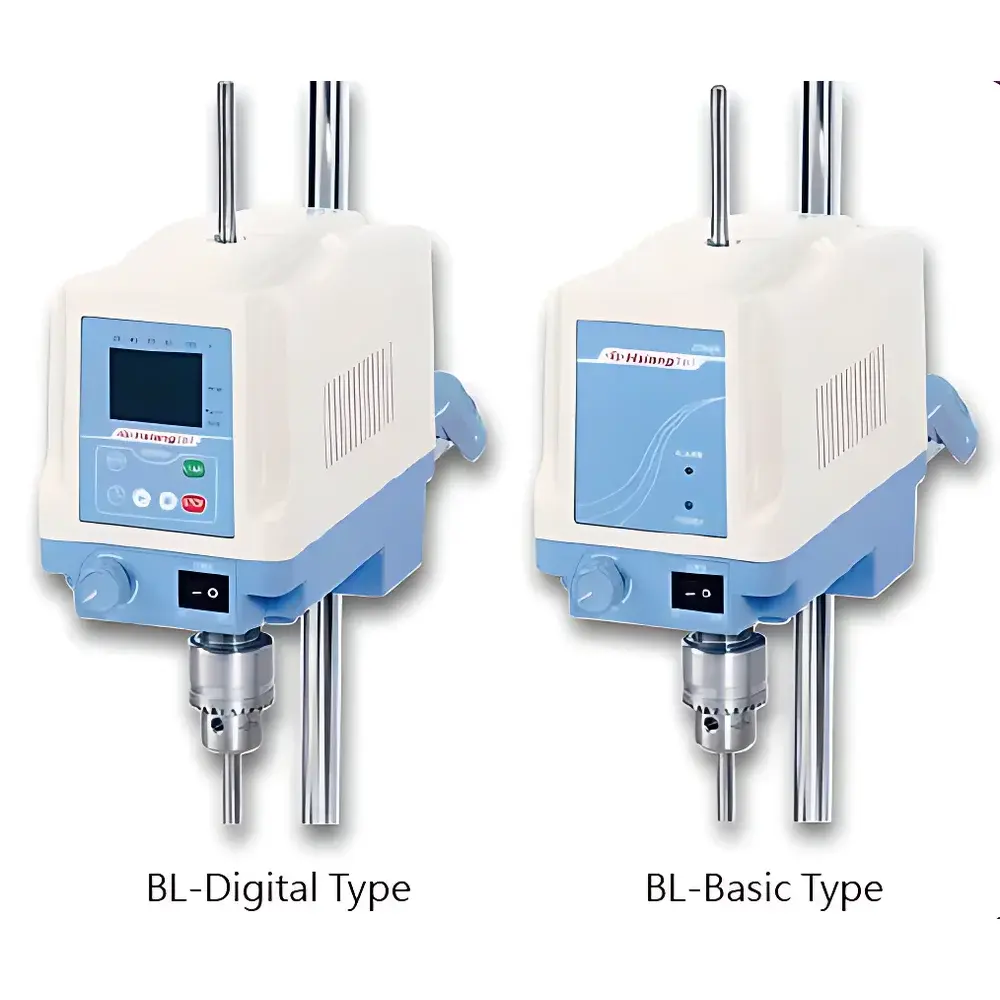
HsiangTai BL-300D Brushless DC Electric Stirrer
| Brand | HsiangTai (HSIANGTAI) |
|---|---|
| Origin | Taiwan |
| Model | BL-300D |
| Max. Mixing Volume | 10 L |
| Speed Range | 0–3000 rpm |
| Motor Power | 150 W DC |
| Torque | 3.5 kgf·cm (0.34 N·m) |
| Timer Range | 0–99 h 59 min (digital) |
| Dimensions (W×L×H) | 111 × 215 × 225 mm |
| Weight | 3.5 kg |
| Input Voltage | AC 110 V / 220 V, 50 / 60 Hz |
| Safety Protections | Overload, Overheat, Fuse |
| Display | LED speed display, dual torque indication (5-stage analog % + digital N·m), digital timer |
Overview
The HsiangTai BL-300D Brushless DC Electric Stirrer is an industrial-grade laboratory stirring system engineered for precision, stability, and long-term operational reliability in demanding R&D, QC, and pilot-scale synthesis environments. Unlike conventional AC-motor stirrers, the BL-300D employs a high-efficiency brushless DC motor that delivers consistent torque output across its full 0–3000 rpm range, minimizing thermal drift and mechanical wear. Its core design follows fundamental fluid dynamics principles for viscous shear transfer—optimized for laminar-to-transitional flow regimes typical in low- to medium-viscosity liquid-phase mixing (e.g., aqueous solutions, polymer precursors, suspension formulations, and buffer preparations). The unit is not intended for high-shear dispersion or emulsification but excels in homogeneous blending, dissolution, temperature equilibration, and gentle agitation where reproducible rotational energy input is critical.
Key Features
- Brushless DC motor with integrated electronic commutation ensures maintenance-free operation, extended service life (>10,000 hours), and reduced electromagnetic interference compared to brushed alternatives.
- Center-hollow shaft design enables vertical adjustment of the stirring rod (up to 500 mm length) and secure clamping of rods ≤10 mm diameter using corrosion-resistant stainless-steel chuck jaws.
- Dual-torque monitoring system provides real-time feedback via both analog five-segment LED indicators (20%, 40%, 60%, 80%, 100%) and a digital N·m readout—enabling users to detect viscosity shifts, impeller stalling, or unexpected load changes during extended runs.
- Digital timer with 1-minute resolution supports unattended operation up to 99 hours and 59 minutes, suitable for overnight dissolution studies or slow-reaction monitoring under ambient or externally controlled temperature conditions.
- Comprehensive safety architecture includes thermal cutoff sensors, current-limiting circuitry, and a replaceable fuse—fully compliant with IEC 61010-1:2010 safety requirements for laboratory electrical equipment.
- LED speed display with ±10 rpm accuracy and zero-crossing detection ensures stable setpoint adherence even under variable load conditions; automatic torque compensation maintains preset speed within ±3% deviation across viscosity changes up to 5000 mPa·s.
Sample Compatibility & Compliance
The BL-300D is validated for use with standard laboratory glassware (e.g., beakers, flasks, and jacketed reactors) up to 10 L capacity when paired with appropriately sized impellers (e.g., propeller, paddle, or anchor types). It supports ISO/IEC 17025-compliant method development workflows when integrated into documented SOPs, particularly where mechanical agitation parameters must be traceable and repeatable. While the unit itself does not incorporate temperature control, its robust thermal management allows safe integration with external circulators or heating mantles. All electrical components meet CE marking requirements per EMC Directive 2014/30/EU and Low Voltage Directive 2014/35/EU. No internal battery or wireless module is present—ensuring intrinsic compatibility with electromagnetic-sensitive environments such as NMR labs or cleanroom HVAC zones.
Software & Data Management
The BL-300D operates as a standalone instrument without proprietary software dependencies. All operational parameters—including speed setpoint, torque status, elapsed time, and safety event logs—are displayed locally via front-panel LEDs and require no host PC connection. For GLP/GMP-aligned laboratories, manual recording of run parameters (e.g., operator ID, batch number, start/stop timestamps, observed torque behavior) satisfies audit trail requirements under FDA 21 CFR Part 11 when documented in bound logbooks or validated electronic lab notebooks (ELNs). Optional accessories—including spring-loaded lift assemblies and modular stainless-steel support stands—enable rapid reconfiguration between vessels without recalibration.
Applications
- Preparation of calibration standards and reference solutions in analytical chemistry labs.
- Homogenization of cell culture media, buffers, and reagent kits prior to filtration or sterilization.
- Controlled agitation during titration endpoint verification or pH stabilization protocols.
- Supporting ASTM D2196 (viscosity of paints) and ISO 2557-2 (plasticizer homogeneity testing) sample conditioning steps.
- Facilitating solvent-based polymer dissolution in materials science workflows where shear degradation must be avoided.
- Use in pharmaceutical QC labs for USP compounding support—where consistent, low-turbulence mixing of sterile preparations is required prior to filtration.
FAQ
Does the BL-300D include built-in temperature control?
No. The unit provides only mechanical agitation; temperature regulation must be achieved externally via heated/circulating baths or environmental chambers.
Can the BL-300D be used with corrosive solvents?
Yes—provided the stir bar or impeller material (e.g., PTFE-coated, glass, or Hastelloy) is chemically compatible; the motor housing and chuck are stainless steel (AISI 304), resistant to incidental splashes of common lab solvents.
Is the digital timer programmable for interval operation?
No. The timer functions only as a continuous countdown; it does not support on/off cycling or multi-step sequences.
What impeller types are recommended for optimal performance?
Propeller impellers (e.g., Rushton or pitched-blade) are advised for low-viscosity liquids (<100 mPa·s); anchor or helical ribbons are preferred for higher-viscosity applications up to 5000 mPa·s.
Does the unit comply with FDA 21 CFR Part 11 for electronic records?
As a non-networked, non-data-logging device, the BL-300D does not generate electronic records; however, its deterministic behavior and visible parameter display support manual data capture in Part 11–compliant documentation systems.



