
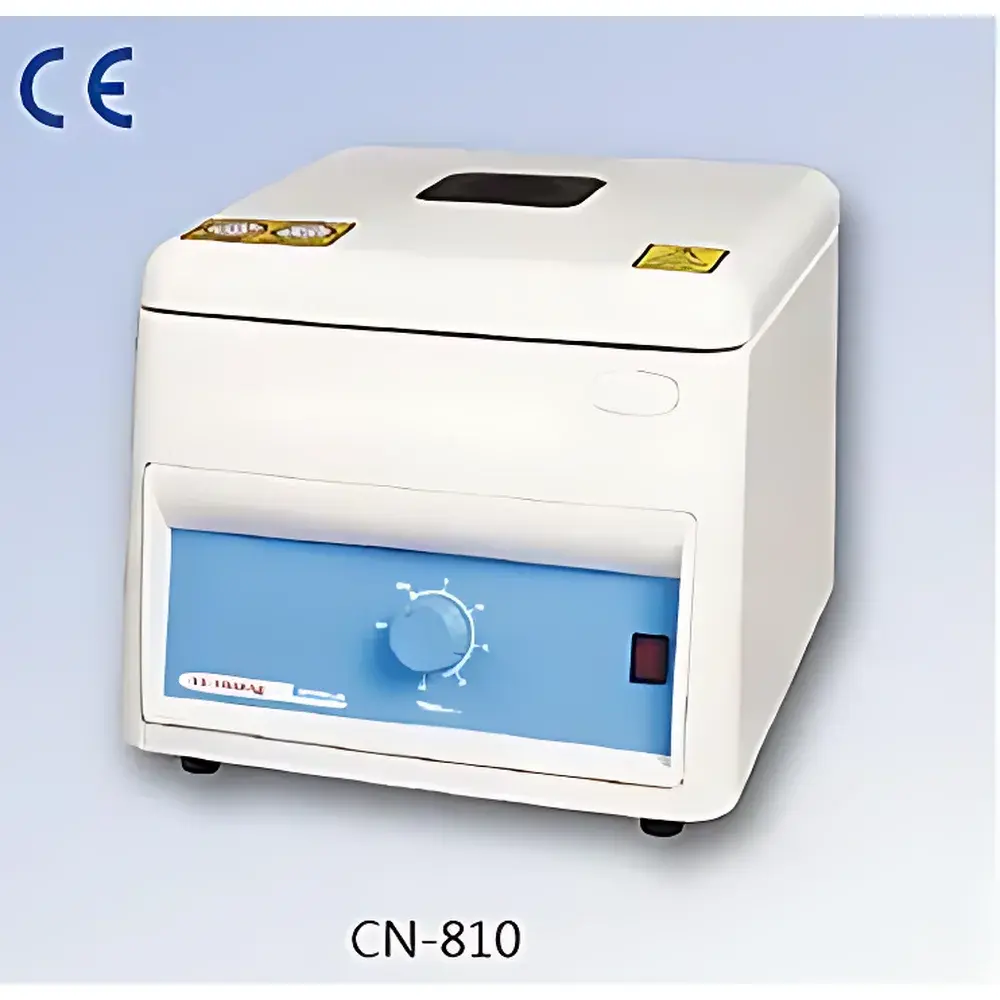
HsiangTai CN-810 / CN-820 / CN-830 Benchtop Centrifuge
| Brand | HsiangTai |
|---|---|
| Origin | Taiwan |
| Model | CN-810 / CN-820 / CN-830 |
| Type | Benchtop Low-Speed Centrifuge |
| Max. Speed | 3500 rpm |
| Max. RCF | 1420 × g |
| Capacity | 6 mL × 8 or 10 mL × 8 (CN-810/CN-820) |
| Timer Range | 0–30 min |
| Dimensions (W×D×H) | 290 × 320 × 250 mm |
| Weight | 8 kg |
| Power Supply | AC 220 V, 50/60 Hz |
| Motor | Brushless DC |
| Safety Features | Automatic lid interlock, power-off protection, fault self-diagnosis |
Overview
The HsiangTai CN-810, CN-820, and CN-830 are compact, benchtop low-speed centrifuges engineered for routine separation tasks in academic teaching labs, clinical diagnostics support environments, and quality control settings where sample volumes are limited and operational simplicity is critical. These instruments operate on the principle of sedimentation under controlled centrifugal force—utilizing rotational acceleration to separate components based on density differentials in heterogeneous liquid mixtures. Designed for robust daily use without requiring specialized infrastructure, each model delivers consistent performance at a fixed or adjustable speed up to 3500 rpm, generating a maximum relative centrifugal force (RCF) of 1420 × g. Their brushless DC motor ensures stable torque output across speed ranges, reduced electromagnetic interference, and extended service life compared to traditional brushed motors—critical for maintaining reproducibility during repeated batch processing.
Key Features
- Brushless DC motor for quiet, vibration-dampened operation and long-term reliability
- ABS polymer housing with integrated transparent viewing window for real-time sample monitoring
- Automatic lid interlock system that halts rotation immediately upon lid opening—compliant with IEC 61010-2-020 safety requirements for laboratory centrifuges
- Integrated fault detection circuitry providing audible and visual alerts for rotor imbalance, overspeed, or abnormal temperature rise
- Fixed-speed (CN-810) and variable-speed (CN-820/CN-830) configurations to accommodate diverse protocol requirements
- 30-minute mechanical timer with auto-stop functionality to prevent over-centrifugation and sample degradation
- Compact footprint (290 × 320 × 250 mm) optimized for space-constrained lab benches or biosafety cabinets
Sample Compatibility & Compliance
The CN-series accommodates standard conical-bottom microcentrifuge tubes (6 mL and 10 mL), compatible with common polypropylene and polycarbonate materials used in diagnostic and research workflows. Rotors R-8 (for CN-810/CN-820) and R-12 (for CN-830) are precision-balanced aluminum alloy assemblies certified for continuous operation at rated speeds. All models meet CE marking requirements under the EU Machinery Directive 2006/42/EC and Low Voltage Directive 2014/35/EU. While not classified as Class II medical devices, their construction and safety logic align with GLP-aligned laboratory practices—particularly for non-sterile pre-analytical sample preparation steps preceding downstream assays (e.g., serum separation prior to ELISA or spectrophotometric analysis).
Software & Data Management
These centrifuges operate via dedicated hardware controls—no embedded software, network interface, or data logging capability is included. This design prioritizes operational transparency, eliminates firmware update dependencies, and supports audit-ready manual recordkeeping per ISO/IEC 17025 Clause 7.7 (control of equipment records). Users maintain traceability through handwritten or LIMS-integrated log entries documenting date, operator ID, rotor type, tube configuration, speed setting, duration, and observed anomalies. For laboratories implementing 21 CFR Part 11 compliance, external electronic lab notebooks (ELNs) may be used to capture and timestamp run parameters—though the instrument itself does not generate digital audit trails.
Applications
- Routine blood serum/plasma separation from whole blood specimens in point-of-care or satellite lab settings
- Cell pellet harvesting in microbial culture workflows (e.g., E. coli, yeast) prior to lysis or DNA extraction
- Clarification of crude plant extracts or enzyme reaction mixtures before HPLC injection
- Removal of precipitated contaminants from buffer solutions or reagent stocks
- Preparative concentration of nanoparticles or colloidal suspensions in materials science education labs
- Centrifugal washing steps in immunoassay kit protocols requiring minimal hands-on time
FAQ
What is the difference between CN-810, CN-820, and CN-830?
The CN-810 operates at a fixed speed of 3500 rpm; the CN-820 offers variable speed control from 0–3500 rpm; the CN-830 shares the same speed range but uses a 12-position rotor instead of an 8-position one—increasing throughput capacity without altering RCF performance.
Can these centrifuges accommodate PCR tubes or 1.5 mL microtubes?
No—rotor configurations are designed exclusively for 6 mL and 10 mL conical tubes. Adapters for smaller formats are not supplied or validated by HsiangTai.
Is rotor balancing required before each run?
Yes. Symmetrical loading of tubes with equal mass (±0.1 g) is mandatory to prevent vibration-induced mechanical stress and ensure bearing longevity.
Does the unit include a refrigeration system?
No. These are non-refrigerated models intended for ambient-temperature applications only.
What maintenance is recommended for long-term reliability?
Monthly visual inspection of rotor threads and lid seal integrity; annual verification of speed accuracy using a calibrated tachometer; replacement of the rubber damping pad every 24 months under typical usage conditions.



