
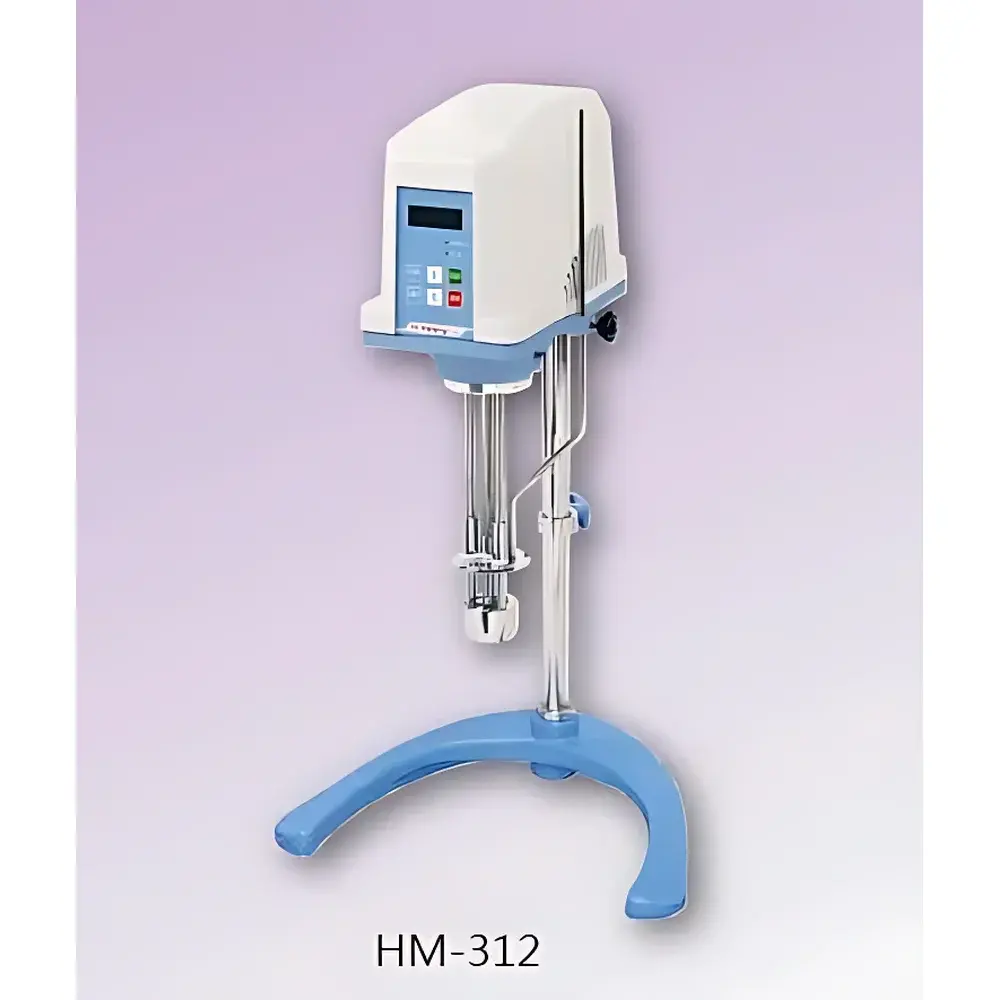
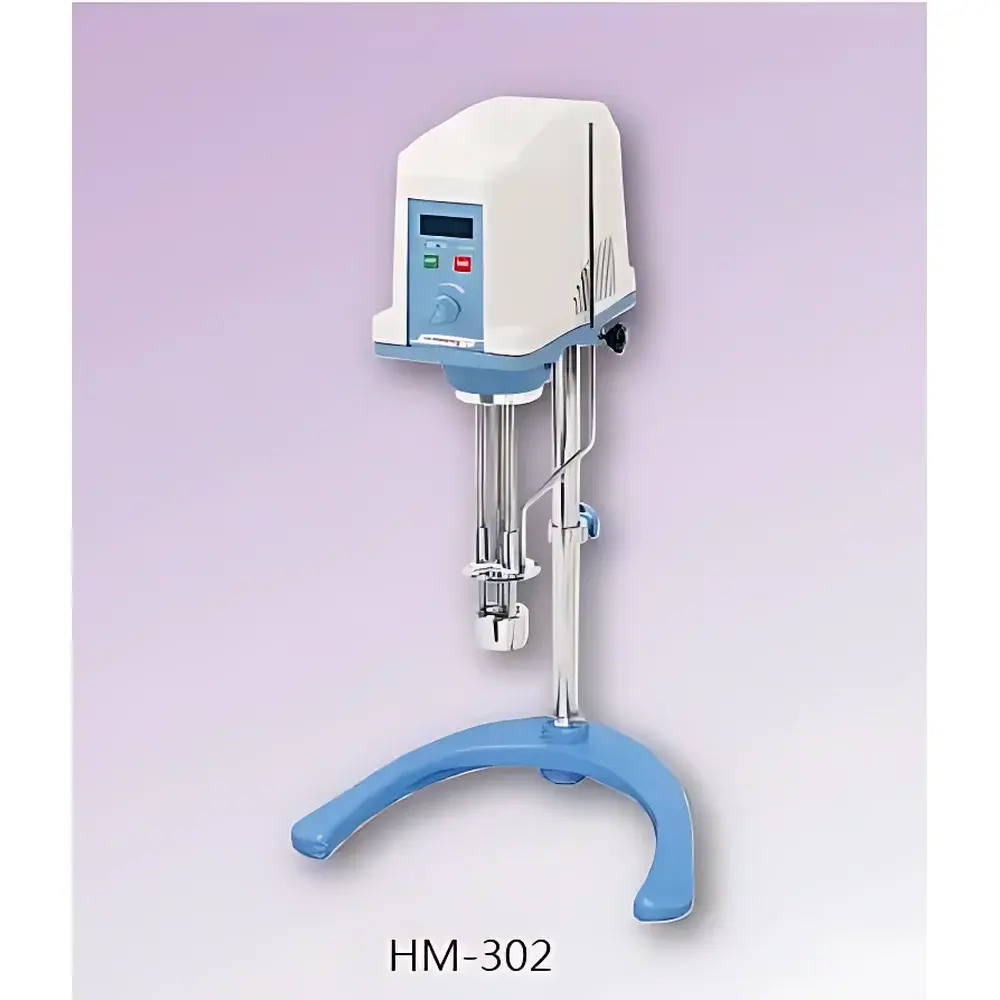
HsiangTai HM-302 & HM-312 Benchtop High-Shear Homogenizer
| Brand | HsiangTai |
|---|---|
| Origin | Taiwan |
| Model | HM-302 / HM-312 |
| Sample Capacity | 2 L |
| Output Power | 220 W DC |
| Speed Range | 500–12,000 rpm |
| Timer Range | 0–99 h 59 min (HM-312), Digital Speed & Time Display (HM-302) |
| Construction Material | SUS316 Stainless Steel Rotor-Stator Assembly |
| Drive Type | Variable-Speed DC Motor with Torque Compensation |
| Safety Features | Thermal Overload Protection, Fuse Protection |
| Dimensions (Overall) | 330 × 303 × 540 mm (W × L × H) |
| Weight | 10 kg |
| Input Voltage | AC 110 V / 220 V, 50 / 60 Hz |
Overview
The HsiangTai HM-302 and HM-312 are precision-engineered benchtop high-shear homogenizers designed for reproducible particle size reduction, emulsification, dispersion, and cell lysis in laboratory-scale R&D and quality control environments. These instruments operate on the principle of rotor-stator shear: a rapidly rotating stainless steel rotor draws sample fluid into a narrow annular gap between itself and a fixed stator, subjecting it to intense hydrodynamic forces—including cavitation, turbulent flow, and laminar shear—resulting in rapid and uniform size reduction of dispersed phases. Unlike ultrasonic or bead-based systems, this mechanical approach delivers consistent energy input across variable viscosities and batch volumes up to 2 L, making it particularly suitable for viscous food matrices, polymer solutions, pharmaceutical suspensions, and industrial coatings where thermal stability and scalability are critical.
Key Features
- Variable-speed DC motor with electronic torque compensation ensures stable rotational speed under load fluctuations—essential for maintaining process consistency during viscosity changes or high-density suspensions.
- SUS316 stainless steel rotor-stator assembly provides superior corrosion resistance and compliance with FDA-compliant material requirements for food, cosmetic, and pharmaceutical applications.
- HM-302 model features digital RPM and elapsed time display for real-time monitoring; HM-312 adds an extended programmable timer (0–99 h 59 min) with keypad input, enabling unattended operation for long-duration dispersion or aging protocols.
- Ergonomic spring-loaded vertical lift mechanism allows rapid, tool-free adjustment of immersion depth—critical for optimizing shear zone positioning relative to vessel geometry and minimizing vortex formation.
- Integrated thermal overload protection and certified fuse safeguard against motor burnout during prolonged operation or accidental dry-running conditions.
- Compact footprint (330 × 303 × 540 mm) and low mass (10 kg) facilitate integration into fume hoods, biosafety cabinets, or modular lab benches without structural reinforcement.
Sample Compatibility & Compliance
These homogenizers accommodate a broad range of Newtonian and non-Newtonian fluids, including dairy emulsions (e.g., cream, whey protein dispersions), acidic beverages (vinegar, citrus juice concentrates), oil-in-water and water-in-oil formulations, pigment dispersions in solvent-based paints, and aqueous polymer solutions (e.g., CMC, xanthan gum). The absence of consumable beads or ultrasonic probes eliminates contamination risk and simplifies cleaning validation—a key requirement under GLP and GMP-aligned workflows. While not certified to ISO/IEC 17025 as a standalone measurement device, the system supports traceable process documentation when paired with calibrated timers and external temperature loggers. Its construction adheres to IEC 61000-6-2 (immunity) and IEC 61000-6-4 (emission) standards for laboratory electromagnetic compatibility.
Software & Data Management
The HM-302 and HM-312 operate as stand-alone instruments with no embedded firmware or network interface. All operational parameters—including set speed, actual RPM, and elapsed time—are displayed locally via LED indicators. For audit-trail compliance in regulated environments (e.g., USP , FDA 21 CFR Part 11), users are advised to integrate external data loggers or connect to laboratory information management systems (LIMS) via RS-232 or analog output modules (available as optional accessories from HsiangTai). Process parameters can be recorded manually or semi-automatically using timestamped video capture synchronized with timer activation—supporting retrospective review during internal QA audits or regulatory inspections.
Applications
- Food science: Stabilization of dairy-based emulsions, reduction of particle size in fruit pulp suspensions, homogenization of functional ingredient blends (e.g., probiotics, omega-3 oils).
- Pharmaceutical development: Preparation of nanoemulsions for oral delivery, dispersion of insoluble APIs in liquid dosage forms, pre-formulation studies of suspension stability.
- Materials chemistry: Exfoliation of graphene oxide dispersions, deagglomeration of nanocellulose suspensions, stabilization of conductive polymer inks.
- Coatings & adhesives: Pigment wetting and dispersion in acrylic or epoxy resin systems, viscosity-controlled blending of crosslinker additives.
- Academic research: Cell disruption for subcellular fractionation (yeast, bacteria), preparation of model colloidal systems for rheological characterization.
FAQ
What is the maximum recommended viscosity for continuous operation?
For optimal rotor-stator clearance maintenance and thermal management, continuous operation is recommended for fluids with dynamic viscosity ≤ 5,000 mPa·s at processing temperature. Higher-viscosity samples require intermittent duty cycles (e.g., 30 s on / 60 s off) to prevent motor overheating.
Can the HM-312 timer be used for multi-step protocols?
No—the built-in timer supports only single-interval countdown. Multi-stage processes (e.g., ramped speed profiles) require external programmable controllers or manual intervention.
Is rotor-stator geometry interchangeable between HM-302 and HM-312?
Yes—both models accept identical SUS316 rotor-stator sets (standard Ø10 mm, Ø15 mm, and Ø20 mm configurations), enabling method transfer and scalability studies across instrument platforms.
Does the system meet IP rating requirements for wet-lab environments?
The unit carries no formal IP rating; however, its sealed motor housing and drip-resistant control panel allow safe use in controlled humidity environments (<80% RH, non-condensing), provided splash exposure is minimized during operation.
How often should the rotor-stator assembly be inspected for wear?
Visual inspection is recommended after every 200 hours of cumulative runtime or prior to each high-value batch. Microscopic pitting or edge rounding exceeding 0.05 mm tolerance warrants replacement to maintain shear consistency and avoid metal particulate generation.
Related Products



