
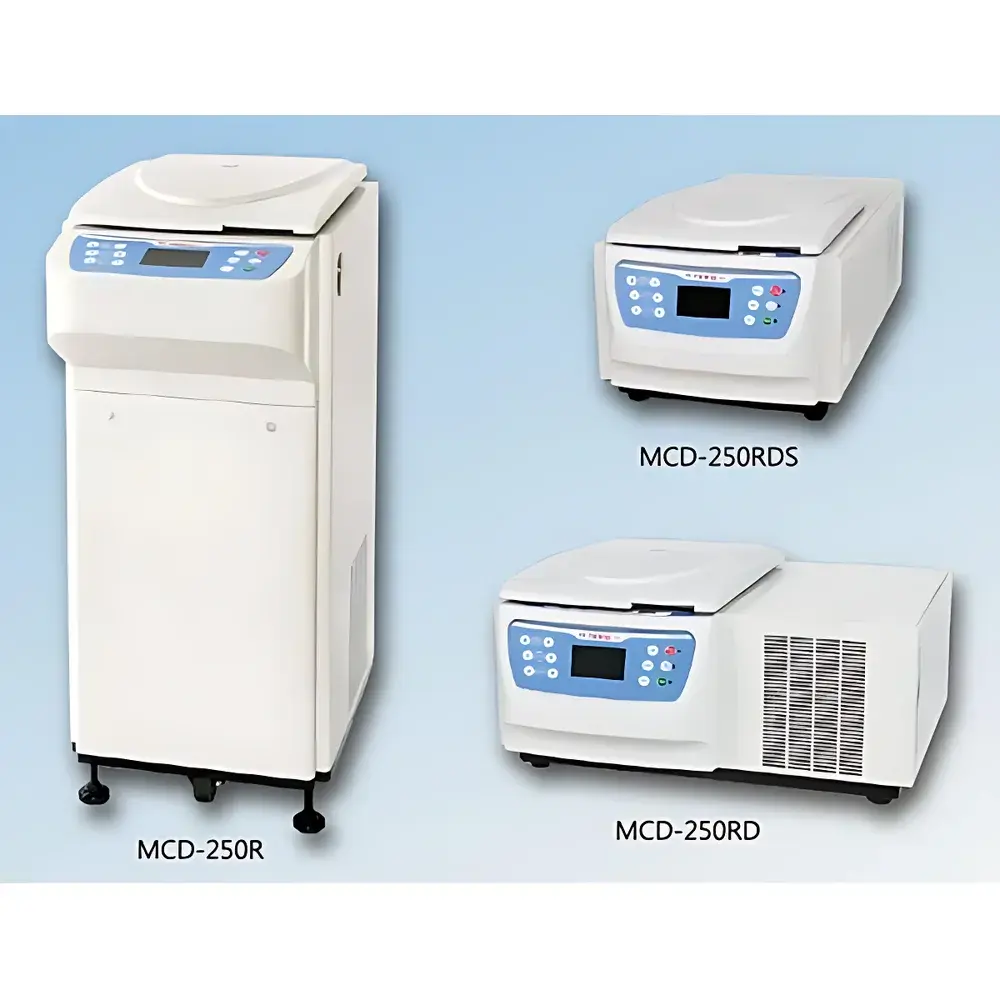
HsiangTai MCD-250R Benchtop Refrigerated Centrifuge
| Brand | HsiangTai |
|---|---|
| Origin | Taiwan |
| Model | MCD-250R |
| Type | Benchtop Refrigerated Centrifuge |
| Max. Speed | 14,000 rpm |
| Max. RCF | 17,750 × g |
| Capacity | 24 × 1.5 mL tubes |
| Temperature Range | −10 °C to 40 °C |
| Dimensions (W×D×H) | 340 × 700 × 280 mm |
| Power Supply | AC 220 V, 50/60 Hz |
| Rotor Compatibility | Fixed-angle rotors (e.g., REAC-1524) |
| Control | Digital display for speed, RCF, temperature, and time |
| Programmable Methods | 10 user-defined protocols |
| Safety Features | Auto-balance detection, lid interlock, overspeed protection, rotor recognition, and automatic deceleration |
Overview
The HsiangTai MCD-250R is a high-performance benchtop refrigerated centrifuge engineered for precision separation of small-volume biological samples in research laboratories, clinical diagnostics, and quality control environments. It operates on the principle of sedimentation under controlled centrifugal force, enabling rapid pelleting of cells, subcellular organelles, nucleic acids, and protein complexes from microliter-scale volumes. Its brushless DC motor ensures low vibration, extended service life, and consistent rotational stability across the full speed range (1,000–14,000 rpm). The integrated refrigeration system maintains sample integrity by precisely regulating chamber temperature between −10 °C and 40 °C—critical for heat-sensitive biomolecules such as RNA, enzymes, and live-cell suspensions. Designed with a vertical high-profile chassis (340 × 700 × 280 mm), the MCD-250R optimizes footprint efficiency without compromising thermal uniformity or mechanical rigidity.
Key Features
- Brushless DC motor delivering high torque, minimal noise (20,000 hours
- Digital microprocessor control with simultaneous real-time display of speed (rpm), relative centrifugal force (RCF), chamber temperature (°C), and remaining run time (min)
- 10 programmable methods stored in non-volatile memory, supporting repeatable method transfer across instruments
- Intelligent auto-balance detection that halts acceleration if mass asymmetry exceeds ±0.5 g per position—preventing rotor damage and ensuring operator safety
- Multi-layer safety architecture: lid interlock with mechanical + electronic dual verification, overspeed cutoff, rotor recognition via embedded RFID tags, and fault-triggered emergency deceleration
- Soft-braking profile with adjustable deceleration rates (0–9 levels) to minimize resuspension of delicate pellets
Sample Compatibility & Compliance
The MCD-250R accommodates standard microcentrifuge tubes (0.2 mL PCR strips, 0.4 mL, 0.5 mL, 1.5 mL, and 2.0 mL) using fixed-angle rotors including the REAC-1524 (24-position, 1.5/2.0 mL) and REAC-0232 (32-position, 0.2 mL PCR). All rotors are certified to ISO 15195:2018 for calibration traceability and comply with IEC 61010-1:2010 for laboratory equipment safety. The unit meets EN 61326-1:2013 electromagnetic compatibility requirements and supports GLP/GMP workflows through audit-trail-capable parameter logging (when paired with optional USB data export). While not FDA 21 CFR Part 11–certified out-of-the-box, its firmware architecture permits integration into validated systems via external LIMS synchronization.
Software & Data Management
The MCD-250R operates autonomously via front-panel controls but supports external data capture via USB interface (standard). Logged parameters—including start/stop timestamps, actual vs. setpoint values for rpm, RCF, temperature, and runtime—are exportable as CSV files for post-run analysis. Firmware versioning (v2.4+) enables field-upgradable logic for future compliance enhancements, including configurable alarm thresholds and event-driven notification outputs (TTL-compatible). No proprietary software installation is required; raw logs are human-readable and compatible with common statistical platforms (e.g., GraphPad Prism, JMP).
Applications
- Routine nucleic acid purification (plasmid DNA, genomic DNA, RNA) from bacterial lysates and tissue homogenates
- Microscale protein precipitation and clarification prior to SDS-PAGE or LC-MS analysis
- Preparation of exosome-enriched supernatants from cell culture media (3,000–14,000 × g sequential spins)
- High-yield recovery of PCR products and restriction digests in molecular cloning workflows
- Centrifugal concentration of dilute antibody solutions or viral vectors in bioprocessing QC
- Stabilization of enzyme assays requiring cold-stage separation of active fractions
FAQ
What is the minimum detectable imbalance tolerance before automatic shutdown?
The auto-balance system triggers immediate deceleration when radial mass deviation exceeds ±0.5 g per tube position.
Does the MCD-250R support swing-bucket rotors?
No—it is configured exclusively for fixed-angle rotors optimized for rapid pelleting of low-volume samples.
Can the unit maintain −10 °C at maximum speed (14,000 rpm)?
Yes, the compressor-based cooling system achieves and sustains −10 °C at full speed, verified per ISO 21501-4 thermal mapping protocol.
Is rotor lifetime tracked by the instrument?
Each rotor contains an embedded RFID tag storing serial number, material grade, and maximum rated cycles; firmware logs cumulative run hours per rotor ID.
What power protection features are included?
Built-in surge suppression, brownout recovery, and uninterruptible power loss response (safe coast-down with rotor braking inhibition during outage).



