
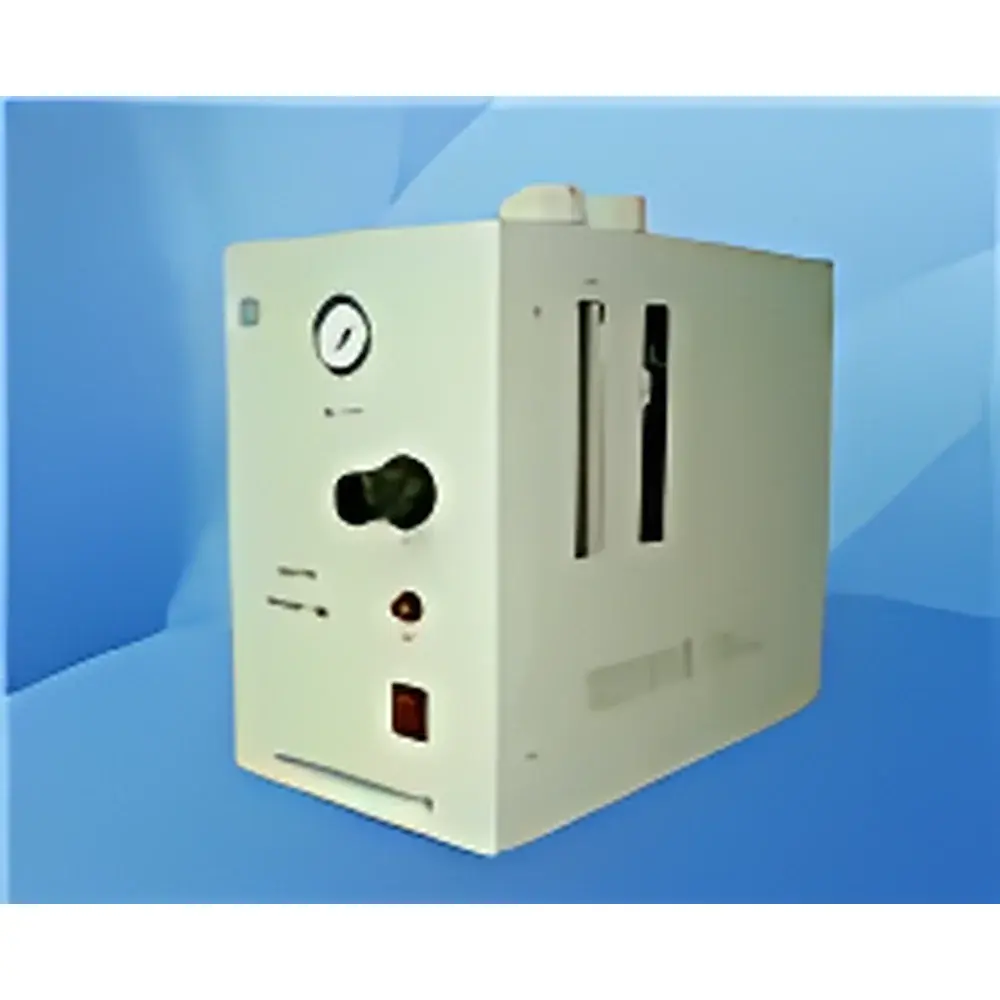
HSPX HS-3 High-Purity Air Generator
| Brand | HSPX |
|---|---|
| Model | HS-3 |
| Origin | Beijing, China |
| Manufacturer Type | Direct Manufacturer |
| Output Flow Rate | 3 L/min |
| Output Pressure Range | 0–0.4 MPa |
| Hydrocarbon Content | ≤0.1 ppm (as methane equivalent) |
| Dew Point | −60 °C |
| Purification Principle | Catalytic Cracking of Hydrocarbons |
| Power Consumption | <170 W |
| Input Voltage | 220 V ±10%, 50–60 Hz |
| Dimensions (L×W×H) | 420 × 230 × 350 mm |
| Net Weight | <26 kg |
Overview
The HSPX HS-3 High-Purity Air Generator is an engineered gas source system designed to deliver consistent, low-hydrocarbon, dry compressed air for analytical instrumentation requiring stable and contamination-controlled pneumatic supply. It operates on a dual-stage purification architecture: first, oil-free compression generates ambient air at regulated pressure; second, integrated catalytic cracking technology oxidizes trace hydrocarbons—including alkanes, alkenes, and aromatics—into CO₂ and H₂O, followed by deep desiccant drying and coalescing filtration. This process ensures compliance with stringent air purity requirements for sensitive detection systems such as flame ionization detectors (FID), nitrogen-phosphorus detectors (NPD), and electron capture detectors (ECD) in gas chromatography (GC) laboratories. Unlike conventional oil-lubricated compressors or bottled air, the HS-3 eliminates cylinder handling, pressure fluctuations, and batch-to-batch variability—making it suitable for unattended, 24/7 operation in QC labs, environmental testing facilities, and pharmaceutical R&D environments.
Key Features
- Oil-free diaphragm compressor ensures zero hydrocarbon carryover from mechanical lubrication
- Catalytic hydrocarbon removal module certified to reduce total hydrocarbons to ≤0.1 ppm (v/v) as methane, validated per ASTM D6299 and ISO 8573-1 Class 1:2:1:1
- Multi-stage purification train: particulate pre-filter → catalytic converter → refrigerated condenser → coalescing separator → desiccant dryer → final 0.01 µm membrane filter
- Stable output pressure control (0–0.4 MPa) with digital pressure regulation and real-time monitoring via front-panel gauge
- Adjustable flow rate up to 3 L/min at constant pressure, with built-in buffer tank for pulse damping and flow stabilization
- Low-noise operation (<52 dB[A] at 1 m), enabling placement inside instrument rooms or fume hoods without acoustic interference
- Thermal overload protection, automatic restart after cooling, and LED status indicators for system health monitoring
Sample Compatibility & Compliance
The HS-3 supplies purified air compatible with all GC detector types requiring combustion-grade support gas, including FID, TCD, and PID. Its dew point of −60 °C meets ISO 8573-1:2010 Class 2 for moisture content and supports long-term column stability in capillary GC applications. The unit complies with IEC 61000-6-3 (EMC emissions) and IEC 61000-6-2 (immunity). For regulated environments, its fixed-parameter operation supports audit-ready documentation under GLP and GMP frameworks; while not inherently 21 CFR Part 11 compliant, it integrates seamlessly with LIMS-controlled workflows when paired with external data loggers recording pressure, runtime, and maintenance intervals.
Software & Data Management
The HS-3 is a standalone hardware system with no embedded firmware or network interface. All operational parameters—including cumulative runtime, compressor cycle count, and filter service alerts—are tracked manually via visual inspection and scheduled maintenance logs. Users are advised to integrate the generator into facility-wide preventive maintenance programs aligned with ISO/IEC 17025 Clause 6.4.2 (equipment management). Optional analog output (0–5 V or 4–20 mA) for pressure and flow can be added upon request to enable connection to SCADA or building management systems for remote monitoring.
Applications
- Carrier and makeup gas for GC-FID and GC-NPD in environmental analysis (e.g., EPA Method 8260, 8270)
- Zero-air supply for calibration gas generators and dilution systems
- Pneumatic actuation for automated sample introduction modules (e.g., autosamplers, purge-and-trap systems)
- Instrument air for FTIR spectrometers, laser-based analyzers, and particle counters requiring non-reactive, dry gas
- Lab-wide compressed air backbone in small-to-midsize analytical labs where centralized air systems are cost-prohibitive
FAQ
What is the recommended maintenance schedule for the HS-3?
Filter cartridges and desiccant media should be replaced every 6 months under continuous operation, or after 2,000 hours of runtime—whichever occurs first. Catalytic converter lifetime exceeds 10,000 hours under typical lab conditions.
Can the HS-3 be used with GC-MS systems?
No. The HS-3 is not intended for mass spectrometer ion source gases due to insufficient oxygen purity and absence of hydrocarbon-free certification to ASTM D1946 or ISO 8573-1 Class 0 requirements.
Is the output pressure adjustable during operation?
Yes. A calibrated needle valve and integrated pressure regulator allow fine-tuning between 0 and 0.4 MPa without interrupting airflow or requiring system shutdown.
Does the unit require external cooling or ventilation?
No dedicated cooling is required. The unit operates within ambient temperatures of 5–35 °C and must be installed in a well-ventilated area with ≥10 cm clearance around all sides for convective heat dissipation.
How does the catalytic hydrocarbon removal compare to activated carbon filtration?
Catalytic cracking achieves irreversible oxidation of hydrocarbons down to sub-ppb levels across a broad volatility range, whereas carbon adsorption exhibits saturation, channeling, and thermal desorption risks—especially under variable flow or humidity conditions.



