
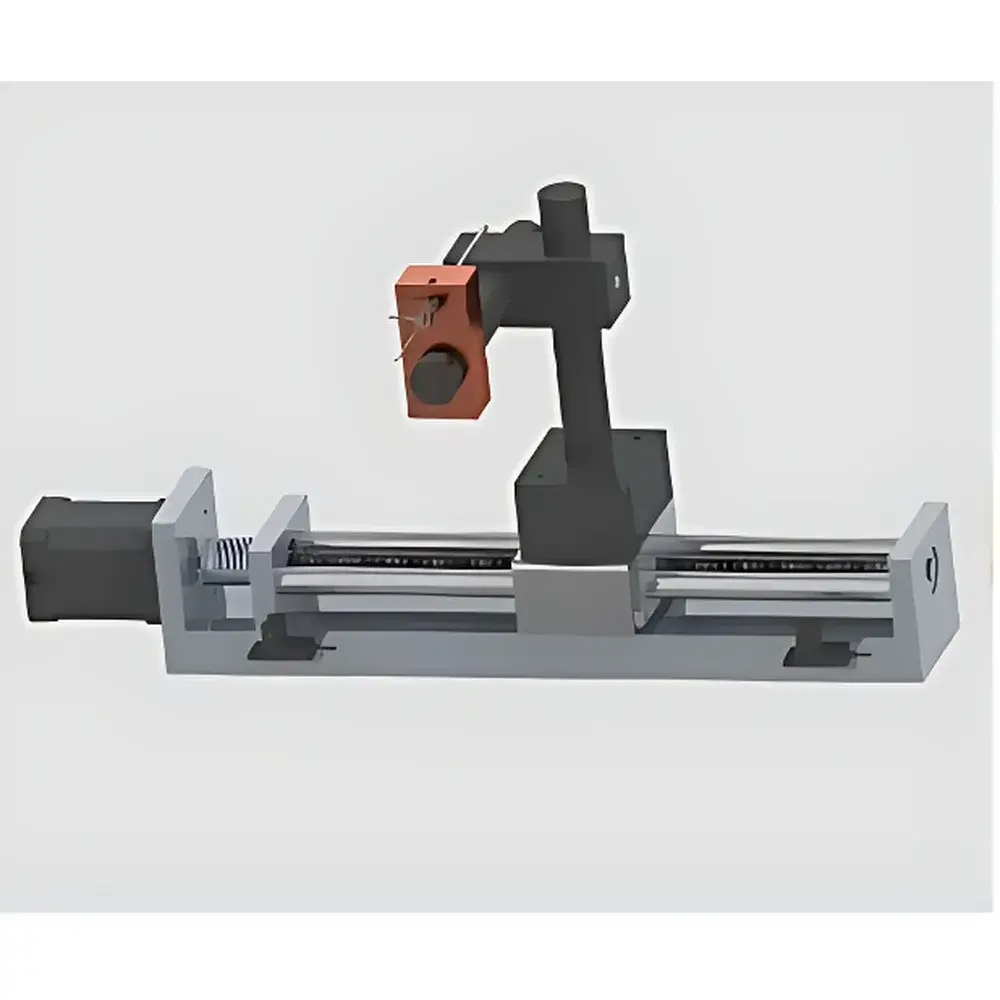
HT200 Reciprocating Nozzle Translation Stage for Electrospinning
| Key | Brand: Chu Bai / Truelab |
|---|---|
| Origin | Shanghai, China |
| Manufacturer Type | Authorized Distributor |
| Country of Origin | China |
| Model | HT200 |
| Pricing | Available Upon Request |
| Stroke Range | 0–200 mm (manually adjustable) |
| Translation Speed | 0–1000 ±1 mm/min |
Overview
The HT200 Reciprocating Nozzle Translation Stage is an engineered mechanical platform designed specifically for precision-controlled linear motion of electrospinning nozzles in nanofiber fabrication systems. It operates on a robust linear translation principle—utilizing a high-rigidity aluminum alloy base, precision-ground stainless-steel guide rails, and a calibrated lead-screw drive mechanism—to deliver stable, repeatable back-and-forth motion along a single axis. This stage is not a standalone instrument but a critical subsystem integrated into laboratory-scale electrospinning setups, where controlled collector or nozzle movement directly influences fiber alignment, mat uniformity, and scaffold architecture. Its core function is to translate the charged polymer solution delivery point across defined spatial coordinates at user-defined velocities and stroke lengths—enabling fabrication of oriented nanofibrous structures such as aligned mats, gradient scaffolds, or layered composites.
Key Features
- Precision manual stroke adjustment from 0 to 200 mm, with engraved scale indicators and locking thumbscrews for repeatable positioning.
- Smooth, low-backlash linear motion with speed controllability from 0 to 1000 ±1 mm/min via external K13 reciprocating motion controller (sold separately).
- Dedicated copper-based nozzle holder assembly—engineered for optimal electrical conductivity and mechanical stability—ensuring consistent charge transfer during high-voltage electrospinning (typically 10–30 kV DC).
- Three-axis micro-adjustment capability: independent vertical height adjustment of the nozzle mount, horizontal spacing control between nozzle tip and collector surface, and fine-tuned lateral alignment for multi-nozzle configurations.
- Modular mounting interface compatible with standard optical breadboards (M6 threaded holes on base plate) and adaptable to custom frames or commercial electrospinning enclosures.
- Support for single-needle, multi-needle arrays, and coaxial dual-nozzle assemblies—facilitating co-axial electrospinning, blend spinning, or parallel deposition experiments.
Sample Compatibility & Compliance
The HT200 stage is compatible with all common electrospinning needle types—including stainless steel Luer-lock, blunt-tip, and tapered capillaries (inner diameters 0.2–1.2 mm)—and accommodates both syringe pump-fed and pressure-driven feed systems. Its conductive copper nozzle holder maintains electrostatic continuity without requiring additional grounding straps. While the stage itself does not carry regulatory certification, its mechanical design and material selection align with general laboratory equipment safety standards (IEC 61010-1). When operated within validated electrospinning protocols, it supports compliance with materials characterization workflows referenced in ISO 18562 (biocompatibility of medical devices), ASTM D3826 (tensile properties of nanofiber mats), and GLP-aligned documentation practices for preclinical scaffold development.
Software & Data Management
The HT200 stage functions as a hardware component controlled exclusively via the K13 motion controller, which provides analog voltage input (0–10 V) and digital TTL trigger compatibility. The K13 unit features an intuitive rotary encoder interface and LCD display for real-time parameter readout (speed, direction, cycle count). Although the stage lacks embedded firmware or USB/Ethernet connectivity, its analog control interface enables seamless integration with third-party data acquisition systems (e.g., LabVIEW, MATLAB, Python-based DAQ platforms) for synchronized logging of translational position, voltage, current, and environmental parameters (temperature/humidity). Audit trails for motion settings can be maintained manually or through externally logged controller output files—supporting traceability requirements under internal quality management systems.
Applications
- Controlled fabrication of aligned polymeric nanofibers for neural tissue engineering and tendon regeneration studies.
- Development of graded fiber density membranes for wound dressing optimization and drug release profiling.
- Multi-nozzle electrospinning of heterogeneous scaffolds combining different polymers (e.g., PCL/PLGA blends) or bioactive agents (growth factors, antibiotics).
- Process validation studies assessing the effect of nozzle translation velocity on fiber diameter distribution (measured via SEM image analysis per ISO/IEC 17025-accredited methods).
- Rapid prototyping of electrospun battery separators and filtration media requiring directional pore architecture.
FAQ
Is the HT200 stage compatible with high-voltage electrospinning systems up to 30 kV?
Yes—the copper nozzle holder and insulated base structure are designed to maintain dielectric integrity and minimize field distortion at operating voltages up to 30 kV DC.
Can the stroke length be set to non-integer values within the 0–200 mm range?
Yes—stroke is adjusted manually using micrometer-style vernier scales; resolution is limited only by operator visual acuity and mechanical backlash, typically ≤0.1 mm repeatability.
Does the stage include limit switches or end-of-travel protection?
No—end-of-travel detection and hard stops must be implemented externally via the K13 controller’s programmable pause function or mechanical bumpers mounted on the base frame.
What is the maximum load capacity for the nozzle holder?
The stage supports static loads up to 1.2 kg distributed across the nozzle mount; dynamic loading during acceleration/deceleration should remain below 0.8 kg to preserve long-term positional accuracy.
Is technical documentation available in English with dimensional drawings and mounting specifications?
Yes—English-language mechanical drawings (PDF), assembly instructions, and torque specifications for all fasteners are provided upon request to registered institutional users.



