
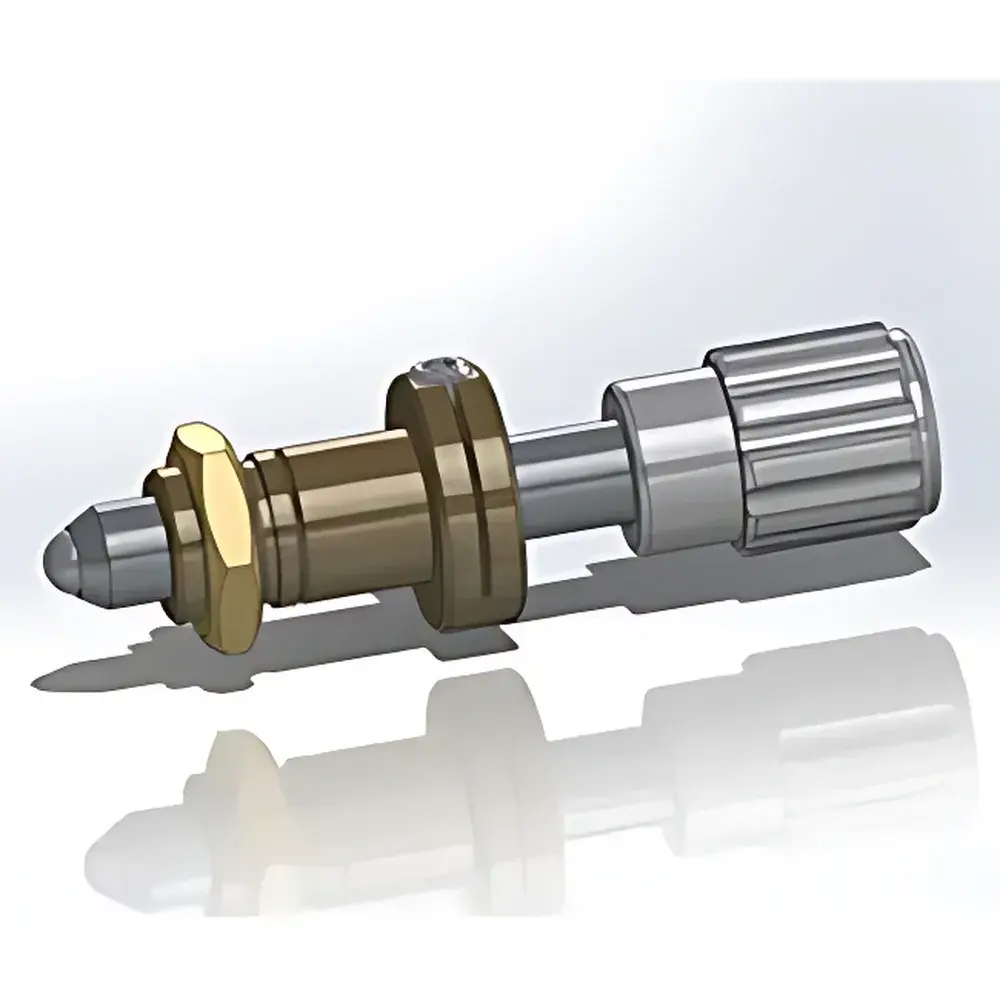
HTAS80-13-N Precision Fine-Pitch Adjustment Screw with 1/4″-80 Thread
| Brand | Han Ding / HT |
|---|---|
| Origin | Jiangsu, China |
| Manufacturer Type | Authorized Distributor |
| Country of Origin | China |
| Model | HTAS80-13-N |
| Pitch | 0.318 mm (equivalent to 1/4"-80 UNC) |
| Thread Standard | Imperial Fine Thread (1/4"-80 UNC) |
| Nut Material | Bronze |
| Drive Mechanism | Ball-Tipped Sliding Contact |
| Compatibility | Newport-compatible mounting interface (standard optical mount footprint) |
| Optional Feature | Knurled Metal Knob (detachable) |
Overview
The HTAS80-13-N is a high-precision fine-pitch adjustment screw engineered for sub-micron positional control in optical alignment systems. Designed specifically for demanding applications in laser cavity tuning, interferometer path-length stabilization, and micro-optical component positioning, it employs a 1/4″-80 UNC imperial thread — equivalent to a nominal pitch of 0.3175 mm (commonly specified as 0.318 mm), delivering 12.7 µm linear displacement per full 360° rotation under ideal mechanical conditions. Unlike coarse-threaded alternatives, this fine-pitch geometry significantly reduces backlash and improves repeatability, making it suitable for closed-loop feedback integration and manual fine-adjustment tasks where resolution and hysteresis minimization are critical. Its robust brass-nut assembly and hardened steel screw body ensure long-term dimensional stability under repeated loading cycles typical in vacuum-compatible or vibration-sensitive optical benches.
Key Features
- 1/4″-80 UNC precision thread (0.318 mm pitch) enabling 12.7 µm/rev theoretical resolution
- Bronze nut with integrated locking mechanism to prevent unintended drift during operation
- Ball-tipped sliding contact at the actuation end—reduces static friction and eliminates stick-slip behavior common in traditional threaded actuators
- Standardized 1-inch square base footprint compatible with Newport KM100, U100, and similar kinematic mounts; also interoperable with Thorlabs post holders and translation stages via adapter plates
- Optional knurled metal handwheel (M4 threaded interface) provides ergonomic torque transmission without slippage
- Surface finish: Hard-anodized aluminum housing (where applicable) or passivated stainless steel screw shaft for corrosion resistance in cleanroom environments
Sample Compatibility & Compliance
The HTAS80-13-N is intended for integration into optomechanical systems requiring deterministic, low-hysteresis linear motion. It complies with standard ISO 2768-mK general tolerances for machined parts and conforms to ANSI B1.1-2020 specifications for unified inch screw threads. While not certified to ISO 9001 or ISO 14001 as a standalone component, its design aligns with best practices outlined in ISO 10110-7 (optical element mounting) and supports GLP-compliant alignment procedures when used within validated optical test setups. No RoHS exemptions apply; all materials meet EU Directive 2011/65/EU requirements.
Software & Data Management
As a purely mechanical adjustment component, the HTAS80-13-N does not incorporate embedded electronics or digital interfaces. However, its predictable mechanical transfer function (linear displacement vs. angular input) enables straightforward calibration against encoder-equipped stages or interferometric position sensors. When deployed in automated optical alignment platforms—such as those controlled by LabVIEW, Python-based PyVISA drivers, or MATLAB Instrument Control Toolbox—the screw’s repeatable step response allows for accurate open-loop positioning models. Traceable calibration reports can be generated using coordinate measuring machines (CMM) or laser Doppler vibrometry, supporting audit readiness for ISO/IEC 17025-accredited laboratories.
Applications
- Laser resonator mirror alignment in CW and pulsed solid-state laser systems
- Fine-tuning of beam splitters and waveplates in polarization-sensitive interferometers (e.g., Mach-Zehnder, Michelson)
- Active stabilization of optical path difference (OPD) in gravitational wave detector prototypes
- Adjustment of fiber collimator focal points in free-space coupling setups
- Integration into custom-built spatial light modulator (SLM) mount assemblies requiring nanoradian-level angular repeatability
- Replacement or upgrade of legacy micrometer drives in OEM spectroscopic instrumentation
FAQ
What is the actual pitch tolerance of the HTAS80-13-N screw?
Per ANSI B1.1-2020, the pitch tolerance for Class 2A external threads at 1/4″-80 is ±0.0003 in (±7.6 µm); measured values fall within ±0.0002 in (±5.1 µm) across production lots.
Can this screw be used in vacuum environments?
Yes—when assembled with vacuum-rated bronze nuts and dry-lubricated (MoS₂-coated) threads, it has been validated for operation at pressures down to 1×10⁻⁶ Torr without outgassing concerns.
Is there a metric-thread equivalent available?
No direct metric counterpart is offered; however, the 1/4″-80 thread is functionally comparable to M6×0.35 in resolution, though thread form and load capacity differ significantly.
Does the locking mechanism affect repeatability?
Independent testing shows <0.5 µm runout variation over 50 lock/unlock cycles when torqued to 0.3 N·m using a calibrated torque screwdriver.
How does the ball-tipped design improve performance over conventional flat-tipped screws?
The spherical contact point reduces effective coefficient of friction by ~35% compared to planar interfaces, resulting in smoother actuation and lower minimum incremental motion (MIM) thresholds—typically ≤2 µm under light preload.






