
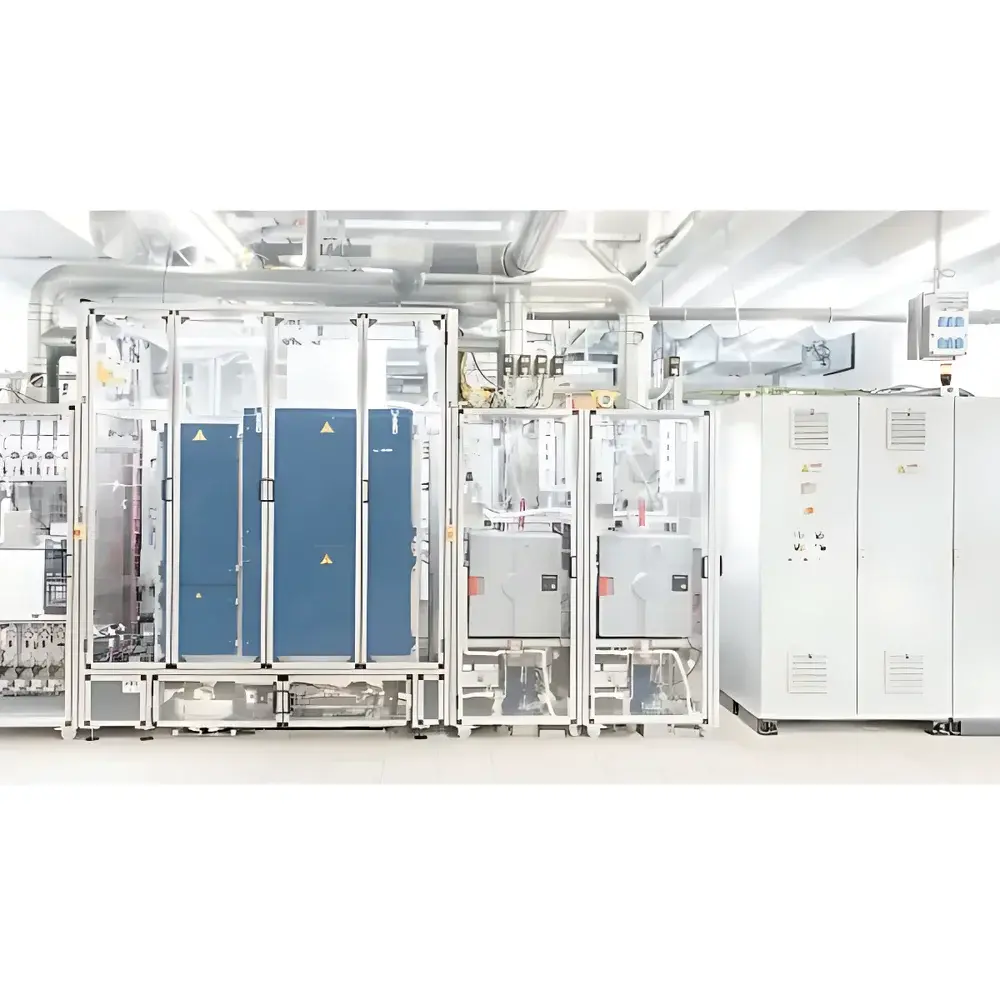
hte X4500 Series High-Throughput Hydroprocessing Catalyst Evaluation System
| Brand | hte |
|---|---|
| Origin | Germany |
| Manufacturer Type | Authorized Distributor |
| Origin Category | Imported |
| Model | X4500 |
| Pricing | Upon Request |
Overview
The hte X4500 Series High-Throughput Hydroprocessing Catalyst Evaluation System is a fully integrated, laboratory-scale continuous-flow platform engineered for rigorous kinetic, stability, and selectivity assessment of heterogeneous catalysts under industrially relevant hydroprocessing conditions. Based on fixed-bed reactor architecture and compliant with ASTM D6231 (Standard Test Method for Determining Catalyst Activity in Hydrodesulfurization), the system implements precise temperature-gradient control, multi-zone furnace heating, and real-time mass-balanced feed delivery to emulate commercial hydrotreater and hydrocracker operating envelopes. Designed as a turnkey solution validated through hte’s Contract Research Program, the X4500 supports operation across the full spectrum of hydroprocessing reactions—including hydrodesulfurization (HDS), hydrodenitrogenation (HDN), hydrodeoxygenation (HDO), hydrodearomatization (HAD), hydroisomerization, dewaxing, and biomass-derived feedstock upgrading—under pressures up to 200 bar and temperatures up to 500 °C.
Key Features
- 16 parallel fixed-bed reactors housed in a modular multi-zone furnace; inter-reactor temperature uniformity < ±1 °C within isothermal zones
- Mass-flow-controlled gaseous feed delivery (H₂, H₂S, NH₃, etc.) using calibrated Bronkhorst or Brooks mass flow controllers
- High-viscosity liquid feed handling up to 150 °C, including vacuum residues and heavy fractions, via gravimetric dosing vessels with in-situ mixing
- In-situ catalyst activation using dimethyl disulfide (DMDS) injection and programmable sulfidation protocols
- Integrated high-pressure gas–liquid phase separation with automated online sampling under reaction pressure
- Steady-state liquid product withdrawal via hte’s proprietary pressure-compensated robotic sampler, enabling unattended multi-day operation
- Onboard steam stripping module to volatilize light ends and prevent fouling by polymeric sulfur species
- Dedicated hteControl™ automation suite with IEC 61131-3-compliant logic, supporting sequential, parallel, and cascaded reactor configurations (upflow/downflow)
Sample Compatibility & Compliance
The X4500 accommodates diverse catalyst forms—from fine powders (≤50 µm) to extrudates, pellets, and monoliths—across reactor volumes ranging from 0.5 mL to 10 mL. Feedstock compatibility spans naphthas, gas oils, bio-oils, pyrolysis liquids, and synthetic crudes. All pressure-retaining components conform to PED 2014/68/EU and ASME BPVC Section VIII Div. 1. Electrical safety complies with IEC 61000-6-2/6-4 and UL 61010-1. The system carries CE marking and meets NACE MR0175/ISO 15156 for sour service environments. Factory Acceptance Testing (FAT) and Site Acceptance Testing (SAT) are performed per ISO/IEC 17025-accredited procedures, including leak testing, thermal mapping, and dynamic response validation.
Software & Data Management
hteControl™ provides closed-loop automation of feed rates, temperature ramps, pressure setpoints, and sampling sequences via OPC UA–enabled communication. myhte™ serves as the central data repository, storing raw sensor logs, GC chromatograms (PIONA, SIMDIS, MOC), elemental analysis (ICP-OES, XRF), and physical property measurements (density, viscosity, distillation curves) in a relational SQL database. All analytical metadata—including sample IDs, timestamps, operator annotations, and instrument calibration records—are traceable for GLP/GMP compliance. Audit trails adhere to FDA 21 CFR Part 11 requirements, with electronic signatures, role-based access control, and immutable log archiving. Offline lab data (e.g., metal content, Conradson carbon residue) can be imported via CSV or LIMS API integration.
Applications
- Kinetic modeling of HDS/HDN/HDO pathways using time-on-stream deactivation studies
- Screening of NiMo, CoMo, NiW, and noble-metal catalysts for ultra-low-sulfur diesel (ULSD) production
- Evaluation of bifunctional catalysts in hydroisomerization of linear paraffins
- Stability testing of catalysts exposed to high-nitrogen or high-oxygen feeds derived from lignocellulosic biomass
- Reaction network analysis of catalytic cracking–hydrogenation hybrids under mixed-phase conditions
- Development of sulfur-tolerant catalysts for renewable diesel co-processing in existing refineries
FAQ
What reactor configurations does the X4500 support?
It supports independent single-reactor operation, parallel screening across 16 channels, and configurable cascades (2–4 reactors in series) with optional inter-stage quenching or re-heating.
Is the system compatible with third-party GC or IR analyzers?
Yes—standardized ¼″ Swagelok fittings and analog/digital I/O interfaces enable seamless integration with Agilent, Thermo Fisher, or Bruker GC systems, as well as FTIR or TCD-based permanent gas analyzers.
How is catalyst loading and unloading performed?
Reactor cartridges are designed for rapid exchange using standardized flange connections; loading is supported by hte’s optional vibratory packing station and density-calibrated volumetric dispensers.
What infrastructure is required for installation?
Minimum floor loading capacity: 500 kg/m²; ambient HVAC control (±2 °C); electrical supply: 400 VAC, 3-phase, 5-wire, 10 kVA; ventilation exhaust: ≥1300 m³/h; instrument air: 6.5 bar, oil-free.
Does hte provide method development support?
Yes—hte offers application-specific protocol development, including sulfidation ramp profiles, steady-state criteria definition, and mass-balance reconciliation workflows aligned with ASTM D7501 and ISO 10723.



