
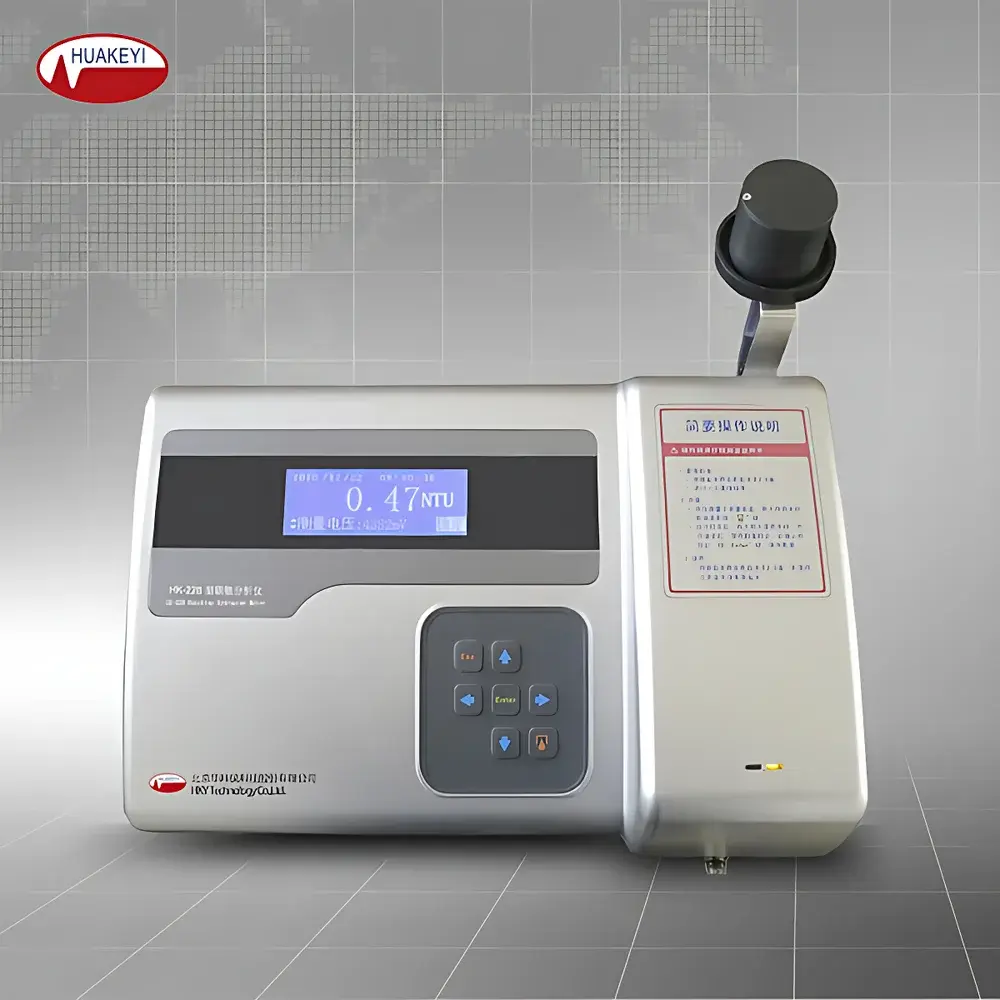
Huake Instrument HK-228 Hydrazine Analyzer
| Brand | Huake Instrument |
|---|---|
| Origin | Beijing, China |
| Manufacturer Type | Authorized Distributor |
| Origin Category | Domestic (China-made) |
| Model | HK-228 |
| Price Range | USD 1,400 – 4,200 |
| Instrument Type | Benchtop Water Quality Analyzer |
| Analyte | Hydrazine (N₂H₄) |
| Display | 192 × 64 Dot-Matrix LCD (Chinese/English Switchable) |
| Measurement Range | 0–100 µg/L |
| Resolution | 0.1 µg/L |
| Basic Error | ±2% FS |
| Repeatability | ≤1% |
| Stability | ±1% FS / 4 h |
| Ambient Temperature | 5–45 °C |
| Relative Humidity | ≤90% RH (non-condensing) |
| Power Supply | AC 100–240 V, 50–60 Hz |
| Power Consumption | 40 W |
| Dimensions (L×W×H) | 392 × 260 × 100 mm |
| Weight | 5 kg |
Overview
The Huake Instrument HK-228 Hydrazine Analyzer is a benchtop photometric water quality analyzer engineered for precise, trace-level quantification of hydrazine (N₂H₄) in ultrapure and process water streams. It operates on the principle of colorimetric analysis using a high-stability monochromatic cold light source—typically operating at a wavelength optimized for the hydrazine–p-dimethylaminobenzaldehyde (DMAB) derivative reaction (λ ≈ 455 nm). Unlike spectrophotometric systems requiring spectral scanning, the HK-228 employs fixed-wavelength photometry with temperature-controlled optical path geometry, minimizing drift and enhancing long-term measurement fidelity. Designed specifically for continuous monitoring and routine verification in critical water loops, it meets operational requirements in thermal power plant feedwater, nuclear secondary coolant systems, boiler drum water, and high-purity water circuits in pharmaceutical and microelectronics manufacturing. Its compact footprint and low power draw support integration into QC laboratories, mobile calibration carts, and on-site maintenance stations.
Key Features
- Stable monochromatic cold light source with calibrated spectral output and <1% intensity drift over 1,000 hours—ensuring consistent photometric baseline across extended operation.
- Integrated 32-bit embedded microcontroller architecture with surface-mount technology (SMT) PCB assembly, delivering deterministic real-time control of optical alignment, thermal regulation, and signal acquisition.
- Rugged IP65-rated housing with full silicone membrane overlay keypad—resistant to splash, dust, and incidental chemical exposure in industrial environments.
- Imported silicon photodiode detector with temperature-compensated transimpedance amplifier, achieving signal-to-noise ratio >5,000:1 at 0.1 µg/L input.
- Fuzzy PID-based thermostatic control system for the cuvette chamber, maintaining optical path temperature within ±0.2 °C—critical for minimizing reagent kinetics variability and photometric drift.
- Reagent-free zero calibration using blank deionized water, eliminating procedural errors associated with standard solution handling and reducing operator dependency.
- Multi-point curve calibration capability (up to 5 points), supporting non-linear response compensation across the full 0–100 µg/L range per ASTM D3755 and ISO 7027-compliant validation protocols.
- Configurable password protection (administrator/operator levels) aligned with GLP data integrity requirements; prevents unauthorized parameter modification or calibration reset.
- Internal non-volatile memory storing ≥10,000 timestamped measurement records with auto-logging interval (1 min to 24 h), accessible via on-screen scroll or USB export.
Sample Compatibility & Compliance
The HK-228 is validated for use with low-conductivity water matrices (≤1 µS/cm) including demineralized, reverse-osmosis, and mixed-bed polished water. It accommodates standard 10-mm pathlength quartz or high-transmission acrylic cuvettes (10 mL volume). Sample introduction is manual via supplied sample cup; optional peristaltic pump interface (HK-ACC-PUMP) enables semi-automated batch analysis. The analyzer complies with key regulatory frameworks governing water quality instrumentation: its calibration traceability aligns with NIST-traceable hydrazine reference standards (e.g., AccuStandard HYDZ-100PPB), and its data handling supports audit-ready documentation per FDA 21 CFR Part 11 when paired with Huake’s optional HK-DataLink software (version 2.3+). It satisfies IEC 61000-4 electromagnetic compatibility standards and meets UL/CSA safety requirements for Class I, Division 2 environments.
Software & Data Management
While the HK-228 operates as a standalone instrument, its embedded firmware supports bidirectional RS-232 and USB-B communication for external data capture. Huake’s HK-DataLink PC software (Windows 10/11 compatible) provides secure, encrypted data transfer with automatic timestamping, user ID logging, and electronic signature support. All calibration events, measurement logs, and system diagnostics are stored with immutable metadata—including ambient temperature, lamp intensity reading, and thermal stability index—enabling full GMP/GLP-compliant audit trails. Export formats include CSV (for LIMS integration), PDF reports (with configurable header/footer), and XML (for enterprise SCADA ingestion). Firmware updates are delivered via signed .bin files with SHA-256 hash verification.
Applications
- Monitoring hydrazine residual in high-pressure boiler feedwater to ensure oxygen scavenging efficacy while avoiding excess dosing that contributes to corrosion under deposits (CUD).
- Verification of hydrazine removal efficiency in condensate polishing units prior to return to steam cycle.
- QC release testing of ultrapure water (UPW) used in semiconductor wet benches where hydrazine contamination may interfere with copper electroplating bath stability.
- Periodic verification of online hydrazine analyzers in nuclear power plants per EPRI TR-102397 guidelines.
- Research-grade quantification in corrosion inhibition studies involving hydrazine derivatives in simulated cooling water systems.
FAQ
What hydrazine detection method does the HK-228 employ?
It uses a standardized colorimetric method based on the reaction between hydrazine and p-dimethylaminobenzaldehyde (DMAB) under acidic conditions, forming a yellow azine derivative measured at 455 nm.
Is the instrument suitable for field use?
Yes—the IP65 enclosure, wide ambient temperature tolerance (5–45 °C), and AC universal power input make it deployable in turbine halls, chemical dosing rooms, and mobile lab vans.
Can the HK-228 be integrated into a plant DCS or SCADA system?
Direct analog output (4–20 mA) is not built-in, but optional HK-IO-420 module provides isolated current loop output with configurable range and damping, enabling seamless integration.
How often does the optical system require maintenance?
No scheduled lamp replacement is required within first 3 years; the cold LED source has rated lifetime >10,000 hours. Cuvette cleaning and blank verification are recommended before each analytical session.
Does the analyzer support USP <645> or EP 2.2.48 conductivity-hydrazine correlation protocols?
While not a conductivity device, the HK-228’s hydrazine data can be cross-referenced with conductivity trends per USP <645> Annex guidance for detecting amine degradation byproducts in purified water systems.
Related Products







