
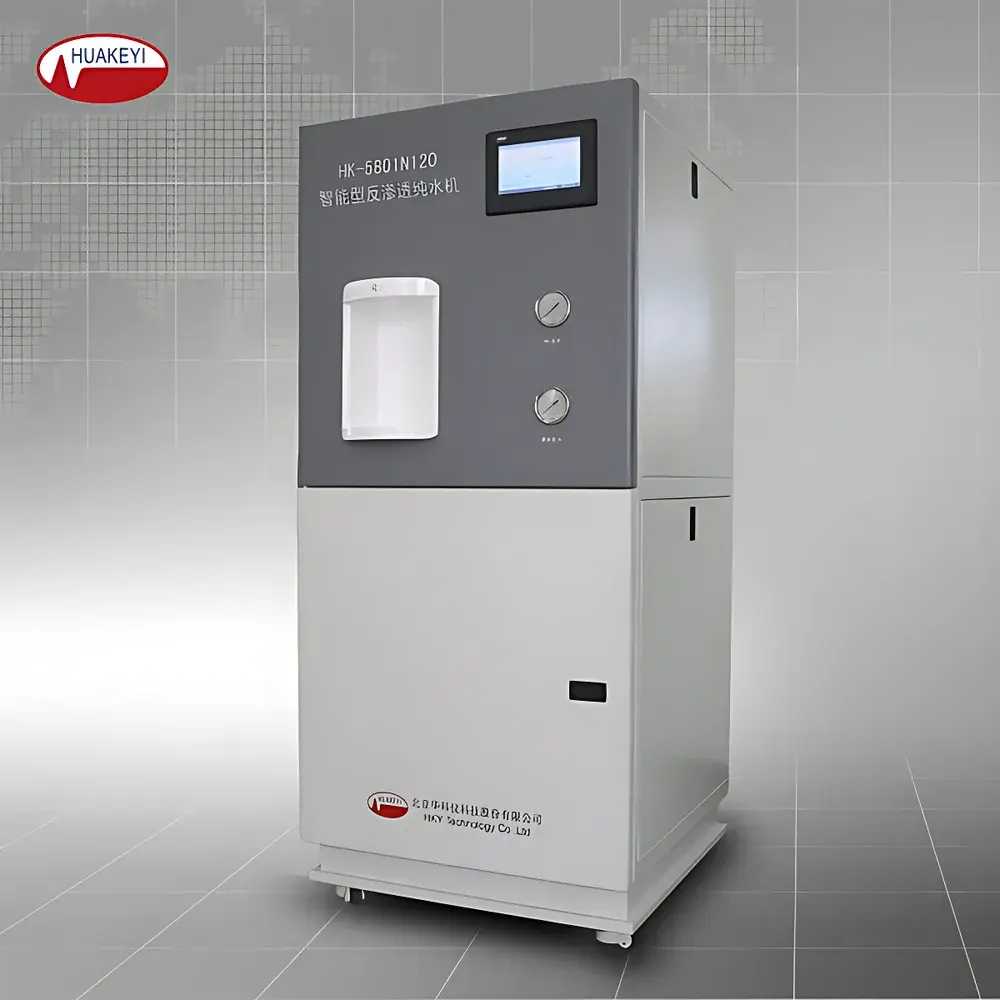
Huake Instrument HK-5801N120 Intelligent Reverse Osmosis Ultra-Pure Water System
| Brand | Huake Instrument |
|---|---|
| Origin | Beijing, China |
| Model | HK-5801N120 |
| Purified Water Grade | Type I (ASTM D1193-20) |
| Resistivity | 18.2 MΩ·cm @ 25°C |
| Heavy Metals & Soluble Silica | < 0.5 ppb |
| Total Organic Carbon (TOC) | < 10 ppb |
| Microbial Count | < 0.05 EU/mL |
| Particles (>0.1 µm) | < 2 particles/mL |
| RO Recovery Rate | >30% |
| RO Output Capacity | ≥120 L/h @ 25°C |
| Feed Water Requirement | Municipal tap water, TDS < 200 ppm, pressure 0.1–0.4 MPa, temp. 5–45°C |
| Integrated Storage | 6-gallon pressurized tank (optional 11-gallon external tank) |
| UV Sterilization | Built-in 185/254 nm dual-wavelength lamp |
| Conductivity Monitoring | Real-time online measurement with temperature compensation |
| Power Supply | AC 100–120 V or 200–240 V, 50/60 Hz |
| Rated Power | 240 W |
| Dimensions (L×W×H) | 630 × 556 × 611 mm |
Overview
The Huake Instrument HK-5801N120 Intelligent Reverse Osmosis Ultra-Pure Water System is an engineered solution for laboratories and industrial facilities requiring continuous, high-reliability production of Type I ultrapure water per ASTM D1193-20 and ISO 3696:1987 standards. It employs a single-stage reverse osmosis (RO) membrane process as the primary desalination stage, followed by integrated post-treatment modules including dual-wavelength (185/254 nm) UV irradiation, precision polishing cartridge(s), and real-time resistivity/conductivity monitoring. Designed for stable operation under variable municipal feed conditions, the system delivers consistent 18.2 MΩ·cm resistivity water with TOC <10 ppb and endotoxin levels below 0.05 EU/mL—meeting critical requirements for HPLC mobile phase preparation, cell culture media formulation, molecular biology assays, and semiconductor rinse applications.
Key Features
- Intelligent touchscreen interface with color LCD display for real-time monitoring of resistivity, TOC (via optional module), water temperature, system pressure, and operational status
- User-level access control supporting multi-tier authentication (operator, technician, administrator) to ensure secure parameter configuration and service logging
- Automated low-pressure protection shutdown to prevent membrane dry-out and extend RO element service life
- Integrated 6-gallon pressurized storage tank with optional 11-gallon external expansion for high-demand environments
- Quantitative dispensing mode with programmable volume delivery (10 mL–9999 mL) and auto-stop functionality
- Consumable life tracking with visual alerts and maintenance history logging for all replaceable components (RO membrane, DI resin, UV lamp)
- Comprehensive alarm system covering feed pressure anomalies, tank level thresholds, UV lamp failure, and conductivity deviation beyond set tolerance bands
Sample Compatibility & Compliance
The HK-5801N120 produces water compliant with ASTM Type I specifications and meets key regulatory benchmarks for analytical and life science use. Its output satisfies ISO 15195:2018 requirements for reference material certification laboratories and supports GLP/GMP-aligned workflows through traceable calibration records and audit-ready event logs. While not FDA 21 CFR Part 11–validated out-of-the-box, the system architecture permits integration with validated LIMS or ELN platforms via RS232/USB data export. All wetted materials—including housing, tubing, and sensor housings—are constructed from USP Class VI-certified polypropylene and stainless steel 316L to prevent leachables and ensure chemical compatibility with aggressive solvents and alkaline buffers.
Software & Data Management
The embedded firmware provides timestamped, non-erasable system logs covering power cycles, alarm events, consumable replacements, and manual interventions. Data export is supported via USB flash drive in CSV format for offline QA review. Optional Ethernet or Wi-Fi connectivity (with add-on module) enables remote diagnostics, centralized fleet monitoring, and scheduled firmware updates. Calibration certificates for the integrated conductivity sensor are traceable to NIST standards; factory calibration intervals are defined per ISO/IEC 17025:2017 guidelines and include temperature compensation verification across 5–35°C.
Applications
- HPLC, LC-MS, and ICP-MS mobile phase and blank preparation where low TOC and metal contamination are critical
- Cell culture and stem cell expansion requiring endotoxin-free water for media and reagent dilution
- PCR, qRT-PCR, and next-generation sequencing workflows sensitive to nuclease activity and organic interference
- Semiconductor wafer cleaning and photomask rinsing in cleanroom environments (Class 100/ISO 5)
- Calibration of clinical analyzers (e.g., automated biochemistry systems) and diagnostic reagent manufacturing
- Boiler feedwater pretreatment in thermal power plants where silica scaling must be minimized
FAQ
What feed water quality is required for optimal RO membrane performance?
Municipal tap water with TDS ≤200 ppm, free chlorine <0.5 ppm, and turbidity <1 NTU is recommended. For sources exceeding 200 ppm TDS, an external softener or antiscalant dosing unit is advised to mitigate fouling.
Is the system suitable for ISO 17025-accredited testing laboratories?
Yes—when operated within specified environmental limits (10–45°C, ≤90% RH, vibration-free installation), with documented calibration of the conductivity sensor and maintained service records, it fulfills infrastructure requirements for accredited water purification systems.
Can the UV lamp be replaced without system shutdown?
No—the UV chamber requires isolation and depressurization prior to lamp replacement; however, the system supports hot-swap capable lamp modules with quick-release fittings to minimize downtime.
Does the system support third-party data acquisition protocols?
Native Modbus RTU over RS485 is available upon request for integration into building management or centralized utility monitoring systems.
What is the expected service life of the RO membrane under typical lab usage?
With proper pretreatment and feed water conditioning, the RO element typically achieves 2–3 years of service life before replacement, contingent on daily throughput, feed TDS, and maintenance adherence per the manufacturer’s logbook protocol.



