
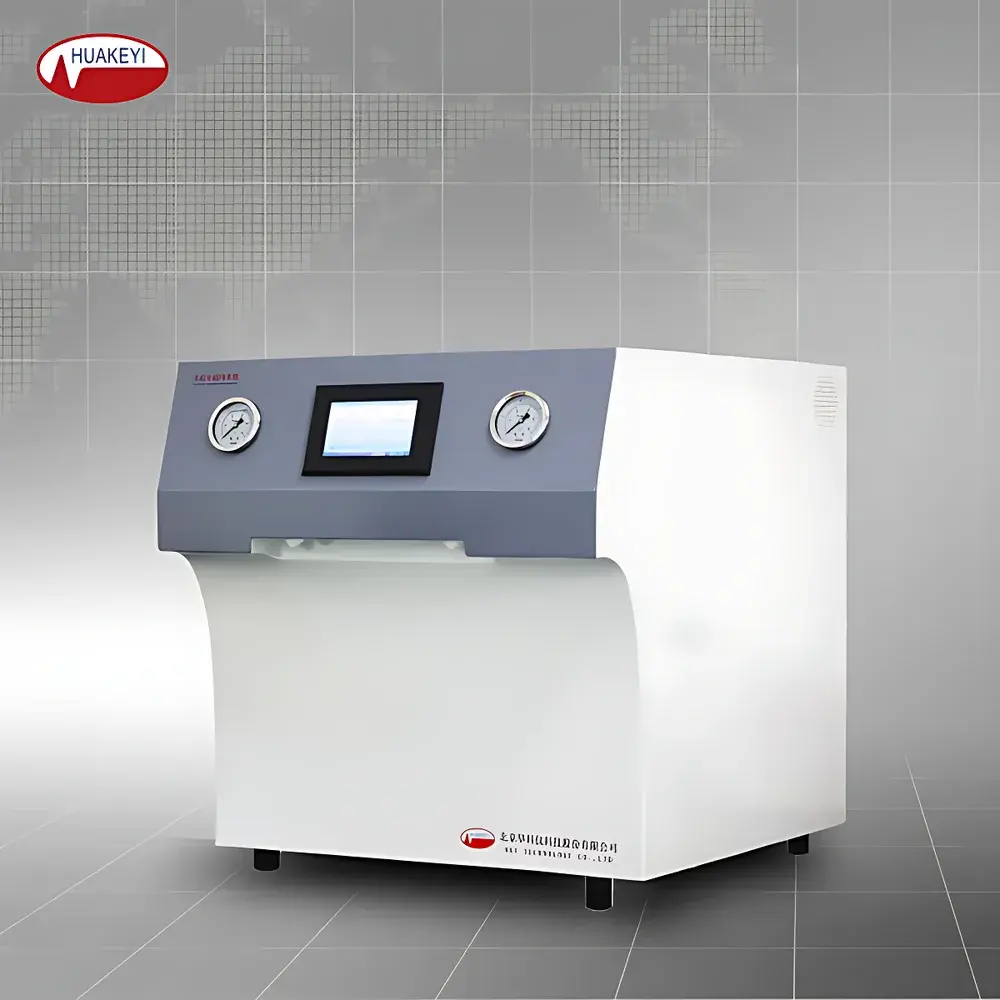
Huake Instrument HK-5801N20 Ultra Pure Water System
| Brand | Huake Instrument |
|---|---|
| Origin | Beijing, China |
| Model | HK-5801N20 |
| Purified Water Grade | Type I (ASTM D1193-20) |
| Resistivity | 18.2 MΩ·cm @ 25 °C |
| Heavy Metals & Soluble Silica | < 0.1 ppb |
| Total Organic Carbon (TOC) | ≤ 10 ppb |
| Microbial Count | < 0.01 EU/mL |
| Particles (> 0.1 µm) | < 4 particles/mL |
| Feed Water Requirement | Municipal tap water, TDS < 500 ppm, 5–45 °C, pressure ≥ 0.15 MPa |
| Production Rate | 20 L/h |
| RO Configuration | Dual-stage reverse osmosis |
| UV Sterilization | Integrated 185/254 nm dual-wavelength lamp |
| Display | Color TFT touchscreen with bilingual (English/Chinese) UI |
| Power Supply | AC 100–120 V or 200–240 V, 50/60 Hz |
| Power Consumption | 240 W |
| Dimensions (L×W×H) | 630 × 556 × 611 mm |
Overview
The Huake Instrument HK-5801N20 Ultra Pure Water System is an engineered solution for laboratories requiring continuous, on-demand production of Type I ultrapure water compliant with ASTM D1193-20, ISO 3696:1987, and CLSI EP28-A3c specifications. It employs a validated dual-stage reverse osmosis (RO) pretreatment stage followed by electrodeionization (EDI) and final polishing via mixed-bed ion exchange and integrated 185/254 nm ultraviolet irradiation. This multi-barrier architecture ensures consistent removal of ions, organic contaminants, endotoxins, nucleases, and particulates—critical for applications including HPLC mobile phase preparation, cell culture media formulation, molecular biology workflows (e.g., PCR, sequencing), and calibration of high-sensitivity analytical instrumentation. Unlike tank-based systems, the HK-5801N20 utilizes a tankless, direct-draw architecture to eliminate stagnant water storage—a primary vector for biofilm formation and organic leaching—thereby maintaining microbiological integrity throughout distribution.
Key Features
- Tankless design with real-time water generation: Eliminates microbial regrowth risk associated with stored ultrapure water and reduces facility footprint.
- Dual-stage RO + EDI + mixed-bed + dual-wavelength UV (185 nm for TOC oxidation; 254 nm for microbial inactivation): Provides redundant contaminant removal pathways for robust, reproducible water quality.
- Integrated online monitoring: Dual sensors continuously measure feed water conductivity, RO permeate conductivity, and UP water resistivity at 25 °C—automatically temperature-compensated per ASTM D1125.
- Color TFT touchscreen interface with English/Chinese bilingual support: Displays real-time parameters (resistivity, TOC, temperature), system status, maintenance alerts, and user-accessible calibration logs.
- Multi-tier user authentication: Configurable administrator, operator, and guest access levels with password protection—supports audit-ready operation under GLP/GMP environments.
- Automated RO membrane flush cycle: Scheduled low-pressure flushing extends membrane life and maintains consistent salt rejection performance (>95% at inlet TDS < 500 ppm).
Sample Compatibility & Compliance
The HK-5801N20 delivers water meeting or exceeding international standards for Type I reagent water: resistivity ≥18.2 MΩ·cm (25 °C), TOC ≤10 ppb, bacterial count <0.01 EU/mL, and particle count 0.1 µm). Its output is suitable for use in USP purified water applications, ISO 15189-accredited clinical labs, and FDA-regulated pharmaceutical R&D. All wetted materials—including UP-grade PFA, PVDF, and sanitary stainless-steel fittings—comply with USP Class VI biocompatibility requirements. The system supports 21 CFR Part 11-compliant data integrity when paired with optional networked logging software (not included), enabling electronic signatures, change control, and secure audit trails.
Software & Data Management
The embedded firmware records all operational events—including sensor readings, alarm triggers, consumable usage hours, and manual interventions—in non-volatile memory with timestamping. Data export is supported via USB port (CSV format) for offline analysis. Optional Ethernet/Wi-Fi connectivity enables remote monitoring, predictive maintenance alerts, and integration into centralized laboratory information management systems (LIMS). All calibration and validation records adhere to ISO/IEC 17025 documentation requirements, including traceability to NIST-traceable reference standards for conductivity/resistivity verification.
Applications
- HPLC, UHPLC, and LC-MS mobile phase and blank preparation
- Cell culture media, transfection reagents, and stem cell expansion buffers
- PCR, qRT-PCR, NGS library prep, and CRISPR-Cas9 editing workflows
- Atomic absorption spectroscopy (AAS), ICP-MS, and TOF-SIMS calibration standards
- Pharmaceutical stability testing, dissolution media, and parenteral formulation
- Electron microscopy sample preparation and TEM grid washing
FAQ
What is the maximum allowable feed water TDS for stable RO performance?
The HK-5801N20 is rated for municipal tap water with TDS ≤500 ppm. For sources >300 ppm, an external softener is recommended to prevent scaling and maintain >30% RO recovery rate.
Does the system meet ISO 3696:1987 Grade 1 specifications?
Yes—output resistivity (18.2 MΩ·cm), TOC (≤10 ppb), and particle count (0.1 µm) satisfy all critical parameters defined in ISO 3696:1987 for Grade 1 water.
How often must consumables be replaced?
RO membranes require replacement every 2–3 years depending on feed water quality; UP polishing cartridges are typically replaced every 6–12 months or after 1,500–2,500 L of UP water, as indicated by resistivity decay or system alert.
Is the UV lamp replaceable by the end user?
Yes—the dual-wavelength UV module is field-serviceable with tool-free access and includes built-in lamp life monitoring (5,000-hour rated lifetime).
Can the system be validated per IQ/OQ protocols?
Yes—factory-provided validation templates (IQ/OQ/PQ) align with ASTM E2500 and EU Annex 15 guidelines, including test methods for flow rate, TOC, endotoxin, and microbial challenge studies.



