
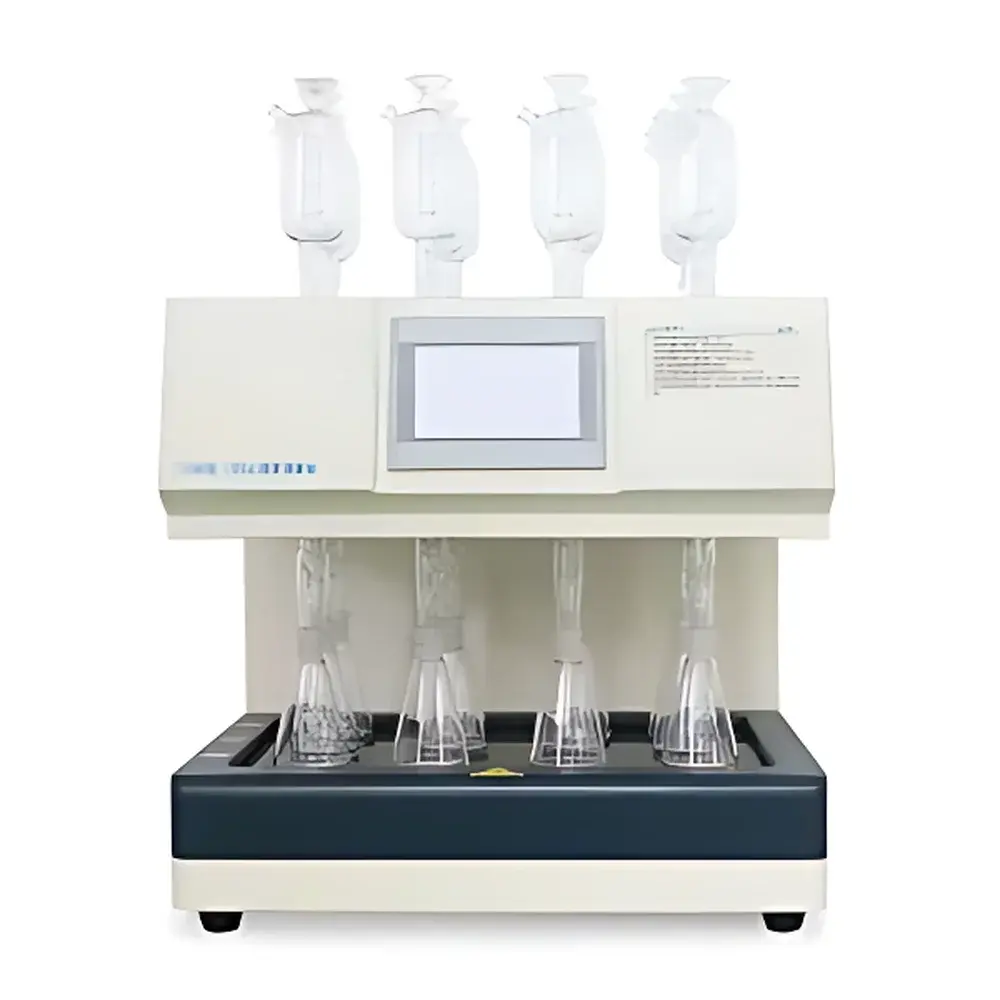
HUANKONG 1200K Advanced Graphite Block COD Digestion System
| Brand | HUANKONG |
|---|---|
| Origin | Shandong, China |
| Manufacturer Type | Direct Manufacturer |
| Country of Origin | China |
| Model | 1200K |
| Digestion Method | Reflux Digestion |
| Heating Module | Graphite Block |
| Batch Capacity | 12 samples |
| Temperature Range | Ambient to 300 °C |
| Temperature Accuracy | ±1% of setpoint |
Overview
The HUANKONG 1200K Advanced Graphite Block COD Digestion System is a laboratory-grade, fully automated reflux digestion instrument engineered for precise and reproducible chemical oxygen demand (CODCr) determination in accordance with ISO 6060, ASTM D1252 (Method B), and China’s HJ 828–2017 standard. It employs a high-thermal-mass graphite heating block as the primary heat source, delivering uniform thermal distribution across all 12 independent digestion positions. Unlike conventional ceramic or metal-sheathed heaters, the graphite block ensures minimal temperature gradient (<±0.5 °C across the surface at 150 °C), critical for achieving inter-sample consistency required in regulatory-compliant wastewater analysis. The system operates on the closed-reflux principle: samples are digested in sealed conical digestion vials under controlled thermal conditions, minimizing reagent loss, volatile organic interference, and operator exposure to hazardous fumes. Designed for integration into routine environmental testing workflows, the 1200K supports not only CODCr but also standardized digestion protocols for total nitrogen (TN) and total phosphorus (TP) in aqueous matrices—enabling consolidated sample preparation prior to spectrophotometric or titrimetric quantification.
Key Features
- 12 independent, digitally isolated heating channels — each with dedicated PID temperature control and real-time feedback monitoring
- Graphite block heating module rated for continuous operation up to 300 °C, offering superior thermal stability, corrosion resistance, and service life exceeding 5 years under typical lab use
- Touchscreen HMI with intuitive navigation, multilingual interface (English/Chinese), and password-protected method storage (up to 20 user-defined programs)
- Precision temperature control from ambient to 300 °C (±1% accuracy) and timer range of 0–200 minutes with 1-minute resolution
- Dedicated safety architecture including over-temperature cutoff, open-circuit detection, cooling-down delay logic, and audible/visual fault alerts
- Integrated conical digestion vial support compatible with standard 150 mL borosilicate glass flasks — enabling direct post-digestion titration without transfer, reducing analytical error and contamination risk
Sample Compatibility & Compliance
The 1200K accommodates a broad range of water and wastewater matrices, including municipal influent/effluent, industrial discharges (e.g., textile dyeing, pulp & paper, petrochemical effluents), surface water, and groundwater. It complies with key regulatory digestion prerequisites for EPA Method 410.4, ISO 6060, and HJ 828–2017. All thermal profiles and timing parameters are fully configurable to match method-specific requirements—such as the 2-hour reflux at 150 °C for CODCr, or the 30-minute ramp-and-hold protocol for TN digestion per HJ 636–2012. The unit’s design facilitates GLP-compliant documentation when paired with external data loggers or LIMS interfaces; audit trails for temperature setpoints, run duration, and operator ID can be exported via USB. No modifications to digestion chemistry or vial geometry are required to meet method validity criteria.
Software & Data Management
While the 1200K operates as a standalone instrument, its embedded firmware supports traceable operation through timestamped event logging (start time, target temperature, actual temperature profile, end time, fault codes). All parameters—including method name, operator ID, sample batch ID, and calibration verification status—are stored in non-volatile memory and exportable in CSV format. Optional RS-232 or USB-to-serial connectivity enables remote configuration and integration with laboratory information management systems (LIMS) or electronic lab notebooks (ELN). Firmware updates are delivered via secure USB drive, ensuring continued alignment with evolving national and international standard revisions. The system meets basic requirements for FDA 21 CFR Part 11 compliance when deployed with appropriate procedural controls (e.g., role-based access, electronic signatures, and change history review).
Applications
- Routine CODCr analysis in municipal wastewater treatment plants for process optimization and discharge compliance reporting
- Preparation of digested samples for UV-Vis spectrophotometry (e.g., dichromate reduction at 600 nm) or automated potentiometric titration
- Multi-parameter digestion workflows supporting simultaneous TN and TP analysis in environmental monitoring laboratories
- Method validation and proficiency testing in accredited labs seeking CNAS (ISO/IEC 17025) or ILAC recognition
- Teaching laboratories requiring robust, low-maintenance instrumentation for undergraduate and graduate-level water chemistry instruction
FAQ
Does the 1200K support digestion methods other than CODCr?
Yes — it is validated for HJ 636–2012 (total nitrogen) and HJ 670–2013 (total phosphorus) digestion protocols, provided appropriate reagents and vial configurations are used.
What type of digestion vials are recommended?
Standard 150 mL borosilicate glass conical flasks (e.g., Kimax or equivalent) with ground-glass joints or PTFE-lined caps. Quartz vials are not required or supported.
Is external ventilation mandatory during operation?
Yes — although the system includes passive fume containment features, connection to a certified laboratory fume hood or active exhaust manifold is required per OSHA 1910.1200 and local chemical hygiene plans.
Can temperature calibration be performed onsite?
Yes — the instrument supports two-point calibration using NIST-traceable RTD probes; procedure is documented in the operator manual and requires no service technician intervention.
What is the expected maintenance interval for the graphite block?
Under normal usage (≤8 hrs/day, ≤5 days/week), the graphite block requires no scheduled replacement; periodic visual inspection for cracking or carbon dust accumulation is recommended every 6 months.







