
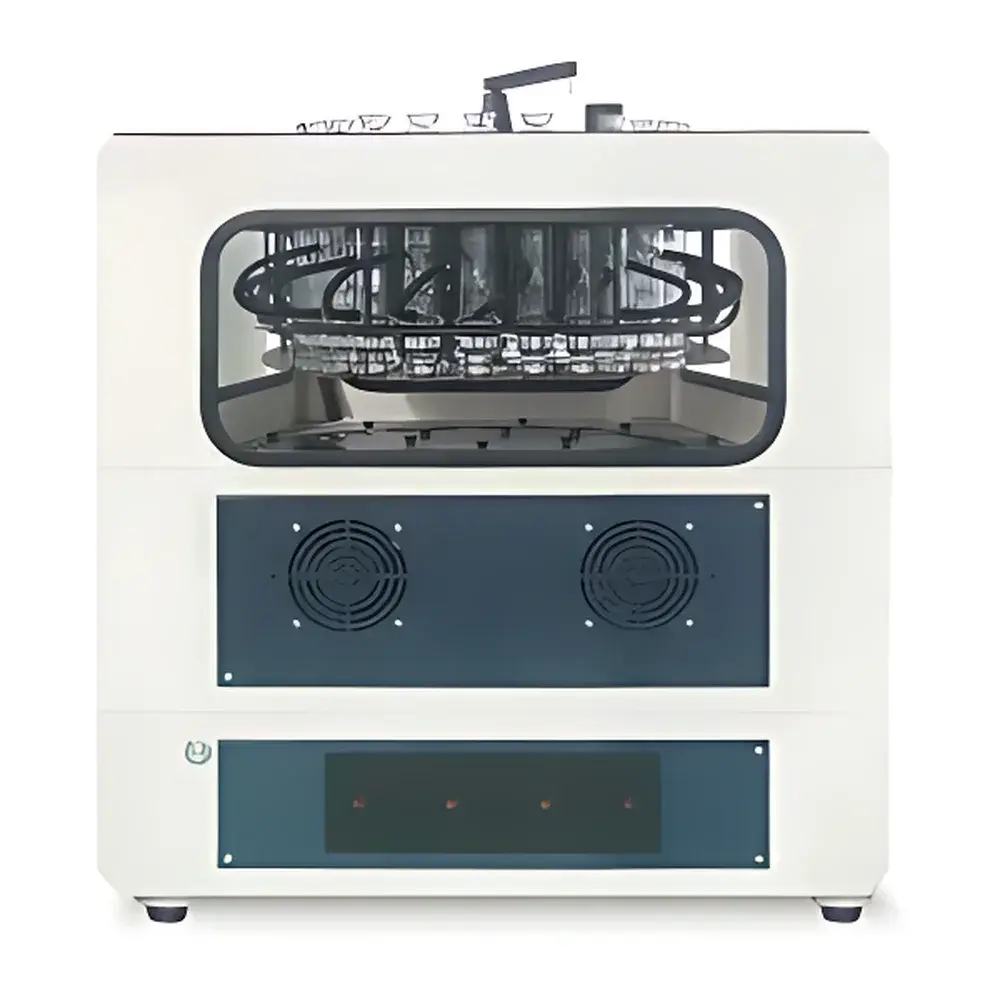
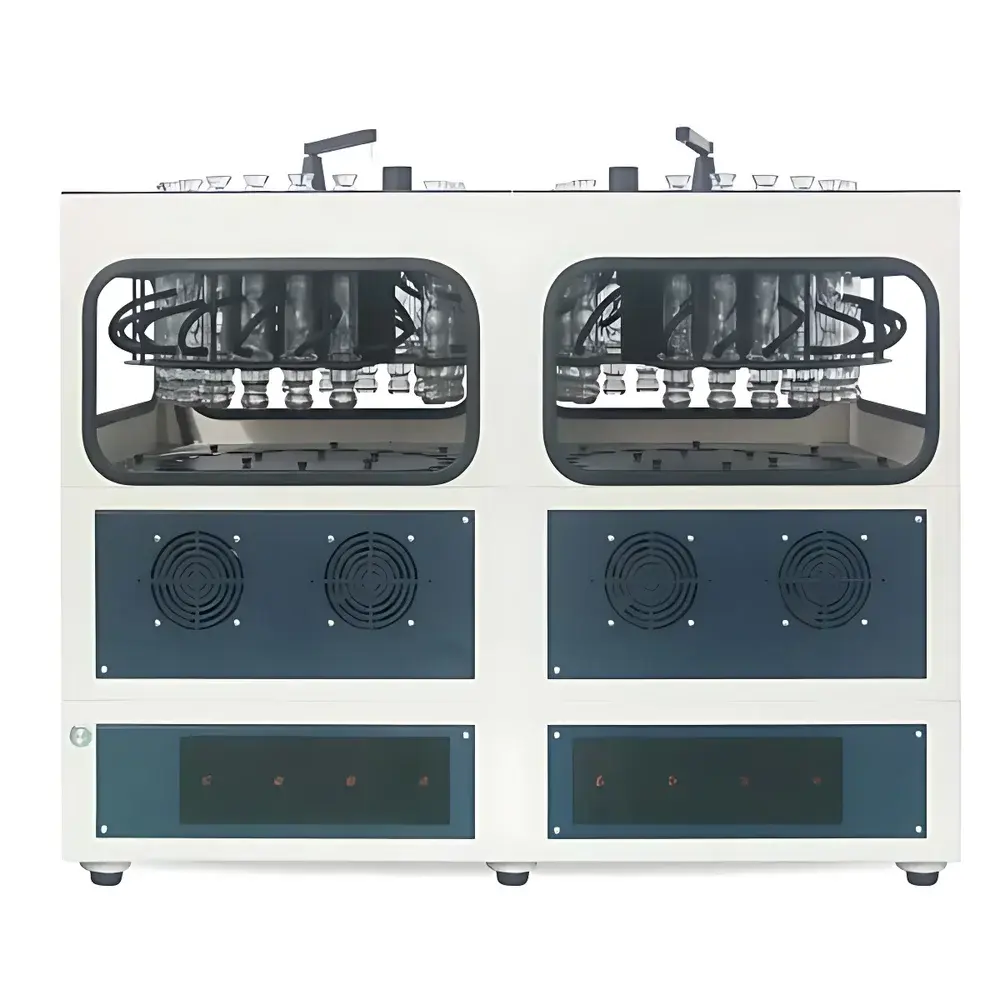
HUANKONG 1500 Series Fully Automated CODCr Analyzer (20-Position)
| Brand | HUANKONG |
|---|---|
| Origin | Shandong, China |
| Manufacturer Type | Direct Manufacturer |
| Instrument Type | Laboratory-Based |
| Model | 1500 |
| Measurement Principle | Potassium Dichromate Digestion Method (Online Capable) |
| Accuracy | ±2% |
| Detection Limit | 4 mg/L COD |
| Batch Capacity | 20/32/42 samples per run |
| Compliance Standards | GB/T 11914, HJ/T 828 |
Overview
The HUANKONG 1500 Series Fully Automated CODCr Analyzer is an integrated laboratory instrument engineered for precise, reproducible, and unattended determination of Chemical Oxygen Demand (COD) in water and wastewater matrices. It implements the standardized potassium dichromate digestion method—codified in GB/T 11914 and HJ/T 828—as a fully automated workflow encompassing reagent dispensing, sealed reflux digestion, condensation, and photometric endpoint detection via full-spectrum colorimetric titration. Unlike manual or semi-automated approaches, this system eliminates human intervention during hazardous steps—including concentrated sulfuric acid addition and high-temperature digestion—thereby mitigating operator exposure risks while improving inter-run consistency. The analyzer operates on a robust mechanical architecture featuring dual robotic arms, microcrystalline carbon far-infrared heating elements, elastic-sealed digestion–condenser coupling, and a closed-loop temperature-regulated condensation system. Its design prioritizes analytical integrity, operational safety, and regulatory traceability—making it suitable for environmental monitoring laboratories, municipal wastewater treatment facilities, and industrial QC/QA departments requiring routine, high-throughput COD analysis under GLP-aligned workflows.
Key Features
- Compliance with national standard methods: Fully aligned with HJ/T 828 and GB/T 11914 for CODCr determination, supporting audit-ready documentation.
- 20-position circular digestion module with uniform far-infrared microcrystalline carbon heating—ensuring rapid, consistent thermal transfer and minimal temperature gradient across all sample positions.
- Dual independent robotic arms for precise, cross-contamination-free reagent delivery; eight dedicated reagent channels with individual peristaltic pumps and calibrated syringe-type metering units.
- Elastic-sealed, auto-aligning digestion–condenser interface with silicone O-ring gasketing to prevent volatile loss during reflux and ensure quantitative recovery.
- Programmable condensation system: Integrated recirculating water bath with adjustable setpoint temperature (10–30 °C), supplemented by auxiliary air-cooling modules for accelerated cooldown and extended hardware longevity.
- Full-spectrum colorimetric titration engine: Real-time RGB-based endpoint recognition across the entire visible spectrum (400–700 nm), eliminating subjectivity associated with manual visual endpoint judgment.
- Self-diagnostic safety protocol: Position-mapping verification between sample tray configuration and software-defined sequence prior to acid injection; automatic error flagging for misloaded or empty wells.
Sample Compatibility & Compliance
The 1500 Series accommodates raw and pretreated aqueous samples including surface water, domestic sewage, and industrial effluents—without requirement for pre-filtration or dilution in most cases. It supports both low-range (4–100 mg/L) and high-range (100–1000 mg/L) COD quantification within a single run using adaptive endpoint recognition logic. All fluidic pathways are constructed from chemically resistant PTFE, ETFE, and borosilicate glass to withstand repeated exposure to hot concentrated H2SO4/K2Cr2O7 mixtures. The system meets fundamental requirements for ISO/IEC 17025-compliant laboratories, including defined calibration intervals, reagent lot traceability, and electronic audit trails for critical events (e.g., digestion start/end time, titrant volume consumed, endpoint confirmation signal). While not inherently 21 CFR Part 11 compliant out-of-the-box, its data export architecture (CSV, PDF, XML) facilitates integration into validated LIMS environments supporting electronic signatures and user access controls.
Software & Data Management
Control and data acquisition are managed through a Windows-based workstation application that supports remote operation via Ethernet. The interface displays real-time status mapping—color-coded indicators show “queued”, “digesting”, “titrating”, and “completed” states for each position. Users define analytical sequences—including sample IDs, expected concentration ranges, digestion duration (60–120 min), and condensation setpoints—via intuitive drag-and-drop scheduling. All raw absorbance curves, titration volume logs, and endpoint confidence metrics are stored locally with timestamped metadata. Export formats include ANSI-compliant CSV files for statistical process control (SPC), PDF analytical reports with embedded chromatogram-like titration profiles, and XML datasets compatible with EPA WQX and EU Water Framework Directive reporting schemas. Audit trail functionality records operator login/logout, method parameter changes, and calibration event timestamps—enabling retrospective review per GLP and internal QA protocols.
Applications
- Routine compliance monitoring of municipal wastewater discharge points per local environmental regulations.
- Process control in electroplating, pharmaceutical, food processing, and pulp & paper industries where organic load must be tracked across treatment stages.
- Research-grade COD profiling in limnological and estuarine studies requiring high replicate precision across spatially distributed sampling campaigns.
- Method validation and interlaboratory comparison exercises where operator-dependent variability must be minimized.
- Training platforms for environmental science curricula emphasizing automation safety, metrological traceability, and regulatory method adherence.
FAQ
Does the instrument support multi-range COD analysis without manual dilution?
Yes—the system automatically selects appropriate titrant concentration and detection sensitivity based on preliminary absorbance screening, enabling seamless analysis of samples spanning 4–1000 mg/L COD within one batch.
How is reagent cross-contamination prevented?
Each of the eight reagent lines employs dedicated, non-shared peristaltic pump heads and chemically inert fluid paths; no shared valves or manifolds exist between channels.
Can digestion temperature and time be customized?
Yes—users may configure digestion setpoints from 120 °C to 165 °C and durations from 60 to 120 minutes, with real-time thermocouple feedback and overheat cutoff protection.
Is external cooling water required?
No—the integrated recirculating chiller eliminates dependency on tap water or external chillers; only ambient air ventilation is needed for the auxiliary fan-cooled condenser module.
What data security features are included?
Role-based user accounts, encrypted local database storage, and configurable auto-backup intervals to network drives or NAS devices ensure continuity and confidentiality of analytical records.
Related Products







