
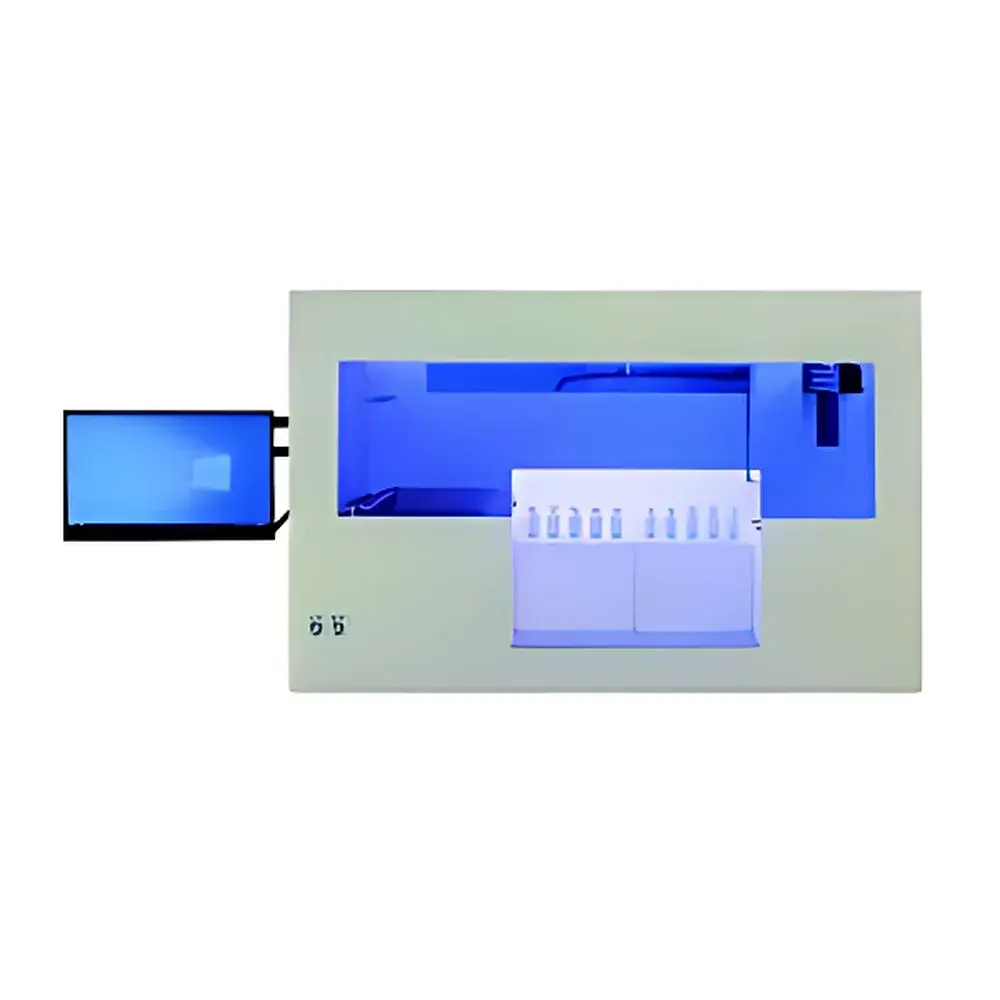
HUANKONG 3600 Automated Total Phosphorus and Total Nitrogen Analyzer
| Brand | HUANKONG |
|---|---|
| Origin | Shandong, China |
| Manufacturer Type | Direct Manufacturer |
| Product Category | Domestic |
| Model | 3600 |
| Measurement Parameters | Total Phosphorus (TP) & Total Nitrogen (TN) |
| Instrument Type | Laboratory-Based |
| Measurement Principle | Spectrophotometry (UV-Vis) |
| Compliance | GB/T 11893–1989 (TP), GB/T 11894–1989 (TN), HJ 636–2012, HJ 637–2012 |
Overview
The HUANKONG 3600 Automated Total Phosphorus and Total Nitrogen Analyzer is a laboratory-grade, fully integrated analytical system engineered for precise, unattended quantification of total phosphorus (TP) and total nitrogen (TN) in aqueous environmental samples—including surface water, wastewater, groundwater, and effluent. It implements standardized spectrophotometric detection following established Chinese national standards (GB/T 11893–1989 for TP; GB/T 11894–1989 for TN) and Ministry of Ecology and Environment protocols (HJ 636–2012, HJ 637–2012). Unlike manual or flow-injection-based approaches, the 3600 employs discrete, batch-wise high-pressure steam digestion—ensuring complete oxidation of organic and refractory phosphorus/nitrogen species into orthophosphate and nitrate, respectively—followed by stable, interference-minimized colorimetric measurement in the visible/UV range. Its architecture eliminates operator-dependent variability in reagent addition, digestion timing, temperature control, and cuvette handling—critical factors affecting reproducibility in regulatory compliance testing.
Key Features
- Fully automated end-to-end workflow: sample loading → reagent dispensing → high-pressure steam digestion (programmable temperature up to 160 °C, pressure up to 0.6 MPa) → post-digestion cooling → volumetric dilution → homogenization → spectrophotometric analysis → system rinsing → data export.
- Intelligent dual-channel digestion module with real-time monitoring of temperature, pressure, and elapsed time; automatic lid actuation, water filling, and condensate drainage ensure process repeatability and operator safety.
- Corrosion-resistant, fully enclosed 3-axis electric robotic arm for precise sample tube handling, reagent aspiration, and transfer—eliminating manual exposure to hot vessels, strong acids (e.g., K₂S₂O₈/H₂SO₄ for TN; K₂S₂O₈/NaOH for TP), and hazardous vapors.
- Hermetic sample vial sealing during digestion prevents analyte volatilization (e.g., NH₃ loss in alkaline TN digestion) and cross-contamination between runs.
- Simultaneous TP/TN determination within the same batch: no method switching or hardware reconfiguration required; optimized for throughput without compromising accuracy or linearity.
- Compliance-ready architecture supporting audit trails, user access levels, and electronic signature capability—aligned with GLP principles and preparatory for 21 CFR Part 11 readiness via optional software modules.
Sample Compatibility & Compliance
The analyzer accommodates standard 16-mm borosilicate glass tubes (50 mL capacity) and accepts raw, filtered, or centrifuged liquid samples with turbidity ≤ 50 NTU. It supports matrix types defined in national standard methods: municipal wastewater, industrial discharge, river/lake water, and treated effluent. All digestion and detection steps strictly adhere to GB/T 11893–1989 (ammonium molybdate spectrophotometry for TP) and GB/T 11894–1989 (alkaline potassium persulfate UV digestion + spectrophotometry for TN). Method validation data demonstrate linearity (R² ≥ 0.999) across 0.01–10 mg/L (TP) and 0.5–100 mg/L (TN), with intra-day precision <3% RSD and recovery rates of 92–105% for certified reference materials (CRM-WW-1, NIST SRM 1643e).
Software & Data Management
The embedded Windows-based control software provides intuitive method setup, real-time status visualization (digestion progress, optical density readings, error logs), and automated calibration curve generation using multi-point standards. Raw absorbance data, digestion parameters, and QC flags are timestamped and stored in encrypted SQLite databases. Export formats include CSV, PDF reports (with lab header, analyst ID, instrument ID, and revision-controlled method version), and LIMS-compatible XML. Audit trail functionality records all user actions—including method edits, result overrides, and calibration events—with immutable timestamps and operator identifiers—meeting requirements for ISO/IEC 17025 accreditation and internal QA/QC documentation.
Applications
- Regulatory environmental monitoring labs performing routine TP/TN analysis under China’s Surface Water Environmental Quality Standards (GB 3838–2002) and Wastewater Discharge Standards (GB 8978–1996).
- Municipal wastewater treatment plants conducting influent/effluent nutrient load assessment and process optimization.
- Industrial environmental departments verifying compliance with discharge permits for phosphorus-limited watersheds.
- Research institutions studying eutrophication dynamics, nutrient cycling, and long-term water quality trends.
- Third-party testing laboratories requiring high-throughput, auditable, and method-validated TP/TN data for certification reporting.
FAQ
Does the 3600 comply with internationally recognized standards such as ISO or ASTM?
It implements nationally mandated Chinese methods (GB and HJ series), which are technically equivalent to ISO 6878 (for TP) and ISO 11905-1 (for TN) in digestion chemistry and detection principle—but formal ISO/IEC 17025 accreditation requires site-specific validation per local authority requirements.
Can the system handle highly turbid or suspended-solid-rich samples?
Samples must be pre-filtered (0.45 µm membrane) or centrifuged prior to loading; undiluted solids >50 mg/L may impair digestion efficiency and cause mechanical carryover—method SOPs define acceptable pretreatment protocols.
What maintenance intervals are recommended for the robotic arm and digestion module?
Robotic arm lubrication and positional calibration every 6 months; digestion vessel O-rings and pressure sensors inspected quarterly; full system performance verification performed annually using CRM traceable to NIM (National Institute of Metrology, China).
Is remote monitoring or integration with existing LIMS possible?
Yes—via TCP/IP interface and configurable API endpoints; standard HL7 and ASTM E1384 message mapping supported for bidirectional data exchange with major LIMS platforms.
How does the 3600 mitigate interferences from chloride, nitrite, or heavy metals?
Built-in correction algorithms apply matrix-matched calibration and optional masking agents (e.g., sulfamic acid for nitrite); method-specific interference testing data are provided in the validation report per HJ 636–2012 Annex B.
Related Products







