
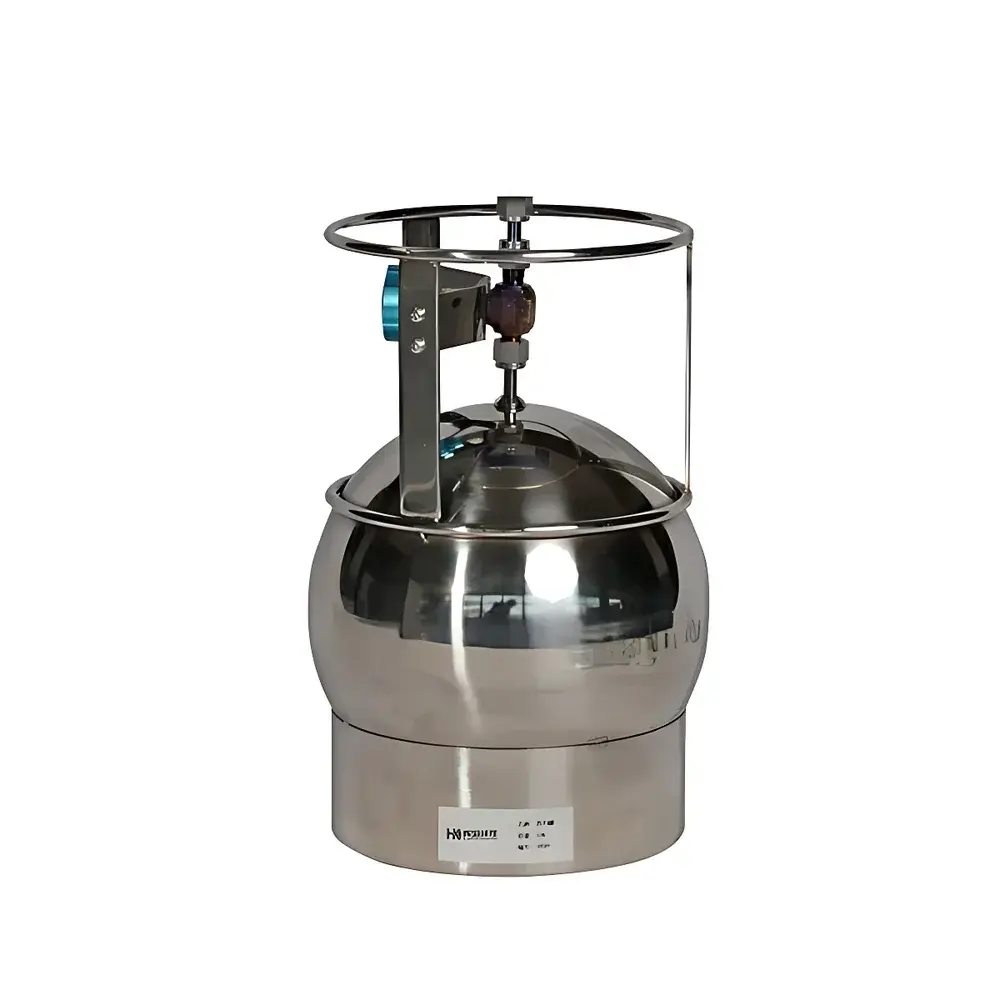
HUANKONG GHD-01 Summa Canister for VOCs Air Sampling
| Brand | HUANKONG |
|---|---|
| Origin | Shandong, China |
| Manufacturer Type | Direct Manufacturer |
| Country of Origin | China |
| Model | GHD-01 |
| Capacity Options | 1 L, 3.2 L, 6 L, 15 L |
| Material | Electropolished 316L Stainless Steel |
| Internal Surface Treatment | Dual-stage Silanized Inert Coating (100% passivated, metal-free contact) |
| Compliance | HJ 759–2015, U.S. EPA TO-15, EPA Method TO-14A |
| Valve Type | High-Purity Electropolished Stainless Steel Sampling Control Valve |
| Environmental Rating | IP65-rated robust housing |
Overview
The HUANKONG GHD-01 Summa Canister is a precision-engineered, inert gas sampling vessel designed for quantitative collection, stabilization, and transport of volatile organic compounds (VOCs) from ambient, indoor, and stack air matrices. Based on the established Summa canister principle—originally developed by the U.S. Environmental Protection Agency—the GHD-01 employs a dual-stage silanization process applied to electropolished interior surfaces of 316L stainless steel, eliminating active adsorption sites and preventing analyte loss via surface interaction, polymerization, or oxidation during storage. This inert architecture ensures high recovery (>95% for C2–C12 hydrocarbons, chlorinated VOCs, oxygenates, and aromatics) and long-term sample integrity (up to 30 days at 25 °C under nitrogen-purged, pressurized conditions), meeting the stringent stability requirements of regulatory trace-level analysis workflows.
Key Features
- Electropolished 316L stainless steel body with zero-weld internal geometry—minimizes dead volume and particulate entrapment.
- Dual-stage silanized coating (e.g., SilcoNert®-equivalent passivation) applied under controlled cleanroom conditions; verified via helium leak testing (<1×10⁻⁹ atm·cm³/s) and blank analysis (detection limits ≤5 pptv for target VOCs).
- Integrated high-purity sampling valve with PTFE-sealed stainless steel stem and integrated pressure relief mechanism—enabling precise flow-controlled filling and automated purging in pre-concentrator interfaces.
- Four standardized volumetric options (1 L, 3.2 L, 6 L, 15 L) calibrated to NIST-traceable standards; each unit supplied with individual certificate of conformance including leak test record and inertness verification data.
- Mechanically reinforced cylindrical design rated for sustained operation at pressures up to 30 psig; validated for field deployment across temperature ranges from –20 °C to +50 °C without dimensional creep or seal degradation.
Sample Compatibility & Compliance
The GHD-01 is validated for use with EPA TO-15 (Determination of Volatile Organic Compounds (VOCs) in Ambient Air Using Specially Prepared Canisters and Gas Chromatography/Mass Spectrometry (GC/MS)), EPA TO-14A (Determination of Volatile Organic Compounds (VOCs) in Ambient Air Using Specially Prepared Canisters and Gas Chromatography (GC)), and China’s HJ 759–2015 (Ambient Air—Determination of Volatile Organic Compounds—Canister Sampling/Gas Chromatography-Mass Spectrometry Method). Its inert surface chemistry supports quantitative recovery of reactive species including aldehydes (e.g., formaldehyde, acetaldehyde), terpenes, halogenated methanes, and sulfur-containing VOCs—critical for source apportionment, odor impact assessment, and ozone precursor monitoring. Each canister batch undergoes third-party validation per ASTM D5466 and ISO 16000-6 protocols for blank performance and adsorption kinetics.
Software & Data Management
While the GHD-01 is a passive sampling device, its integration into modern atmospheric pre-concentration systems (e.g., Markes UNITY-xr, Entech 7100A) relies on standardized digital asset tagging and chain-of-custody tracking. Each unit is laser-engraved with a unique serial number linked to a manufacturer-issued electronic Certificate of Conformance (CoC), accessible via QR code scan. The CoC includes date of inertization, pressure test results, certified volume, and batch-specific blank chromatograms. When deployed in GLP- or ISO/IEC 17025-accredited laboratories, the GHD-01 supports full auditability under FDA 21 CFR Part 11-compliant LIMS environments through structured metadata export (CSV/JSON) including fill timestamp, operator ID, ambient T/P logging, and purge cycle parameters.
Applications
- Ambient air quality monitoring networks requiring multi-site, time-integrated VOC speciation (e.g., urban background, roadside, rural receptor sites).
- Indoor air quality (IAQ) investigations in commercial buildings, schools, and healthcare facilities—especially for identifying off-gassing sources (adhesives, coatings, cleaning agents).
- Calibration and standard gas generation: serves as stable, reusable reference reservoir in dynamic dilution systems for GC/MS method validation and instrument calibration verification.
- Mobile laboratory platforms and unmanned atmospheric monitoring stations where ruggedized, low-maintenance sampling hardware is essential.
- Method development and interlaboratory comparison studies requiring certified inert sampling media compliant with international harmonized protocols.
FAQ
What cleaning and passivation procedures are performed before shipment?
Each GHD-01 canister undergoes ultrasonic cleaning in high-purity solvents, followed by vacuum bake-out at 250 °C for 8 hours, and dual-stage silanization under nitrogen blanket. Post-treatment, it is purged with ultra-high-purity nitrogen and sealed at 30 psig.
Can the GHD-01 be used for sulfur-containing compounds such as H₂S or mercaptans?
Yes—electropolishing combined with silanization significantly reduces catalytic surface activity. Recovery rates for methanethiol and dimethyl sulfide exceed 92% over 14-day storage when maintained at <10% relative humidity.
Is the valve compatible with automated pre-concentrator inlet manifolds?
The standard valve conforms to EPA-specified Summa canister interface dimensions and uses a 1/4″ Swagelok-compatible port; optional VCR or NPT adapters are available for OEM system integration.
How often should the canister be re-passivated?
Under routine use (≤100 fills/year), re-inertization is recommended every 12 months or after exposure to high-humidity samples (>80% RH), acidic gases (SO₂ >1 ppm), or particulate-laden air—verified by blank analysis prior to critical measurements.



