
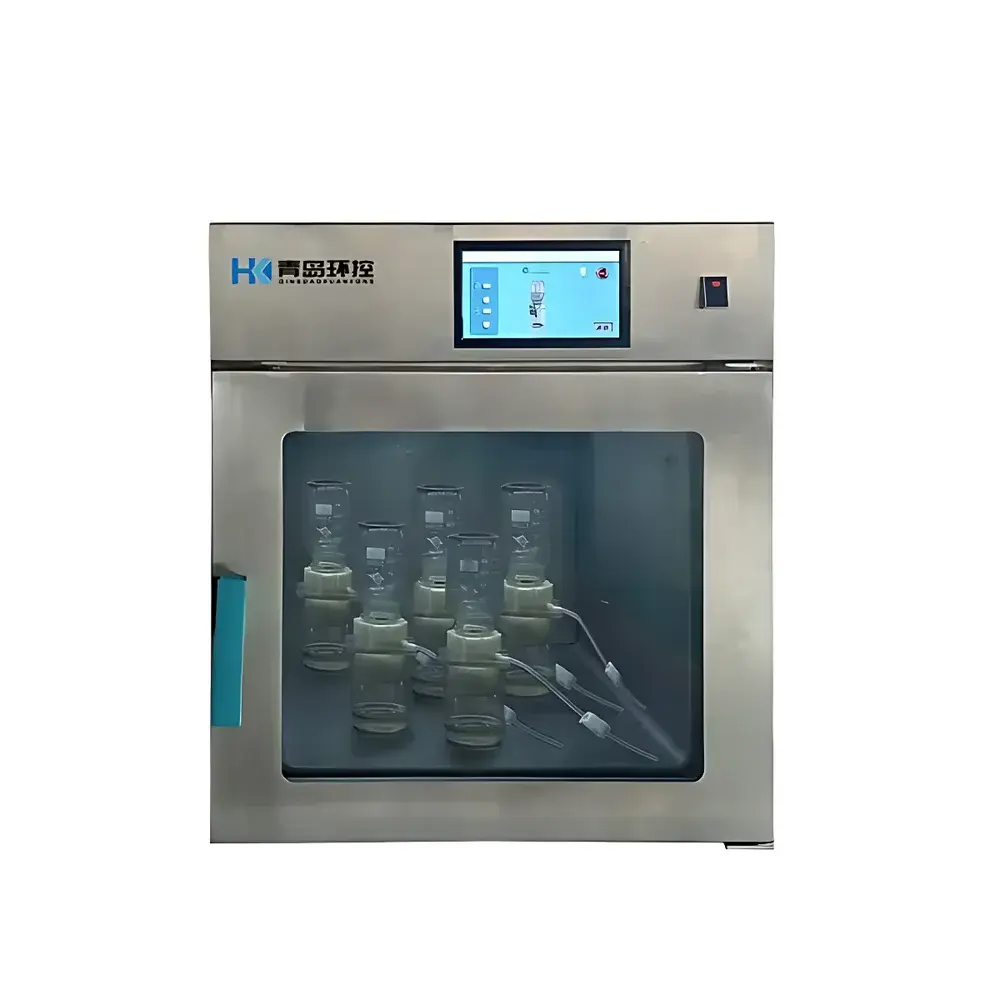
HUANKONG GHD-CL10 Automated Vacuum Filtration System
| Brand | HUANKONG |
|---|---|
| Origin | Shandong, China |
| Manufacturer Type | Direct Manufacturer |
| Product Origin | Domestic (China) |
| Model | GHD-CL10 |
| Pricing | Upon Request |
| Filter Membrane Diameter | 47 mm |
| Compatible Membrane Materials | Polypropylene, PTFE, Quartz |
| Maximum Simultaneous Samples | 15 |
| Sample Volume per Filtration | 250 mL |
| Integrated Rinse Function | Yes |
| Automatic Backflush Capability | Yes |
| Filtration Workflow | Fully Automated (no manual tubing connection or filter flask cleaning required) |
Overview
The HUANKONG GHD-CL10 Automated Vacuum Filtration System is an engineered solution for high-throughput, reproducible liquid-solid separation in regulated analytical laboratories. Designed specifically to support standardized extraction protocols—such as alkaline extraction followed by flame atomic absorption spectrometry (FAAS) for hexavalent chromium (Cr(VI)) analysis in soils and sediments—the system replaces manual vacuum filtration with a precisely controlled, programmable vacuum manifold architecture. It operates on the principle of pressure-driven membrane filtration under regulated negative pressure, with real-time vacuum stabilization and adaptive backflush logic to maintain consistent transmembrane flux across multiple channels. Unlike conventional Buchner funnel or single-station vacuum setups, the GHD-CL10 integrates sample positioning, vacuum sequencing, timed rinse cycles, and automatic pressure release into a unified workflow—eliminating operator-dependent variability and reducing hands-on time per batch.
Key Features
- Fully automated batch filtration for up to 15 samples simultaneously, each accommodating up to 250 mL of extractant solution
- Integrated programmable rinse function delivering precise volume and timing control to ensure quantitative recovery of analytes from filter surfaces
- Intelligent backflush mechanism that dynamically detects flow resistance increase and initiates brief positive-pressure pulses to clear membrane surface fouling—extending membrane service life and sustaining filtration rate
- Modular 47 mm filter holder array compatible with standard circular membranes of diverse chemistries: polypropylene (PP), polytetrafluoroethylene (PTFE), quartz fiber, and other certified inert materials per method requirements
- Self-contained vacuum generation and regulation—no external vacuum pump or compressed air supply required; includes built-in oil-free diaphragm pump and digital pressure sensor feedback loop
- Touchscreen HMI with preloaded method templates (e.g., EPA Method 7196A, ISO 11885, GB/T 23940–2009) and user-definable protocols for start/stop, rinse volume, dwell time, and vacuum setpoint
Sample Compatibility & Compliance
The GHD-CL10 supports aqueous and mildly alkaline matrices typical of environmental extraction procedures—including NaOH-based Cr(VI) leaching solutions (pH ≥ 11.5), food digestates, pharmaceutical suspensions, and potable water particulate concentrates. Its wetted path components are constructed from chemically resistant polymers (e.g., PTFE-sealed valves, PP manifolds) to prevent metal leaching or adsorption artifacts. The system meets fundamental design criteria aligned with Good Laboratory Practice (GLP) and ISO/IEC 17025:2017 requirements for trace metal analysis: full operational traceability via timestamped method logs, non-volatile parameter storage, and audit-ready event history. While not intrinsically 21 CFR Part 11 compliant, its data export functionality (CSV/Excel) supports integration into validated LIMS environments where electronic records are governed by organizational SOPs.
Software & Data Management
The embedded firmware enables method recall, run logging, and error diagnostics without external PC dependency. Each filtration cycle generates a metadata-rich record including date/time stamp, selected protocol ID, actual vacuum level (kPa), total filtration duration, number of backflush events, and rinse volume delivered. Export is supported via USB port to standard spreadsheet formats for QA review or regulatory submission. Optional RS-232 or Ethernet interface (upon request) allows remote monitoring and synchronization with laboratory information management systems (LIMS). All configuration changes are logged with operator ID (if enabled via optional login module) and timestamp, satisfying minimum ALCOA+ principles (Attributable, Legible, Contemporaneous, Original, Accurate) for raw data integrity.
Applications
- Regulatory environmental testing: Cr(VI) quantification in soil/sediment per EPA 7196A, ISO 11885, and China’s HJ 687–2014
- Food safety laboratories: Clarification of acid-digested samples prior to ICP-MS or AAS analysis
- Pharmaceutical QC: Particulate removal from parenteral solutions and stability study filtrates
- Drinking water compliance: Total suspended solids (TSS) preparation and metal fractionation studies
- Academic and method development labs: High-reproducibility filtration for kinetic solubility or leaching experiments
FAQ
Is the GHD-CL10 compatible with aggressive alkaline extraction solutions used for Cr(VI)?
Yes—the fluid path is rated for sustained exposure to ≤1 mol/L NaOH at ambient temperature, and all seals and housings resist hydroxide-induced stress cracking.
Can the system be validated for GLP or ISO 17025 compliance?
While the instrument itself is not certified, its design enables full validation: users may perform installation qualification (IQ), operational qualification (OQ), and performance qualification (PQ) using documented test protocols covering vacuum stability, rinse accuracy, and inter-channel consistency.
What maintenance is required for long-term reliability?
Routine maintenance consists of periodic inspection of membrane gaskets, cleaning of the vacuum chamber condensate trap, and annual calibration of the integrated pressure sensor using NIST-traceable reference gauges.
Does the system support custom filter diameters beyond 47 mm?
No—the mechanical stage and sealing geometry are optimized exclusively for 47 mm circular membranes to ensure uniform compression and leak-free operation across all 15 positions.
How is cross-contamination between samples prevented?
Each filtration channel operates independently with dedicated vacuum lines and sealed valve actuators; no shared fluid paths exist. The rinse function further minimizes carryover by flushing residual solution from both the membrane surface and the filtrate collection path.



