
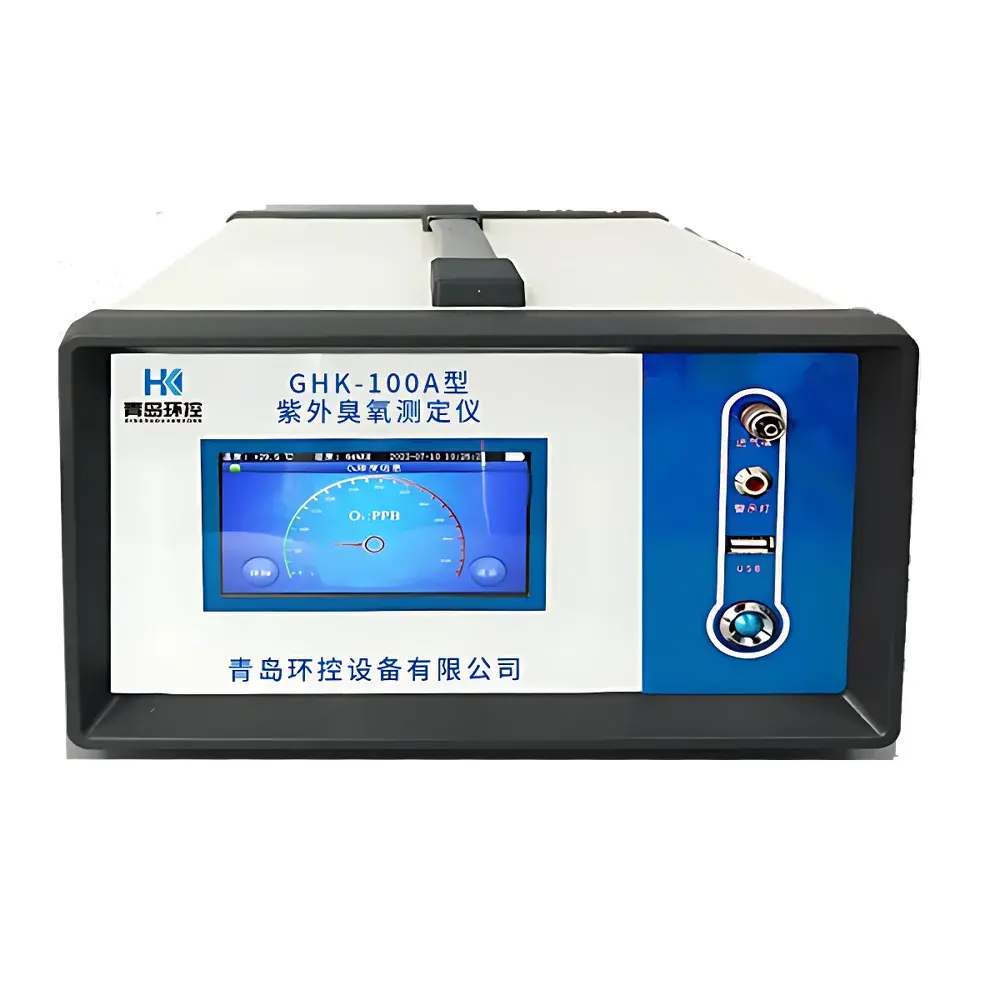
HUANKONG GHK-100A Portable UV Absorption Ozone Analyzer
| Brand | HUANKONG |
|---|---|
| Origin | Shandong, China |
| Manufacturer Type | Direct Manufacturer |
| Instrument Type | Portable |
| Model | GHK-100A |
| Measurement Range | 0–1 ppm |
| Detection Limit | 1 ppb |
| Response Time | T90 ≤ 20 s |
| Resolution | ≤ 1% of full scale |
| Display | Color touchscreen with dual-mode (digital + analog gauge) visualization |
| Data Storage | 8,000 measurement records |
| Power Supply | Rechargeable high-capacity lithium battery (≥4 h continuous operation) |
| Environmental Compensation | Integrated temperature and humidity sensors with real-time algorithmic correction |
| Connectivity | USB data export, Bluetooth thermal printing, IoT-enabled cloud platform integration |
| Compliance Standards | HJ 590–2010, JJG 1077–2012, GB/T 18883–2022 |
| Alarm | Configurable audible and visual alarm thresholds |
| Units | Switchable between ppb and µg/m³ |
Overview
The HUANKONG GHK-100A Portable UV Absorption Ozone Analyzer is a precision gas measurement instrument engineered for quantitative determination of ozone (O₃) in ambient air and indoor environments. It operates on the principle of ultraviolet absorption photometry at 254 nm—the characteristic absorption wavelength of ozone—ensuring high selectivity and minimal spectral interference from common atmospheric constituents such as NO₂, SO₂, or VOCs. Unlike electrochemical or semiconductor-based sensors, UV photometric detection provides inherent stability, long-term calibration integrity, and immunity to sensor poisoning or drift under variable humidity conditions. The analyzer is designed for both spot-check field measurements and unattended continuous monitoring applications, meeting the metrological requirements specified in HJ 590–2010 (Chinese standard for ambient ozone measurement) and JJG 1077–2012 (verification regulation for ozone analyzers). Its compact, hand-carried form factor enables rapid deployment across urban air quality networks, occupational health surveys, cleanroom validation, and laboratory reference verification.
Key Features
- UV photometric detection at 254 nm with stable low-pressure mercury lamp source and high-precision optical path design
- Real-time environmental compensation using integrated Pt100 temperature and capacitive humidity sensors, applying NIST-traceable correction algorithms
- High-sensitivity optical detection system achieving a verified limit of detection (LOD) of 1 ppb (0.001 ppm) with ≤1% full-scale resolution
- Fast response kinetics: T90 ≤ 20 seconds for dynamic ozone concentration changes, enabling time-resolved exposure assessment
- Industrial-grade sampling system featuring a maintenance-free imported diaphragm pump with ≥30 kPa vacuum capability and >10,000-hour service life
- Intuitive color TFT touchscreen interface supporting dual display modes: numeric readout and analog-style gauge visualization
- Built-in statistical engine calculating and storing 1-hour, 8-hour, and 24-hour moving averages per IEC 61547 and WHO air quality guidelines
- Configurable alarm logic with independent upper/lower threshold settings and simultaneous visual (LED) and audible (85 dB) alerting
Sample Compatibility & Compliance
The GHK-100A is validated for direct analysis of ambient air, indoor air, and low-particulate process airstreams without sample conditioning or scrubbing—provided particulate loading remains below 10 µg/m³ and relative humidity stays within 10–90% RH (non-condensing). It complies with national regulatory frameworks including HJ 590–2010 (equivalent in performance to ISO 13964:2022 for UV ozone measurement), JJG 1077–2012 (aligned with OIML R126 metrological requirements), and GB/T 18883–2022 (indoor air quality standard referencing 100 µg/m³ as the 8-h average limit). While not certified for EPA TO-11A or EN 14625 compliance out-of-the-box, its measurement uncertainty profile (<±2% of reading above 50 ppb, traceable to NIM SRM-1001 ozone standards) supports use in GLP-conforming environmental laboratories and QA/QC workflows.
Software & Data Management
Data acquisition and management are facilitated through an embedded ARM Cortex-M7 controller running a deterministic real-time OS. All measurements include timestamp (RTC-synced), temperature, humidity, and battery voltage metadata. Stored records (up to 8,000 entries) retain full audit trail integrity and support CSV export via USB 2.0 mass storage mode. Optional cloud firmware enables TLS 1.2-secured MQTT transmission to private or public IoT platforms (e.g., AWS IoT Core or Azure IoT Hub), with configurable reporting intervals (1 s to 1 h). Bluetooth 5.0 LE supports direct pairing with portable thermal printers for on-site report generation. Firmware updates are performed over USB with SHA-256 signature verification, satisfying basic cybersecurity requirements for field-deployed instrumentation.
Applications
- Ambient air quality monitoring stations (reference and indicative)
- Indoor air quality (IAQ) assessments in schools, hospitals, offices, and residential buildings per GB/T 18883–2022
- Ozone generator output verification and leak detection in water treatment and sterilization facilities
- Occupational hygiene surveys in industrial settings where ozone is used as an oxidant or disinfectant
- Calibration and cross-validation of fixed-site ozone analyzers (e.g., UV photometers or chemiluminescence systems)
- Field research campaigns requiring mobile, battery-operated ozone profiling with geotagged logging
FAQ
What is the recommended calibration frequency for the GHK-100A?
For routine environmental monitoring, quarterly zero/span verification using certified ozone permeation tubes or UV-calibrated transfer standards is advised; annual full metrological recalibration is recommended per JJG 1077–2012.
Can the instrument measure ozone in humidified or heated airstreams?
Yes—integrated temperature and humidity compensation ensures accuracy across 10–90% RH and 0–40 °C, though condensation must be prevented upstream via Nafion dryers if RH exceeds 95%.
Is the GHK-100A compliant with FDA 21 CFR Part 11 for electronic records?
No—the device does not implement electronic signatures or audit trail encryption required under Part 11; however, exported CSV files may be archived in Part 11-compliant LIMS environments.
Does the analyzer require warm-up time before measurement?
No—UV lamp stabilization is achieved within <30 seconds; measurements are valid immediately upon power-on per HJ 590–2010 Section 6.3.
How is data security handled during cloud transmission?
All MQTT payloads are encrypted end-to-end using TLS 1.2 with device-authenticated certificates; no credentials or raw sensor data are stored on the instrument’s internal flash memory beyond active logging buffers.
Related Products







