
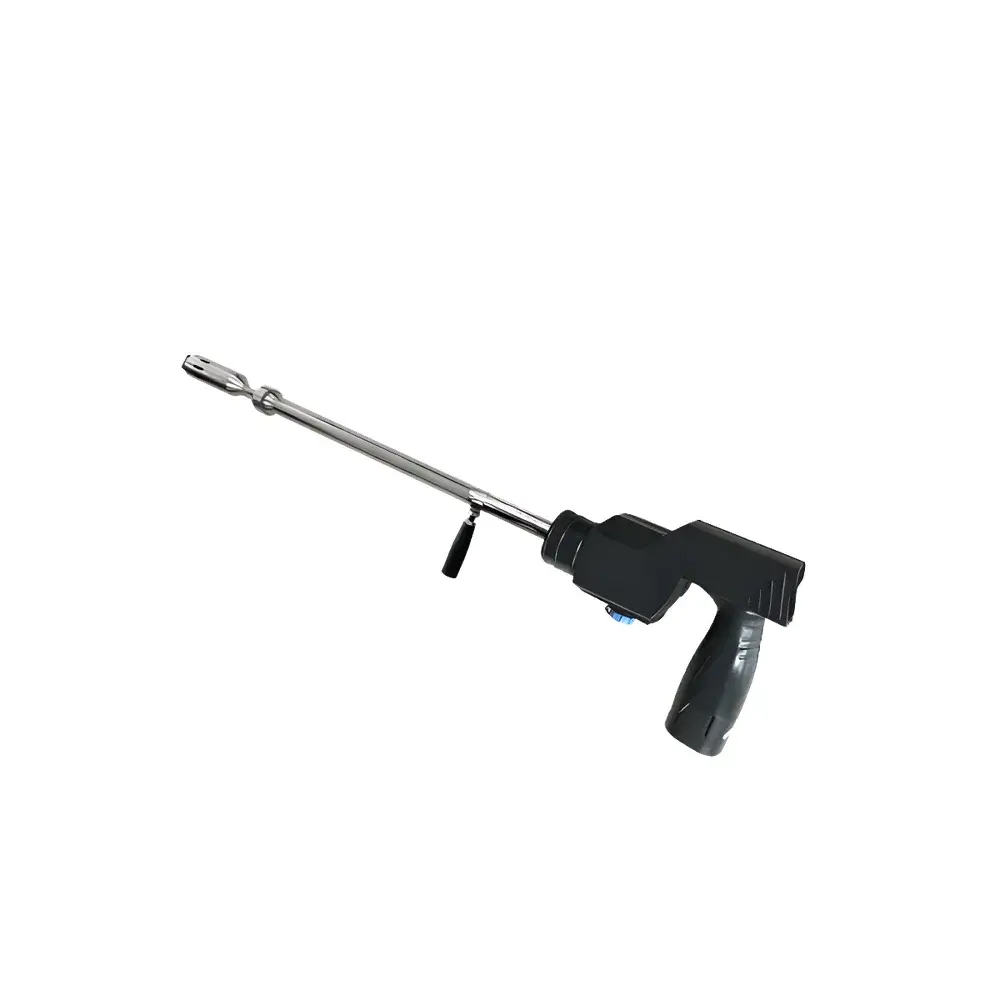
HUANKONG GHK-2020B Portable Flue Gas Humidity, Velocity & Condition Analyzer
| Brand | HUANKONG |
|---|---|
| Origin | Shandong, China |
| Manufacturer Type | Direct Manufacturer |
| Origin Category | Domestic (China) |
| Model | GHK-2020B |
| Instrument Type | Portable Flue Gas Analyzer |
| Measurement Accuracy (Humidity) | < ±1% FS |
| Repeatability | < 2% |
| Response Time | < 30 s |
| Measured Parameters | Relative Humidity (%RH), Flue Gas Velocity (m/s), Static/Total Pressure (kPa), Temperature (°C), and Operating Condition Parameters (e.g., stack diameter, sampling point depth, isokinetic ratio) |
Overview
The HUANKONG GHK-2020B Portable Flue Gas Humidity, Velocity & Condition Analyzer is a field-deployable, integrated measurement system engineered for regulatory-compliant flue gas characterization in stationary emission sources. It operates on the principle of capacitive polymer humidity sensing combined with differential pressure-based velocity calculation via Pitot-static tube methodology, conforming to the physical foundation outlined in JJG518–1998 (Verification Regulation for Pitot Tubes) and GB/T16157–1996 (Sampling Methods for Particulate Matter and Gaseous Pollutants from Fixed Pollution Sources). The instrument simultaneously acquires real-time humidity (%RH), gas velocity (m/s), static and total pressure (kPa), and temperature (°C), then applies on-board thermodynamic compensation algorithms—based on ideal gas law and water vapor saturation models—to derive corrected volumetric flow rate, isokinetic sampling ratios, and normalized dry/wet basis concentrations. Its design prioritizes metrological integrity under harsh industrial conditions: high-temperature flue environments (up to 200 °C ambient exposure), acidic condensates, and particulate-laden streams typical of coal-fired boilers, waste incinerators, and cement kilns.
Key Features
- Capacitive polymer humidity sensor with dual-stage particulate filtration, ensuring long-term stability and resistance to acid dew-point corrosion
- High-stability micro-differential pressure transducer with <0.1% FS zero drift per 10 °C ambient change, enabling precise velocity derivation across low- to medium-velocity ranges (1–30 m/s)
- On-device temperature and static pressure compensation logic compliant with ISO 14644-3 and EPA Method 2 (Determination of Stack Gas Velocity and Volumetric Flow Rate)
- Programmable heating module (80–160 °C) for probe and sensor housing, preventing condensation-induced measurement hysteresis and signal attenuation
- Modular battery pack with hot-swap capability and >8 hours continuous operation at 25 °C ambient
- Isokinetic sampling assistant function: calculates optimal traverse points, spacing, and dwell time per ASTM D6784–22 (Standard Test Method for Elemental, Organic, and Isotopic Analysis of Combustion Aerosols)
- Auto-zero calibration routine with user-initiated baseline reset and software-accessible gain adjustment for sensor drift correction
Sample Compatibility & Compliance
The GHK-2020B is validated for use in non-explosive, non-radioactive flue gas streams containing SO₂, NOₓ, CO, O₂, HCl, and water vapor at temperatures up to 180 °C (probe tip) and pressures ranging from −10 to +10 kPa gauge. It meets national metrological verification requirements per JJG518–1998 and environmental monitoring methodology standards including GB/T11605–2005 (Humidity and Temperature Measurement) and GB/T16157–1996. While not intrinsically safe, it is suitable for Zone 2/Class I, Division 2 environments when used with appropriate isolation protocols. Data output formats support traceability under China’s HJ 75–2017 and HJ 76–2017 CEMS technical specifications, and raw parameter logs are structured for third-party audit alignment with ISO/IEC 17025 quality management systems.
Software & Data Management
Internal firmware supports storage of up to 10,000 complete measurement records—including timestamped sensor readings, compensation coefficients, operator ID, and location metadata—in non-volatile flash memory. Data export is available via USB-C interface in CSV format compatible with Excel, LabVIEW, and EPA-approved data validation tools (e.g., EQuIS, EnviroData). The embedded display features a 4.3-inch industrial-grade TFT screen with anti-glare coating and wide operating temperature range (−20 to 60 °C). Optional thermal printer integration enables on-site hardcopy generation meeting GLP documentation requirements for field inspections and compliance reporting. Firmware updates are delivered via signed binary packages to ensure integrity and version control.
Applications
- Pre-compliance verification of continuous emission monitoring systems (CEMS) prior to certification audits
- Stack testing for municipal solid waste incinerators under EU Directive 2000/76/EC or China’s GB 18485–2014
- Performance evaluation of desulfurization (FGD) and denitrification (SCR/SNCR) units via moisture-corrected pollutant concentration normalization
- Isokinetic sampling setup validation during source testing campaigns per US EPA Methods 1–4 and 5
- Thermal efficiency assessment through simultaneous humidity–velocity–temperature profiling in boiler stacks
- Commissioning and periodic verification of flue gas recirculation (FGR) systems in industrial furnaces
FAQ
Does the GHK-2020B comply with US EPA or ISO flue gas measurement standards?
It implements core physical principles and algorithmic corrections aligned with EPA Methods 2, 4, and ISO 16911–1; however, formal EPA CTM or QAL certification requires third-party verification per 40 CFR Part 60 Appendix B.
Can the device measure absolute humidity or only relative humidity?
It reports %RH by default but calculates and stores absolute humidity (g/m³) internally using measured temperature, pressure, and saturation vapor pressure equations per IAPWS-95 formulation.
Is the heating function mandatory during operation?
Heating is recommended whenever flue gas dew point exceeds ambient probe temperature to prevent condensation; the setpoint is user-adjustable and logged with each measurement record.
How is traceability maintained for calibration records?
Each unit ships with a factory calibration certificate referencing NIM (National Institute of Metrology, China) traceable standards; users may append field calibration logs with date, reference standard ID, and deviation values.
What is the maximum allowable particulate loading for reliable operation?
The dual-layer filter assembly is rated for continuous exposure to ≤500 mg/m³ total suspended particulates (TSP); beyond this, pre-filtration or cyclonic separation is advised.







