
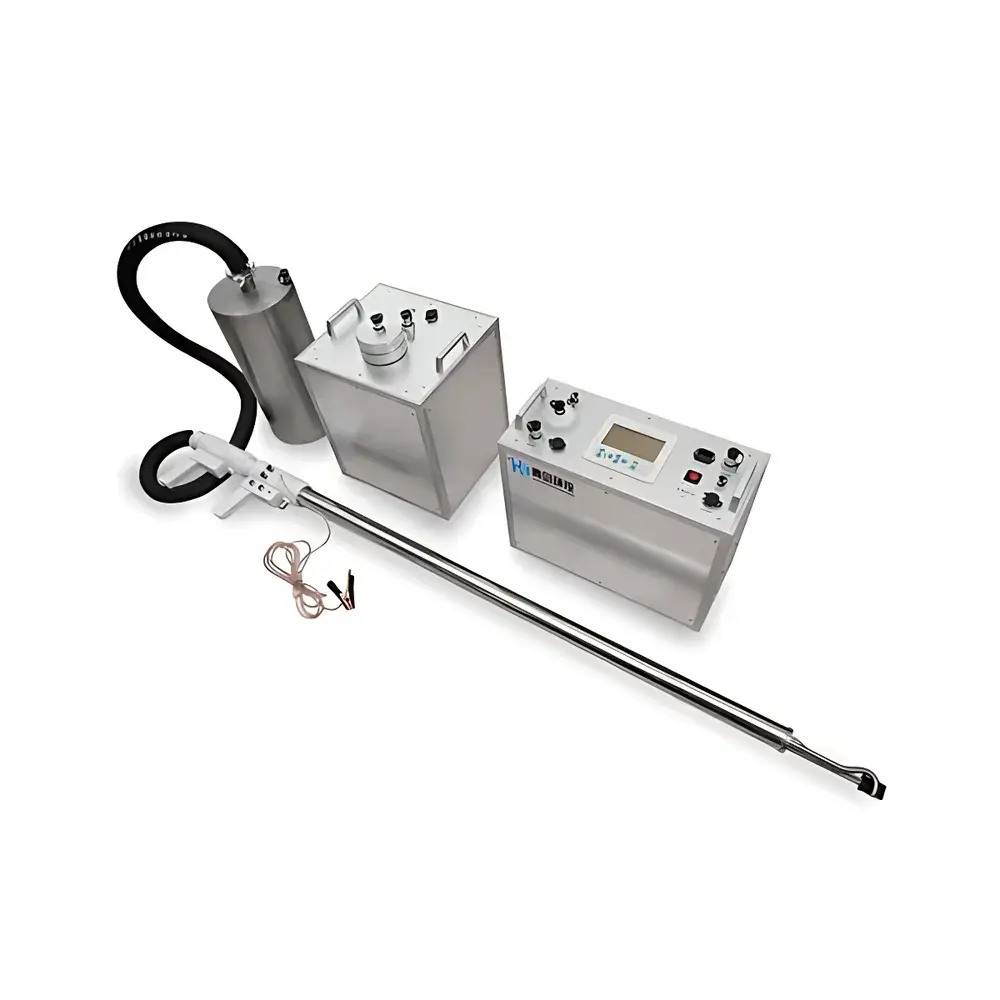
HUANKONG GHK-2050 Dilution Particulate Matter Sampler
| Brand | HUANKONG |
|---|---|
| Origin | Shandong, China |
| Manufacturer Type | Manufacturer |
| Country of Origin | China |
| Model | GHK-2050 |
| Configuration | Integrated Dilution Sampling System |
| Compliance | GB/T 16157, Technical Guidelines for Source Apportionment Monitoring of Ambient Particulate Matter (2020) |
Overview
The HUANKONG GHK-2050 Dilution Particulate Matter Sampler is a field-deployable, integrated dilution sampling system engineered for quantitative collection and size-resolved characterization of fine and coarse particulate matter (PM) from high-temperature, high-humidity flue gas streams. It operates on the principle of controlled isokinetic sampling followed by rapid dilution cooling—using filtered ambient air—to simulate atmospheric aging conditions while preserving particle morphology and volatility distribution. The system enables representative sampling of PM10 and PM2.5 fractions emitted from coal-fired, oil-fired, and industrial combustion sources under real-world stack conditions. Designed in strict accordance with GB/T 16157 “Methods for Sampling Particulate Matter and Gaseous Pollutants from Stationary Source Exhausts”, the GHK-2050 supports regulatory compliance, source apportionment studies, and emission factor development in accordance with China’s Technical Guidelines for Source Apportionment Monitoring of Ambient Particulate Matter (2020).
Key Features
- Isokinetic tracking control: Real-time dynamic adjustment of probe velocity to match flue gas flow velocity, minimizing particle inertial losses and ensuring representative sampling across variable stack conditions.
- Heated sampling probe: Maintains probe wall temperature above dew point to prevent condensation and particle loss during transit; temperature regulated via embedded PID algorithm.
- Programmable dilution ratio: Adjustable dilution factor (typically 5:1 to 50:1) with continuous monitoring of dilution air flow, sample gas flow, and cut-point flow at each impactor stage.
- Multi-channel sequential filtration: Four independent filter channels with automated membrane handling—enabling unattended collection of parallel samples for replicate analysis, blank correction, or multi-analyte workflows (e.g., gravimetric, elemental carbon, water-soluble ions).
- Integrated flue gas parameter measurement: Simultaneous acquisition of stack temperature, static/dynamic pressure, differential pressure, volumetric flow rate, flue gas velocity, and moisture content using calibrated NIST-traceable sensors.
- Embedded Linux platform: Industrial-grade ARM-based controller with deterministic real-time operation, local data logging (≥10,000 records), USB host interface for external storage export, and firmware-upgradable architecture.
- Compact portable design: Total system mass <18 kg; modular chassis with shock-absorbing casing suitable for rooftop, mobile lab, and remote site deployment.
Sample Compatibility & Compliance
The GHK-2050 accommodates standard 47-mm quartz fiber, Teflon, or PTFE membrane filters (including EPA TO-13A and EN 12341 compliant media). Its dilution-cooling configuration mitigates thermophoretic losses and semi-volatile artifact formation common in undiluted hot-stack sampling. All operational parameters—including isokinetic deviation (<±5%), dilution air purity (HEPA + activated carbon filtered), and flow calibration traceability—are documented per GB/T 16157 Annex B requirements. Data logs include timestamps, sensor diagnostics, and audit trails compatible with GLP-aligned quality assurance protocols.
Software & Data Management
Field data are stored in CSV-compatible structured format with ISO 8601 timestamps. The onboard interface displays real-time metrics: cut-point flow (L/min), standard-condition sampled volume (m³@STP), dilution ratio, and calculated flue gas velocity (m/s). USB export enables direct ingestion into laboratory LIMS or statistical analysis platforms (e.g., R, Python pandas). Optional PC software provides post-processing tools for isokinetic correction, moisture compensation, and PM mass concentration derivation per ISO 25597 and US EPA Method 201A conventions. Audit log entries record operator ID, method version, and calibration event history—supporting 21 CFR Part 11–aligned electronic record integrity where required.
Applications
- Regulatory emissions testing of thermal power plants, cement kilns, and waste incinerators.
- Source-specific PM emission profiling for receptor modeling and chemical mass balance (CMB) analysis.
- Method validation and inter-laboratory comparison studies targeting PM2.5 speciation (e.g., OC/EC, metals, anions).
- Development of emission inventories aligned with MEPC and IPCC Tier 2 reporting frameworks.
- Field evaluation of control device efficiency (e.g., ESP, baghouse, wet scrubber) under transient load conditions.
FAQ
What dilution ratios are supported, and how is dilution air quality ensured?
The GHK-2050 supports user-defined dilution ratios from 5:1 to 50:1. Dilution air passes through sequential HEPA (≥99.97% @ 0.3 µm) and activated carbon filtration stages, with pressure drop and flow stability continuously monitored.
Can the system operate unattended for extended periods?
Yes—fully autonomous operation up to 24 hours is supported via internal rechargeable battery backup (optional) and scheduled membrane exchange across four channels.
How is isokinetic performance verified during sampling?
Real-time velocity matching is calculated from pitot-static differential pressure, stack temperature, and gas composition inputs; deviation is logged continuously and triggers audible alert if >±5% threshold is exceeded.
Is the system compatible with international standards such as ISO or EPA methods?
While designed to meet GB/T 16157, its physical sampling architecture aligns with ISO 25597 (dilution tunnel sampling) and EPA Method 201A principles; method adaptation documentation is provided for cross-referenced validation.
What filter types and sizes are supported?
Standard 47-mm circular filters only; compatibility confirmed for quartz fiber (Pallflex EFA-0600), Teflon (SKC 225-1001), and nylon membranes meeting ASTM D7520 specifications.
Related Products







