
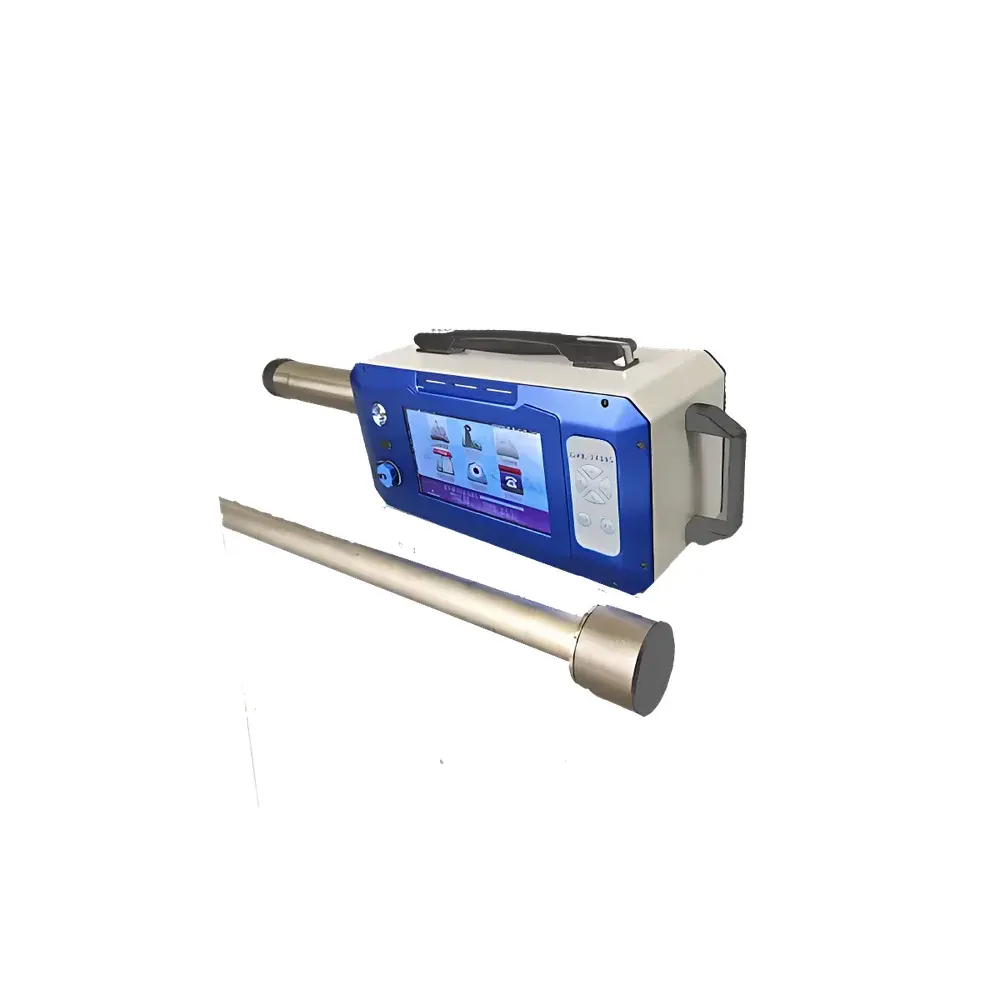
HUANKONG GHK-2400S Portable UV Differential Optical Absorption Spectroscopy (DOAS) Flue Gas Analyzer
| Brand | HUANKONG |
|---|---|
| Origin | Shandong, China |
| Manufacturer Type | Manufacturer |
| Country of Origin | Domestic (China) |
| Model | GHK-2400S |
| Instrument Type | Portable Flue Gas Analyzer |
| Response Time | ≤90 s |
| Measurable Gases | SO₂, NO, NO₂, NH₃, CO, CO₂, O₂ |
Overview
The HUANKONG GHK-2400S Portable UV Differential Optical Absorption Spectroscopy (DOAS) Flue Gas Analyzer is an engineered solution for in-situ quantification of key combustion-related pollutants in hot, humid flue gas streams from stationary emission sources. At its core, the instrument employs ultraviolet differential optical absorption spectroscopy—a well-established, physics-based measurement principle that exploits the unique absorption cross-sections of target gases (SO₂, NO, NO₂, NH₃, CO, CO₂, and O₂) across the 190–350 nm spectral range. Unlike NDIR or electrochemical sensors, DOAS enables simultaneous multi-component analysis without cross-sensitivity to water vapor or particulate interference, making it especially suitable for wet-stack applications where condensation and aerosol loading are prevalent. The GHK-2400S implements a true hot-wet measurement strategy: the entire gas path—from probe tip to optical cell—is actively heated and maintained above the dew point, eliminating adsorption losses and phase-change artifacts that compromise accuracy in cooled-dry systems. This architecture complies with the fundamental metrological requirements defined in HJ1131-2020, HJ1132-2020, and GB/T 37186-2018 for portable UV-absorption-based emission monitoring.
Key Features
- UV-DOAS optical engine with pulsed xenon lamp source—short warm-up time (1 × 10⁹ flashes)
- Heated dual-layer sampling probe: outer sheath isolates ambient heat; inner heated tube maintains >180 °C throughout transport, preventing condensation and wall deposition
- Modular, detachable sampling probe—standard length configurable; optional extensions available for stacks up to 10 m depth
- Integrated moisture-resistant optical cell with vibration-damped mounting and fused-silica fiber coupling for long-term signal stability
- 7-inch high-brightness capacitive touchscreen with dual input mode (touch + physical keys) and glove-compatible interface
- Multi-stage filtration system: stainless-steel cyclone, hydrophobic PTFE membrane filter (0.5 µm), and optical window guard to prevent lens fouling
- Automatic leak check, zero calibration, post-measurement purge cycle, and on-board battery-powered purge blower (≥2 L/min flow for ≥5 min)
- Dual-range gas detection architecture: auto-switching between low- and high-concentration ranges to optimize SNR across full dynamic span
- Real-time wet- and dry-basis concentration calculation with user-inputtable humidity value (0–100% RH); simultaneous mg/m³ and ppm unit display
- Embedded data logging with timestamped records (≥10,000 entries), power-fail recovery, and automatic file backup upon shutdown
Sample Compatibility & Compliance
The GHK-2400S is validated for direct sampling of undiluted, hot flue gas (up to 200 °C at probe tip) from coal-fired boilers, waste incinerators, cement kilns, and industrial furnaces. Its hot-wet design ensures representative measurement of SO₂, NOₓ (NO + NO₂), NH₃ (for SCR monitoring), CO, CO₂, and O₂ under real-world stack conditions—without dilution, cooling, or chemical scrubbing. The analyzer meets traceability and performance criteria specified in JJG 968–2002 (Verification Regulation for Flue Gas Analyzers), HJ 1045–2019 (Technical Requirements for Portable UV Absorption Instruments), and HJ 870–2017 (for CO₂ via NDIR sub-module). While not certified to EPA Method 6C or EN 15267, its DOAS methodology aligns with ISO 12039 and ASTM D6522 principles for UV-based gas quantification. All firmware and calibration protocols support audit-ready documentation per GLP-compliant field operations.
Software & Data Management
The embedded operating system provides intuitive workflow navigation, configurable measurement sequences (single-shot, timed interval, or continuous averaging), and real-time spectral visualization. Measurement parameters—including integration time, averaging count, and humidity correction factor—are fully programmable. Data export is supported via USB-C and Bluetooth v5.0 to paired mobile devices or PCs. A companion Windows application enables post-processing: baseline correction, spectral deconvolution, interference compensation (e.g., H₂O vapor bands), and report generation compliant with local regulatory templates (e.g., China’s “Pollutant Emission Monitoring Report” format). Audit trail functionality logs all operator actions, calibration events, and configuration changes with UTC timestamps—supporting basic 21 CFR Part 11 readiness when deployed with password-protected user roles.
Applications
- Regulatory compliance monitoring of SO₂ and NOₓ emissions during CEMS validation and periodic stack testing
- Process optimization in thermal power plants—real-time feedback for air/fuel ratio control and denitrification efficiency assessment
- Ammonia slip measurement downstream of selective catalytic reduction (SCR) systems
- Combustion diagnostics in industrial boilers and kilns—O₂ and CO co-analysis for excess air and incomplete combustion evaluation
- Field verification of continuous emission monitoring systems (CEMS) per HJ 75–2017 technical specifications
- Environmental impact assessments and fugitive emission surveys requiring portable, multi-gas capability
FAQ
What gases does the GHK-2400S measure simultaneously?
SO₂, NO, NO₂, NH₃, CO, CO₂, and O₂—all measured concurrently using UV-DOAS (except CO₂, which uses NDIR per HJ 870–2017).
Is calibration traceable to national standards?
Yes—factory calibration is performed using NIST-traceable gas standards; field zero/span verification follows JJG 968–2002 procedures.
Can the instrument operate in rain or high-humidity ambient conditions?
Yes—the probe features integrated water deflection structures and hydrophobic filtration; the main unit has IP54-rated enclosure.
Does it support remote data transmission?
Not natively via cellular/WiFi; however, Bluetooth-exported data can be relayed through third-party gateways for cloud upload.
What is the typical service interval for optical maintenance?
Under normal field use, optical alignment and lamp output verification are recommended every 12 months or after 500 operational hours.







