
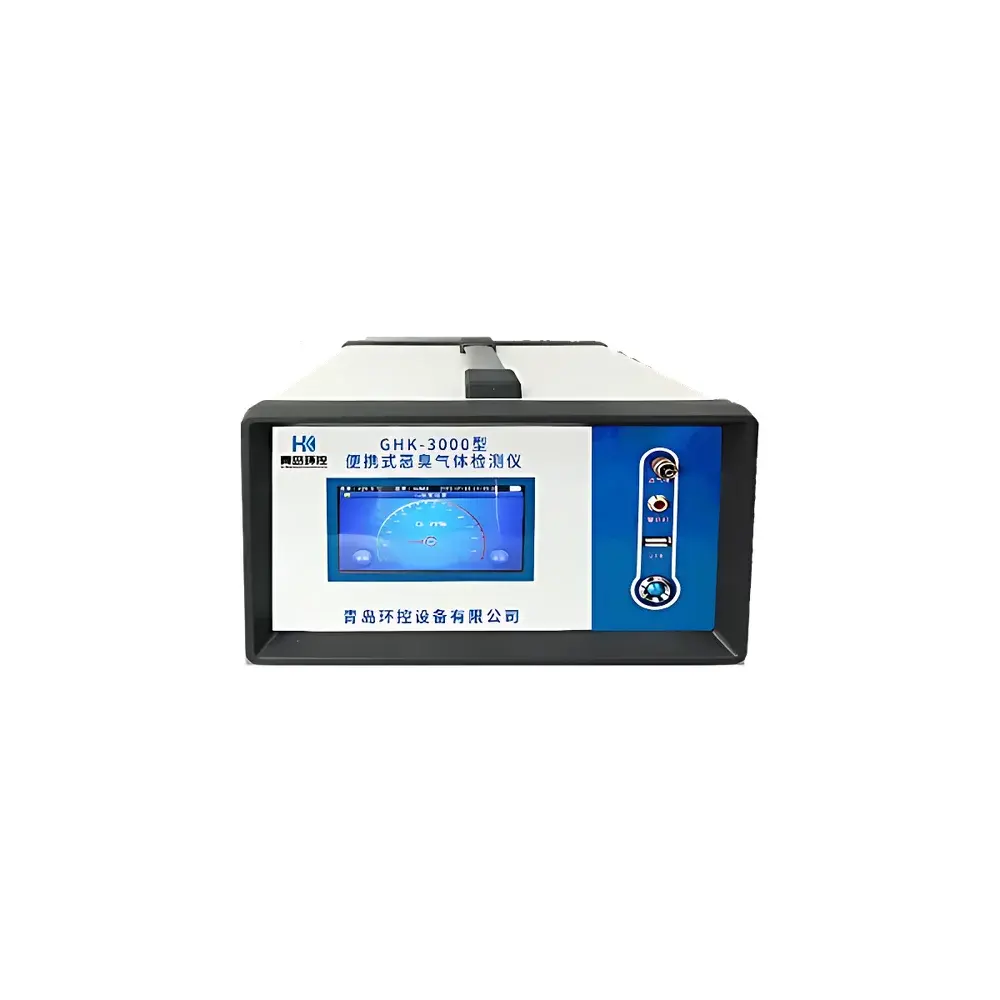
HUANKONG GHK-3000 Portable Odor Gas Analyzer
| Brand | HUANKONG |
|---|---|
| Model | GHK-3000 |
| Type | Portable |
| Detection Principle | Electrochemical / Metal Oxide Semiconductor (MOS) Sensor Array (Multi-Gas Correlation Algorithm) |
| Operating Temperature | −50 °C to +100 °C |
| Operating Humidity | 0–100 % RH |
| Data Storage Capacity | ≥5,000 measurement records |
| Battery Life | ≥8 hours (fully charged Li-ion) |
| Communication Interfaces | USB, RS232, optional Bluetooth printing module |
| Alarm | Configurable audible/visual alarm with user-defined thresholds |
| Units | ppm, mg/m³, and odor concentration (ouₑ/m³) convertible |
| Compliance | GB 14554–1993, HJ 905–2017, HJ 1262–2022 |
Overview
The HUANKONG GHK-3000 Portable Odor Gas Analyzer is an engineered field-deployable instrument designed for quantitative assessment of odorant compounds in ambient air and occupational environments. Unlike single-gas detectors, the GHK-3000 employs a multi-sensor array architecture—comprising calibrated electrochemical and metal oxide semiconductor (MOS) sensors—coupled with proprietary cross-sensitivity compensation algorithms. This configuration enables simultaneous semi-quantitative estimation of key odor-causing volatiles including hydrogen sulfide (H₂S), ammonia (NH₃), methyl mercaptan (CH₃SH), trimethylamine (C₃H₉N), and volatile organic compounds (VOCs) associated with sewage, composting, livestock operations, and industrial effluents. The device operates on the principle of sensor response correlation modeling, where real-time signal outputs are normalized against reference calibration curves traceable to NIST-traceable gas standards. Its ruggedized enclosure and wide environmental tolerance (−50 °C to +100 °C; 0–100 % RH) support deployment across extreme climatic zones—from arctic wastewater lift stations to tropical landfill perimeter monitoring.
Key Features
- High-resolution 5-inch capacitive color touchscreen with intuitive icon-driven navigation and multilingual UI (English, Spanish, French preloaded)
- Dual-mode sensor platform: electrochemical cells for H₂S/NH₃ and MOS elements for broad-spectrum VOC detection, minimizing interferences via dynamic baseline correction
- Integrated high-vacuum diaphragm sampling pump (≥30 L/min free-air flow) with pressure-compensated inlet for consistent volumetric draw across altitudes up to 5,000 m
- Real-time temperature and humidity compensation using integrated Pt100 RTD and capacitive RH sensor—algorithmically correcting raw signals per ISO 16000-26 Annex B guidelines
- Onboard data logging with timestamped GPS coordinates (optional external module), storing ≥5,000 complete measurement sets including sensor drift diagnostics
- Rechargeable high-energy-density lithium-ion battery pack (14.8 V/8,200 mAh) supporting continuous operation ≥8 hours under typical sampling duty cycles (1 sample/30 s)
- Configurable dual-stage alarm system: visual LED indicators (red/yellow) plus 85 dB piezoelectric buzzer, with programmable threshold limits per target analyte
- Unit flexibility: automatic conversion between ppm, mg/m³, and odor unit (ouₑ/m³) based on compound-specific molecular weight and olfactory threshold data from ASTM E679
- Digital I/O suite: USB-C host/device mode, RS232 serial port (3-wire TTL), and optional Bluetooth 5.0 module for wireless thermal printer pairing and remote firmware updates
Sample Compatibility & Compliance
The GHK-3000 is validated for use in heterogeneous gaseous matrices including humidified biogas streams, ambient urban air, indoor workplace atmospheres, and exhaust ducts from odor control systems. It meets functional requirements outlined in China’s national standards GB 14554–1993 (Emission Standard of Malodorous Pollutants), HJ 905–2017 (Technical Specification for Odor Monitoring in Ambient Air), and HJ 1262–2022 (Determination of Odor Concentration in Ambient Air and Exhaust Gas via Triangular Odor Bag Method). While not a replacement for laboratory olfactometry, the GHK-3000 serves as a Tier-2 screening tool aligned with ISO 16000-26 (Indoor Air — Determination of Odor Emission Rates) for rapid source identification and trend analysis. All firmware and calibration protocols adhere to GLP-compliant audit trails, with electronic logs retaining operator ID, calibration dates, and sensor zero/span verification records.
Software & Data Management
Data export is supported via FAT32-formatted USB flash drives (up to 128 GB), generating CSV files compliant with EPA Method TO-15 metadata conventions. The optional PC-based HUANKONG DataLink v3.2 software provides time-series visualization, geospatial mapping (KML export), statistical outlier detection (Grubbs’ test), and automated report generation conforming to ISO/IEC 17025 documentation structures. Audit log entries include cryptographic timestamps and digital signatures, satisfying basic FDA 21 CFR Part 11 requirements for electronic records in non-GMP environmental surveillance applications.
Applications
- Routine perimeter monitoring at wastewater treatment plants, rendering facilities, and anaerobic digesters
- OCCUPATIONAL HYGIENE ASSESSMENTS in food processing, tannery, and pharmaceutical manufacturing where sulfur- or amine-based odors pose exposure concerns
- Regulatory compliance verification during environmental impact assessments (EIAs) and post-remediation validation
- Odor nuisance complaint investigations by municipal health departments and environmental protection bureaus
- Research-grade field studies correlating sensor-derived odor indices with human panel-based olfactometric results (per EN 13725)
FAQ
What calibration standards are required for routine maintenance?
The GHK-3000 requires periodic zero calibration with certified zero air (ISO 8573-1 Class 1) and span calibration using NIST-traceable gas mixtures (e.g., 10 ppm H₂S in nitrogen). Calibration frequency follows HJ 905–2017 recommendations: before each field campaign and after exposure to concentrations >80 % of full scale.
Can the instrument quantify odor concentration in ouE/m³?
Yes—via built-in conversion tables referencing ASTM E679 odor thresholds and compound-specific response factors. Output assumes standard conditions (25 °C, 101.3 kPa) and is intended for comparative screening, not regulatory reporting in lieu of dynamic dilution olfactometry.
Is the device intrinsically safe for use in explosive atmospheres?
No—the GHK-3000 is not ATEX or IECEx certified. It is rated for general-purpose industrial environments only (IP54 ingress protection). Use in Zone 0/1 hazardous locations requires third-party explosion-proof enclosures.
How does humidity compensation affect measurement accuracy?
The integrated RH sensor feeds real-time corrections into the sensor signal processor, reducing typical humidity-induced drift from ±12 % to ≤±3.5 % across 20–95 % RH, per validation testing per HJ 1262–2022 Annex D.
What is the expected service life of the sensor array?
Under normal operating conditions (≤8 hrs/day, <50 ppm average exposure), electrochemical sensors maintain ±5 % linearity for ≥24 months; MOS elements require replacement every 18 months due to gradual surface oxidation.
Related Products







