
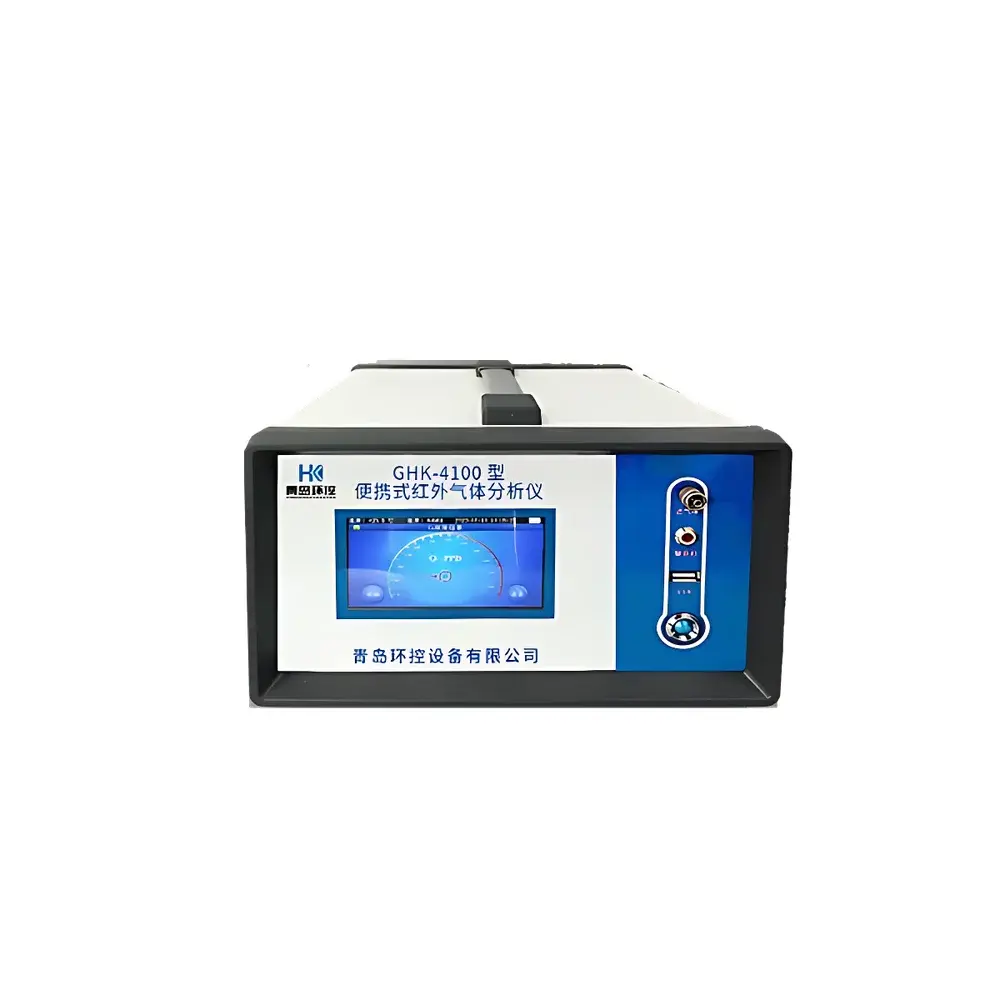
HUANKONG GHK-4100 Portable Multi-Gas Infrared Analyzer for Ambient Air
| Brand | HUANKONG |
|---|---|
| Model | GHK-4100 |
| Type | Portable NDIR Gas Analyzer |
| Detection Principle | Non-Dispersive Infrared (NDIR) |
| Measurable Gases | CO, CO₂, CH₄, C₃H₈, C₂H₄, C₂H₅OH, C₂H₄O, CH₃Br, SF₆ |
| Repeatability | ±1% of Full Scale |
| Operating Flow Rate | 0.5–2.0 L/min |
| Data Storage Capacity | >8,000 records |
| Power Supply | Rechargeable Li-ion battery (≥4 h continuous operation) |
| Communication Interfaces | USB, RS232, Bluetooth (optional) |
| Display | Color touchscreen with dual-mode output (digital + analog-style gauge) |
| Alarm | Configurable audible/visual alarm with user-defined thresholds |
| Units | ppm, mg/m³, % (switchable) |
| Environmental Compensation | Integrated temperature & humidity sensors with real-time correction algorithm |
| Calibration | Dual zeroing mode (catalytic converter or N₂ gas) |
Overview
The HUANKONG GHK-4100 Portable Multi-Gas Infrared Analyzer is an engineered solution for field-deployable, real-time quantification of key gaseous pollutants in ambient air, indoor environments, and occupational settings. It operates on the principle of Non-Dispersive Infrared (NDIR) spectroscopy — a well-established, selective, and stable optical detection method that exploits the unique absorption bands of target molecules in the mid-infrared region (typically 2–14 µm). The instrument simultaneously measures carbon monoxide (CO) and carbon dioxide (CO₂) by default, with optional modular sensor configurations supporting up to nine additional analytes including methane (CH₄), propane (C₃H₈), ethylene (C₂H₄), ethanol (C₂H₅OH), ethylene oxide (C₂H₄O), bromomethane (CH₃Br), and sulfur hexafluoride (SF₆). Its compact form factor, robust mechanical architecture, and low-power embedded electronics make it suitable for mobile monitoring campaigns, regulatory compliance verification, indoor air quality (IAQ) audits, and industrial hygiene surveys where portability and measurement fidelity are jointly critical.
Key Features
- High-selectivity NDIR optical modules with thermally stabilized detectors and interference-filtered light paths to minimize cross-sensitivity among co-measured gases
- Integrated environmental compensation system using calibrated temperature and relative humidity sensors, applying real-time correction algorithms per ISO 16000-23 and GB/T 18204.2-2014 protocols
- Dual zero-calibration capability: catalytic oxidation-based zeroing for field use without external gas cylinders, or high-purity nitrogen (N₂) purging for laboratory-grade baseline stability
- Automated valve sequencing via built-in electromagnetic switching manifold, enabling seamless transition between zero, span, and sample measurement phases
- Multi-timescale averaging functionality: programmable 1-hour, 8-hour, and 24-hour moving averages compliant with WHO air quality guidelines and China’s GB 3095-2012 ambient air quality standards
- Color touchscreen interface supporting both numeric readout and analog-style gauge visualization for intuitive operator interpretation under variable lighting conditions
- Extended data logging capacity (>8,000 timestamped records) with automatic time/date stamping, configurable sampling intervals, and metadata tagging (e.g., location ID, operator code)
- Industrial-grade sampling pump with adjustable flow control (0.5–2.0 L/min), capable of maintaining stable draw across variable filter loading and pressure differentials
- Comprehensive unit conversion engine supporting ppm, mg/m³, and % volume — automatically adjusted based on molecular weight, ambient temperature, and barometric pressure inputs
Sample Compatibility & Compliance
The GHK-4100 is validated for direct analysis of undiluted ambient air samples at standard temperature and pressure (STP) conditions. It meets metrological traceability requirements outlined in JJG 635–2011 (Calibration Specification for CO/CO₂ Infrared Gas Analyzers) and aligns with methodological frameworks defined in HJ 965–2018 (Automatic Determination of CO in Ambient Air Using NDIR), GB/T 18204.2–2014 (Public Health Inspection Methods – Part 2: Chemical Contaminants), and GBZ/T 300.37–2017 (Determination of Toxic Substances in Workplace Air – Part 37: CO and CO₂). Instrument design adheres to IP54 ingress protection rating, ensuring operational integrity during outdoor deployment in dust-prone or light-rain conditions. All firmware and data handling routines support audit-ready operation in GLP-compliant laboratories and field programs requiring documented chain-of-custody.
Software & Data Management
Data acquisition and configuration are managed through an embedded Linux-based operating system with secure boot and write-protected firmware partitions. Measurement files are stored in CSV format with UTF-8 encoding and include full metadata headers (instrument serial number, calibration dates, sensor IDs, environmental parameters). USB mass storage mode enables drag-and-drop export to external drives; RS232 supports integration into SCADA or central monitoring systems using Modbus RTU protocol. Optional Bluetooth module facilitates wireless transmission to Android/iOS tablets running certified third-party environmental reporting apps. Firmware updates are delivered via signed binary packages to ensure integrity and version control in regulated environments subject to FDA 21 CFR Part 11 or CNAS accreditation requirements.
Applications
- Ambient air quality monitoring networks (AQMN) for urban, rural, and roadside stations
- Indoor air quality assessments in schools, hospitals, office buildings, and residential complexes per GB/T 18883–2022
- Occupational exposure evaluation in manufacturing facilities, laboratories, and confined-space entry operations
- Verification of ventilation system performance and HVAC commissioning
- Emergency response screening during chemical spills, fire aftermath, or landfill gas migration events
- Educational demonstrations of gas-phase infrared absorption principles in university analytical chemistry labs
FAQ
What gases can the GHK-4100 measure simultaneously?
The base configuration measures CO and CO₂ concurrently. With optional sensor modules installed, it supports up to 11 gases — including CH₄, C₃H₈, C₂H₄, C₂H₅OH, C₂H₄O, CH₃Br, and SF₆ — though not all channels operate simultaneously due to optical path constraints.
Is the instrument suitable for continuous unattended operation?
While designed primarily for portable, operator-assisted surveys, the GHK-4100 may be deployed semi-continuously (e.g., 8–12 h/day) when powered externally and equipped with a particulate filter and moisture trap. Long-term fixed-site installation requires auxiliary climate-controlled housing and scheduled maintenance per manufacturer’s service manual.
How does the instrument handle humidity-induced signal drift?
It employs a dual-sensor compensation strategy: real-time RH and temperature readings feed into a physics-based correction model derived from Beer–Lambert law adaptations, reducing humidity-related bias to <±0.5% FS across 20–90% RH range at 25°C.
Can measurement data be exported in formats compatible with EPA AQS or national air quality databases?
Yes — CSV exports conform to the column structure specified in China’s national environmental monitoring data exchange standard (HJ 75–2017), and optional middleware tools support automated mapping to EPA Air Quality System (AQS) schema via XML or JSON wrappers.
Does the GHK-4100 support remote diagnostics or over-the-air firmware updates?
Remote diagnostics are available via USB-to-Ethernet bridge or optional 4G LTE module (not included); firmware updates require physical media or local network upload — no cloud-based OTA functionality is implemented to preserve data sovereignty and cybersecurity compliance.







