
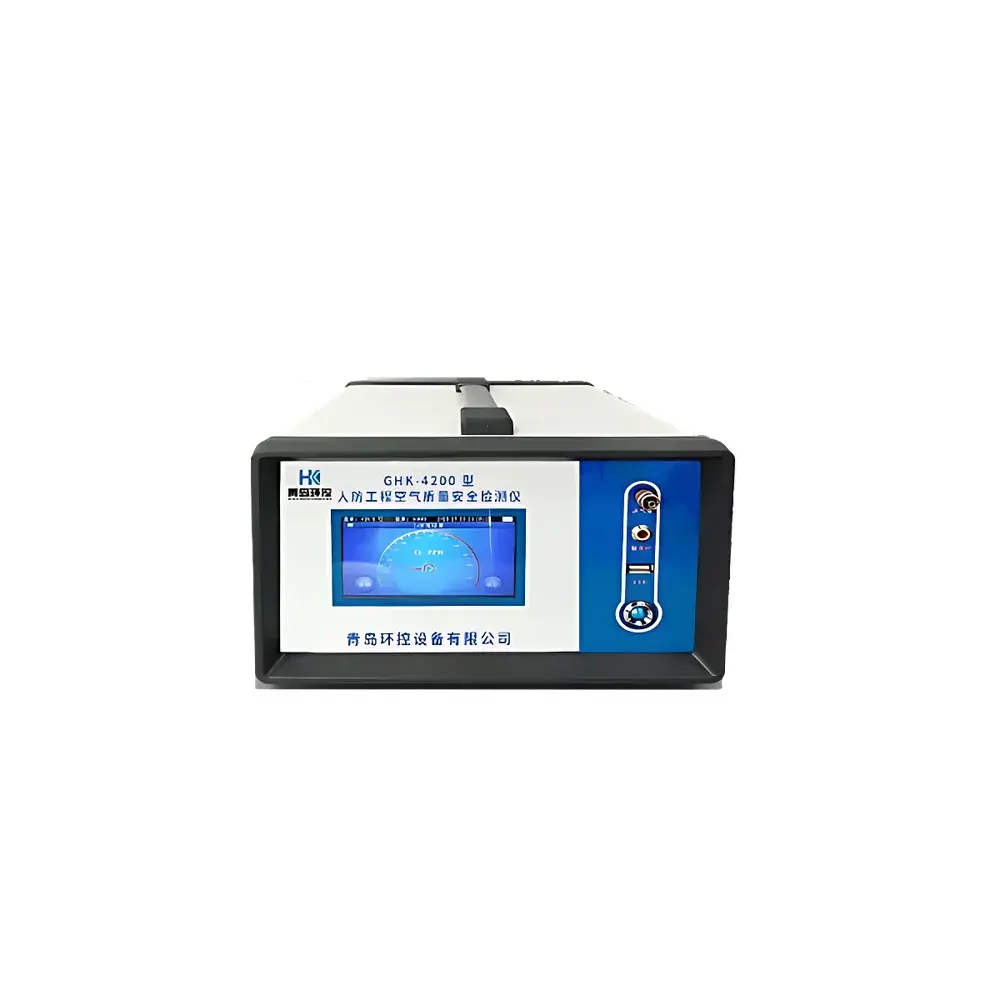
HUANKONG GHK-4200 Multi-Gas Safety Monitor for Civil Defense Shelters
| Brand | HUANKONG |
|---|---|
| Origin | Shandong, China |
| Manufacturer Type | Direct Manufacturer |
| Regional Classification | Domestic (China) |
| Model | GHK-4200 |
| Instrument Type | Portable |
| Detectable Gases | NH₃, Toxic Gases (broad-spectrum), O₂, Combustible Gases (LEL), H₂S, CO, CO₂ |
| Display | Color Touchscreen |
| Power | Rechargeable High-Capacity Lithium Battery (≥8 h continuous operation) |
| Data Storage | ≥5000 measurement records |
| Environmental Compensation | Integrated Temperature & Humidity Sensors with Real-Time Compensation Algorithm |
| Communication | USB & RS485 Interface for PC Data Transfer |
| Optional | Bluetooth Wireless Printing Module |
| Compliance | GB 12358–2006, GBZ/T 223–2009, GBZ 2.1–2007 |
Overview
The HUANKONG GHK-4200 Multi-Gas Safety Monitor is an engineered portable instrument designed specifically for real-time, multi-parameter air quality assessment in confined and high-risk environments—including civil defense shelters, underground facilities, emergency response zones, industrial maintenance areas, and occupational workspaces. It operates on electrochemical (for NH₃, H₂S, CO, O₂), catalytic bead (for combustible gases), and NDIR (for CO₂) sensing principles, enabling simultaneous detection of seven critical atmospheric parameters. Its architecture integrates gas-specific sensor arrays calibrated to meet Chinese national standards for workplace safety monitoring, ensuring traceable performance under variable thermal and hygroscopic conditions. Unlike single-gas detectors, the GHK-4200 delivers correlated, time-synchronized measurements—essential for evaluating exposure risk profiles, ventilation efficacy, and emergency readiness in sheltered infrastructure.
Key Features
- Seven-channel simultaneous detection: Ammonia (NH₃), oxygen (O₂), hydrogen sulfide (H₂S), carbon monoxide (CO), carbon dioxide (CO₂), combustible gases (0–100% LEL), and broad-spectrum toxic gas (electrochemical-based generic toxicity index)
- High-fidelity color touchscreen interface with intuitive icon-driven navigation and multilingual UI support (English preloaded)
- Integrated temperature and humidity sensors coupled with adaptive compensation algorithms—minimizing drift across operating ranges of −10 °C to +50 °C and 10–95% RH
- Dual-mode power system: Internal high-energy lithium battery supporting ≥8 hours of continuous operation; external DC input for extended field deployment
- Industrial-grade sampling pump with >1.5 L/min flow rate and pressure resilience up to ±2 kPa—ensuring stable aspiration in low-permeability or negative-pressure enclosures
- Configurable dual-stage alarm system: Visual (LED strobe), audible (≥85 dB), and vibration alerts with user-defined threshold levels per gas channel
- Real-time data streaming via USB 2.0 and isolated RS485 interfaces—compatible with SCADA systems and centralized monitoring platforms
- Onboard non-volatile memory storing ≥5000 timestamped records, each including gas concentrations, ambient T/RH, battery status, and alarm event flags
Sample Compatibility & Compliance
The GHK-4200 is validated for use in ambient air matrices without pre-conditioning, making it suitable for rapid deployment in civil defense shelters, utility tunnels, metro stations, and temporary containment zones. It complies with GB 12358–2006 (General Technical Requirements for Gas Detection Alarm Instruments in Workplaces), GBZ/T 223–2009 (Technical Specifications for Toxic Gas Detection and Alarm Devices), and GBZ 2.1–2007 (Occupational Exposure Limits for Hazardous Agents). While not certified to IEC 61508 or ATEX for Zone 0/1 hazardous locations, its design adheres to functional safety principles aligned with ISO 13849–1 for Category 3 performance. Sensor cross-sensitivity profiles are documented per manufacturer datasheets and verified during factory calibration against NIST-traceable reference gases.
Software & Data Management
Data export is supported via proprietary Windows-compatible configuration software (v3.2+), enabling firmware updates, alarm threshold programming, calibration logging, and batch report generation in CSV/PDF formats. All calibration events—including zero/span adjustments and sensor verification—are automatically timestamped and stored onboard with operator ID fields. Audit trail functionality satisfies basic GLP-aligned documentation requirements, though full 21 CFR Part 11 compliance requires integration with validated third-party laboratory information management systems (LIMS). Bluetooth printing (optional module) supports direct thermal printouts of live readings and summary reports—useful for field documentation and shift handover logs.
Applications
- Civil defense shelter integrity verification: Continuous O₂ depletion tracking, CO accumulation detection during generator operation, and NH₃ leak identification from sanitation systems
- Occupational health surveillance: Real-time exposure assessment against MAC (Maximum Allowable Concentration) limits per GBZ 2.1–2007 for CO, H₂S, NH₃, and CO₂
- Emergency response triage: Rapid screening of confined-space atmospheres prior to entry—supporting NFPA 350-compliant hazard classification
- Maintenance & commissioning: Verification of ventilation system performance, filter integrity testing, and post-decontamination clearance checks
- Research & education: Field-based environmental toxicology studies requiring synchronized multi-analyte datasets under dynamic boundary conditions
FAQ
What gases does the GHK-4200 detect by default, and can sensor configurations be customized?
The standard configuration detects NH₃, O₂, H₂S, CO, CO₂, combustible gas (LEL), and a generalized toxic gas index. Sensor modules are factory-installed and not field-replaceable; custom configurations require OEM coordination during order placement.
Is the device suitable for outdoor use in extreme cold or high humidity?
Yes—the built-in heating element maintains sensor operational stability down to −10 °C, and humidity compensation algorithms correct for signal drift across 10–95% RH.
Does the GHK-4200 support remote monitoring or cloud connectivity?
No native Wi-Fi or cellular module is included; remote capability requires integration via RS485-to-Ethernet gateways or USB-connected host PCs running supervisory software.
How often does the instrument require calibration, and what standards are used?
Zero calibration is recommended before each use; span calibration every 30 days or after exposure to high-concentration gas events. Calibration uses certified reference gases traceable to CNAS-accredited providers.
Can measurement data be exported in machine-readable format for regulatory reporting?
Yes—CSV exports include all raw sensor outputs, timestamps, environmental metadata, and alarm status flags, facilitating import into EPA-compliant reporting tools or internal EHS databases.







