
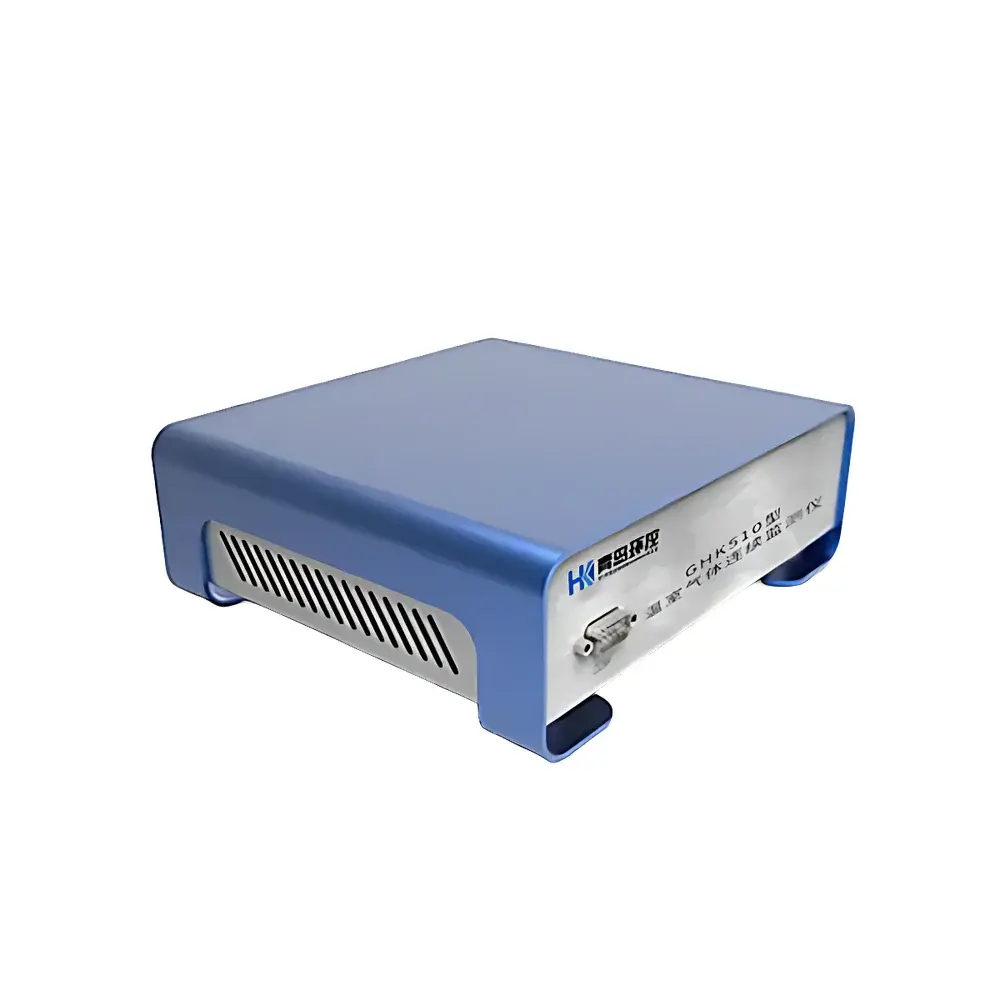
HUANKONG GHK-510 Continuous Greenhouse Gas Monitor
| Brand | HUANKONG |
|---|---|
| Model | GHK-510 |
| Origin | Shandong, China |
| Manufacturer Type | Direct Manufacturer |
| Detection Principle | Tunable Diode Laser Absorption Spectroscopy (TDLAS) |
| Target Gases | CH₄, CO₂, H₂O |
| Compliance | Designed for environmental monitoring applications in accordance with ISO 14064-1 and EPA Method TO-15 guidance principles |
| Software Interface | RS485/Modbus RTU, Ethernet TCP/IP, optional analog 4–20 mA outputs |
Overview
The HUANKONG GHK-510 Continuous Greenhouse Gas Monitor is an industrial-grade, in-situ gas analyzer engineered for long-term, unattended operation in ambient air, stack emissions, and controlled laboratory environments. It employs Tunable Diode Laser Absorption Spectroscopy (TDLAS), a quantitative optical technique based on Beer–Lambert law, to measure trace concentrations of greenhouse gases through high-resolution, wavelength-scanned absorption features in the near-infrared (NIR) spectral region. Unlike broadband NDIR or electrochemical sensors, TDLAS provides inherent selectivity by targeting isolated ro-vibrational transitions of CH₄ (e.g., at ~1653 nm), CO₂ (~2004 nm), and H₂O (~1392 nm), minimizing cross-sensitivity from interfering species such as CO, NOₓ, or VOCs. The system utilizes a temperature- and current-stabilized distributed feedback (DFB) laser diode, coupled with a multi-pass White cell (optical path length ≥ 20 m) to achieve sub-ppb detection limits for CH₄ and sub-ppm precision for CO₂ under standard conditions (25 °C, 1 atm). Its continuous, real-time output supports regulatory reporting, flux quantification, and process control without sample conditioning or consumables.
Key Features
- High-selectivity TDLAS architecture with laser wavelength locking to gas-specific absorption lines—ensuring immunity to matrix effects and baseline drift
- Integrated thermal management and pressure-compensated flow control (mass flow controller, ±0.5% FS accuracy) for stable sample delivery across ambient temperature ranges (−20 °C to +50 °C)
- Modular optical head and electronics enclosure—enabling flexible deployment as standalone analyzer, OEM engine, or rack-mounted unit
- Self-diagnostic firmware with real-time signal-to-noise ratio (SNR) monitoring, laser health logging, and automatic zero/span validation triggers
- Ruggedized aluminum housing (IP65 rated) with internal humidity and temperature compensation algorithms for field-deployable reliability
- Low power consumption (<120 W) and passive cooling design—suitable for solar-powered remote stations or mobile monitoring platforms
Sample Compatibility & Compliance
The GHK-510 is validated for direct analysis of ambient air, flue gas (with optional heated sampling line up to 180 °C), biogas streams, and indoor ventilation ducts. It meets functional requirements outlined in ISO 14064-1 for GHG inventory verification and aligns with EPA’s recommended practices for continuous emission monitoring systems (CEMS) under 40 CFR Part 75 Annex D. While not certified as a reference method per EPA Performance Specification 18 (PS-18), its measurement uncertainty (k=2) is characterized per ISO 5725-2:2019 for repeatability and reproducibility—typically ≤3% RSD for CH₄ at 2 ppmv over 30 days. Data integrity complies with ALCOA+ principles (Attributable, Legible, Contemporaneous, Original, Accurate, Complete, Consistent, Enduring, Available), supporting GLP/GMP-aligned workflows where audit trails and electronic signature capability are implemented via external SCADA integration.
Software & Data Management
The GHK-510 communicates via dual protocol support: Modbus RTU over RS485 (for PLC integration) and TCP/IP Ethernet (for cloud telemetry or local HMI). Embedded firmware includes configurable alarm thresholds, data averaging intervals (1 s to 1 hr), and automatic data buffering during network outages (≥72 hrs internal storage). Optional HUANKONG DataHub software provides time-series visualization, calibration log export (CSV/Excel), and batch report generation compliant with ISO 14064-3 verification templates. For regulated environments, third-party middleware (e.g., Ignition SCADA or LabVIEW) may be configured to enforce 21 CFR Part 11-compliant audit trails, user role-based access, and electronic signature workflows.
Applications
- Continuous ambient monitoring at landfill sites, wastewater treatment plants, and agricultural facilities for CH₄ and CO₂ flux estimation
- Stack emission compliance monitoring for cement, power generation, and chemical manufacturing sectors
- Mobile platform integration (e.g., vehicle-mounted or drone-borne systems) for spatial mapping of fugitive emissions
- Controlled-environment research in eddy covariance towers, climate chambers, and soil respiration studies
- Supporting ISO/IEC 17025-accredited laboratories in method development for atmospheric composition analysis
FAQ
Does the GHK-510 require periodic calibration with certified gas standards?
Yes—initial factory calibration is performed using NIST-traceable gas mixtures. Field recalibration is recommended every 3–6 months depending on operating environment; zero calibration can be performed with synthetic air, while span checks require certified CH₄/CO₂ standards.
Can the instrument detect additional gases beyond CH₄, CO₂, and H₂O?
Yes—through laser source replacement or multi-laser module integration (e.g., adding NH₃ at 1531 nm or CO at 1567 nm), subject to optical path compatibility and firmware update.
Is the GHK-510 suitable for use in explosive atmospheres?
Not intrinsically safe by default; however, explosion-proof enclosures (ATEX Zone 2 / IECEx) and purged cabinet options are available upon request.
What is the minimum detectable concentration for methane under typical field conditions?
Detection limit is 0.5 ppb (1σ, 100 s average) for CH₄ in clean, dry air; practical field LOD is ~5 ppb due to particulate scattering and humidity-induced broadening.
How is water vapor interference handled during CO₂ measurement?
H₂O is co-measured in real time and used dynamically to correct CO₂ line shape broadening via Voigt profile fitting—eliminating need for separate drying units or empirical correction tables.
Related Products







