
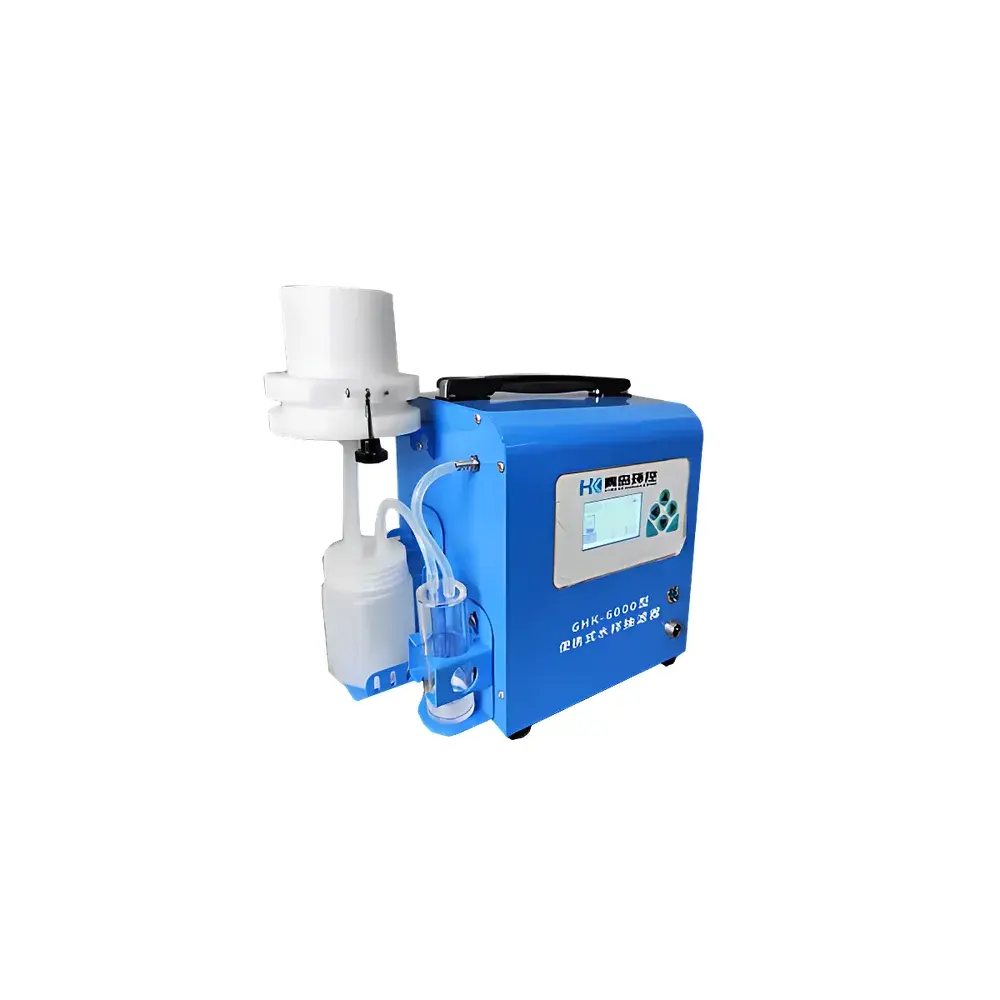
HUANKONG GHK-6000 Portable Water Sample Filtration Unit
| Brand | HUANKONG |
|---|---|
| Origin | Shandong, China |
| Manufacturer Type | Direct Manufacturer |
| Country of Origin | China |
| Model | GHK-6000 |
| Pricing | Upon Request |
| Vacuum Pump | Imported diaphragm pump with acid/alkali resistance |
| Filtration Membrane | 0.45 µm hydrophilic membrane |
| Pressure Display | Real-time LCD vacuum gauge |
| Pressure Setpoint | Adjustable cutoff vacuum |
| Power Supply | AC/DC dual-mode with built-in high-capacity Li-ion battery (≥20 h runtime) |
| Filtration Modes | Multi-step flow rate selection |
| Auto-Depressurization | Yes, upon filtration completion |
| Bottle Design | Integrated sample collection/filtration vessel (metal-ion-free polymer construction) |
| Optional Accessory | Bluetooth thermal printer for audit-trail data export |
Overview
The HUANKONG GHK-6000 Portable Water Sample Filtration Unit is an engineered field-deployable solution designed to meet the stringent requirements of in-situ particulate removal from aqueous environmental samples prior to downstream chemical or elemental analysis. Operating on the principle of controlled vacuum-assisted membrane filtration, the GHK-6000 delivers reproducible, contamination-minimized sample preparation compliant with internationally referenced analytical workflows—including those specified in U.S. EPA Method 1669, ISO 5667-12:2022 (Water quality — Sampling — Part 12: Guidance on sampling of bottom sediments and sludge), and the Chinese national standards HJ 91.2–2022 and HJ 776–2015. Its compact, ruggedized architecture enables reliable operation under variable ambient conditions—whether deployed from a riverbank monitoring station, aboard a research vessel, or within mobile environmental labs conducting rapid-response water quality assessments.
Key Features
- Integrated high-efficiency diaphragm vacuum pump with chemically resistant wetted materials (PTFE, EPDM, PVDF), enabling stable operation across pH 1–14 and compatibility with aggressive matrices including acidified preservation reagents.
- Real-time digital vacuum monitoring via backlit LCD display, with user-defined termination pressure thresholds (range: −20 to −95 kPa) to prevent membrane rupture or analyte loss during low-flow filtration of viscous or particulate-laden samples.
- Multi-stage adjustable suction flow control (3 preset modes) optimized for balancing filtration speed against retention integrity—critical when isolating phytoplankton cells (e.g., per HJ 897–2017) or trace metal fractions (per HJ 700–2014).
- Single-vessel design combining filtrate collection and sample storage in one autoclavable, leach-resistant polymer bottle (certified metal-ion-free per ASTM D5673–21), eliminating cross-sample carryover and reducing field cleaning burden.
- Dual-power architecture supporting universal AC input (100–240 VAC, 50/60 Hz) and extended DC operation via internal 12.8 V / 12,000 mAh Li-ion battery pack—validated for ≥20 hours continuous use at mid-range vacuum settings.
- Automated post-filtration depressurization sequence safeguards membrane integrity and facilitates rapid, tool-free membrane replacement using standardized 47 mm diameter holders.
Sample Compatibility & Compliance
The GHK-6000 accommodates a broad spectrum of natural and anthropogenically impacted waters—including surface runoff, groundwater, wastewater effluents, estuarine brines, and algal bloom suspensions—without requiring pre-dilution or matrix modification. Its 0.45 µm hydrophilic mixed-cellulose ester (MCE) membrane meets ISO 8573-1 purity class 2 requirements for particle retention and is validated for use in methods demanding low background interference (e.g., ICP-MS trace element quantification per HJ 700–2014). Device construction adheres to IP54 ingress protection standards, and all fluid-path components are certified non-leaching per USP and EU Directive 2002/72/EC for food-contact polymers—ensuring compliance in GLP-regulated laboratories and regulatory monitoring programs aligned with China’s Ministry of Ecology and Environment (MEE) directives.
Software & Data Management
While the GHK-6000 operates as a standalone hardware platform, its optional Bluetooth-enabled thermal printer (model BP-GHK-200) generates time-stamped, tamper-evident hardcopy records containing sample ID, filtration start/end timestamps, applied vacuum setpoint, total filtration duration, and ambient temperature (via integrated sensor). These outputs satisfy documentation requirements for audit trails under ISO/IEC 17025:2017 Clause 7.5.2 and support alignment with FDA 21 CFR Part 11 principles when paired with laboratory information management systems (LIMS) that accept CSV-formatted metadata exports.
Applications
- Field-based preparation of filtered water samples for dissolved nutrient analysis (NO₃⁻, PO₄³⁻), metals speciation, and organic contaminant screening.
- Routine QA/QC filtration in municipal drinking water facilities validating turbidity reduction efficiency per GB 5749–2022.
- On-site processing of phytoplankton biomass for chlorophyll-a quantification (HJ 897–2017) and pigment profiling.
- Supporting sediment porewater extraction protocols in benthic ecological surveys.
- Educational deployment in university environmental science curricula emphasizing standardized sampling practice per ISO 5667 series.
FAQ
What membrane types are compatible with the GHK-6000?
The unit accepts standard 47 mm diameter disc membranes; 0.45 µm hydrophilic MCE is supplied as default, but PTFE, nylon, and polycarbonate track-etched variants may be used depending on analyte compatibility requirements.
Is the device suitable for seawater filtration?
Yes—its corrosion-resistant pump head and inert fluid path enable uninterrupted operation with high-salinity matrices; however, post-use rinsing with deionized water is recommended to prevent crystallization-induced seal degradation.
Does the GHK-6000 support electronic data logging?
No internal memory is included, but Bluetooth printer output provides traceable physical records; integration with external data loggers via analog vacuum output (0–5 V) is possible with OEM adapter kits.
How is calibration verified?
Vacuum sensor accuracy is factory-traceable to NIM (National Institute of Metrology, China) standards; users may perform field verification using a certified reference manometer connected to the auxiliary port.
Can the battery be replaced in the field?
The Li-ion pack is user-replaceable without tools; spare batteries (GHK-BAT-128) are available with full CE/UN38.3 certification for air transport.





